Peter Brereton’s account of starting a software business contains a wonderfully practical detail. His older brother Dave had a house in Montreal. Peter, working in sales in Toronto, had a car. If the brothers were going to start something together, the geography more or less chose itself. The mortgage stayed put. The Chevy Nova could move.
Their conversation took place over the holidays in 1983. Peter had trained in programming at CDI College; Dave brought a complementary commercial temperament. In the following years, the operation occupied space behind a computer hardware shop, then Dave’s basement in Pierrefonds, before moving into rented offices. The beginnings had room for ambition and very little room for furniture.
Tecsys started by reselling and implementing business software. There is something useful about that apprenticeship: somebody else writes the product, but you still have to make it work for the customer. An installation is where a tidy promise meets the awkward habits of an actual business. Brereton’s subsequent career would keep returning to that encounter.
He has remained with the company through changes in job title, markets and software delivery. Today he is its co-founder, president and CEO. The distance between those early installations and a publicly traded software company is considerable. The underlying question has proved remarkably durable: how do you help a business get its work done?
The years with a boarding pass
The first decisive expansion came with a distinctly unwelcome push. In the early 1990s, uncertainty surrounding Quebec’s political future weakened Tecsys’s local opportunities. Brereton turned toward the United States. In his recollection, those years involved relentless travel while his wife looked after their young family. By 1995, he said, approximately 80 percent of company revenue came from the U.S.
It is an unusually concrete version of an entrepreneurial pivot. The word can sound almost weightless, as though a company turns on a swivel chair. Here, it meant repeated flights, financial pressure and a household absorbing the consequences. A strategy diagram rarely includes who will be home when the children need something.
The commercial opening was also specific. Suppliers selling into large retailers needed distribution software that could support their obligations. Tecsys had something to offer them. Brereton’s story of that period is less about predicting a grand new market than finding customers whose problems matched the work his company already understood.
He became president in 1995 and CEO in 1998. That same year, Tecsys went public; its common shares first listed on the Toronto Stock Exchange on July 27. The developer and salesman now had shareholders to answer to as well. The journey had acquired a public timetable.
- 1983Two brothers start Tecsys
- 1995Peter becomes president
- 1998CEO appointment and IPO
- 2019EY Quebec Technology award
The customer at the end of the scanner
Ask what Tecsys actually does, and the answer can quickly fill a whiteboard. Warehouse management. Distribution management. Orders. Inventory. Brereton has often explained the business by bringing it back to individual jobs. In a 2011 interview, he discussed the people receiving goods, picking orders and handling purchases, and the need to make their interactions with software intuitive.
The examples were refreshingly physical. A worker needs to locate a product, scan the correct barcode and package an order. Tecsys’s visual instructions were intended to help with those steps. You can discuss software architecture all afternoon; eventually somebody still has to find the right shelf. The shelf is an unforgiving critic.
Brereton’s account of the company’s product development was similarly grounded. In 1992, Tecsys worked with a customer on a distribution management system. A major telecommunications customer helped it enter the U.S. market in 1993. He put revenue at about $3.5 million that year, rising to about $10 million around the 1998 flotation.
Those figures describe a company learning how to sell its own work. They also suggest why Brereton’s attention keeps settling on execution. A product can be elegantly conceived and still irritate everyone required to use it. His emphasis on the clerk and picker makes usefulness a daily test, repeated with every order.
The shelf is an unforgiving critic.On making software useful
One warehouse, many kinds of work
By 2015, Brereton was making a careful distinction about Tecsys’s history: distribution management came before warehouse management. That correction matters because it changes the picture of his business. A warehouse is one location in a larger sequence of buying, receiving, storing, picking, packing and shipping. The software has to understand the sequence.
His explanation of expansion into different industries started with those common tasks. Then came the variations: workflows and requirements that change with the customer’s business. A third-party logistics provider, for example, needs activity-based billing. Shared machinery underneath does not make every customer’s operation identical. The differences are part of the job.
Tecsys had also secured a U.S. patent covering visual instructions for warehouse operators. Brereton described that capability as a reason customers selected the company. It was an intellectual-property milestone attached to a very ordinary human need: please make the next step clear.
For an executive whose early responsibilities ranged from software development to product management, sales and marketing, that combination is revealing. He has had to think about making the product, explaining it and persuading someone to pay for it. A feature has to survive all three conversations. The customer gets a vote in each. A founder can become absorbed in the internal logic of a product. Brereton’s explanations repeatedly step outside that logic and ask what the customer needs to accomplish. That habit gives a reader something firmer than a list of features: a way to judge whether the features deserve to exist.
A name on the award, a team behind it
In November 2019, Brereton received EY’s Quebec Entrepreneur Of The Year award in the Technology category. It was a regional category award, a useful distinction in a business world fond of polishing every trophy until the inscription disappears. The presentation followed decades of work at the same company.
His response turned attention toward his colleagues. “Although it’s my name on the award, it belongs equally to our incredible team here and around the world.” The statement connected the basement beginnings with the international business Tecsys had become. In his telling, the people doing the work belonged in the picture.
That is consistent with the breadth of his own early roles. A founder who has moved between building software and selling it has experienced the handoffs inside a business. The customer’s complaint must reach somebody who can change the product. A salesperson’s promise must be something the implementation team can deliver. Growth makes those connections harder to maintain.
Brereton’s management biography records a career of widening responsibilities rather than a succession of employers. There is a particular challenge in that kind of longevity. Staying with one company requires learning to do a different job as the company changes. The name on the office door can remain familiar while the obligations behind it keep multiplying.
When the rules change in transit
His April 2025 writing on tariffs returned to a subject he had already experienced firsthand: what happens when a business environment shifts beneath you. He argued for systems that let companies see disruption and act on it, from rerouting shipments to reallocating inventory. The interest was operational, down where an unexpected cost becomes somebody’s urgent problem.
He also acknowledged that preparation has limits. Political upheaval and extreme weather can overwhelm even a flexible operation. His case for resilience allowed for recovery and adaptation. That restraint matters. A software company has an obvious reason to recommend software; it has a better argument when it remembers that a port, a border and the weather have opinions too.
Across his public comments, Brereton’s ambition is to make complex supply chains easier to run. The thread connects the warehouse worker’s next instruction with a leader’s next decision. Both need information that is useful before the moment for action has passed.
The symmetry with the U.S. expansion is hard to miss. In the 1990s, his own company had to find a response to uncertainty. Decades later, he was describing tools for customers facing their own version of that predicament. The circumstances differ, but the question feels familiar: what can you change while there is still time?
Forty years later, another quarter begins
The latest quarterly results available for this profile put a date on the continuing work. On September 10, 2026, Tecsys reported C$50.0 million in revenue for its first quarter of fiscal 2027, which ended July 31. Total software-as-a-service revenue reached C$22.7 million, up 18 percent from the comparable quarter.
Its core Elite SaaS revenue grew 24 percent. Total SaaS annual recurring revenue reached C$93.7 million. These are company measures, and they describe a different commercial model from the business-software reseller of the early years. Brereton pointed to existing customers increasing their investment in the platform and to the continuing development of recurring revenue.
The interesting detail is the continuity of the person alongside the changes in the business. A co-founder who once worked on installations is still explaining the next quarter, now with a cloud software model and an international customer base. Four decades do not relieve an executive of having to explain what comes next.
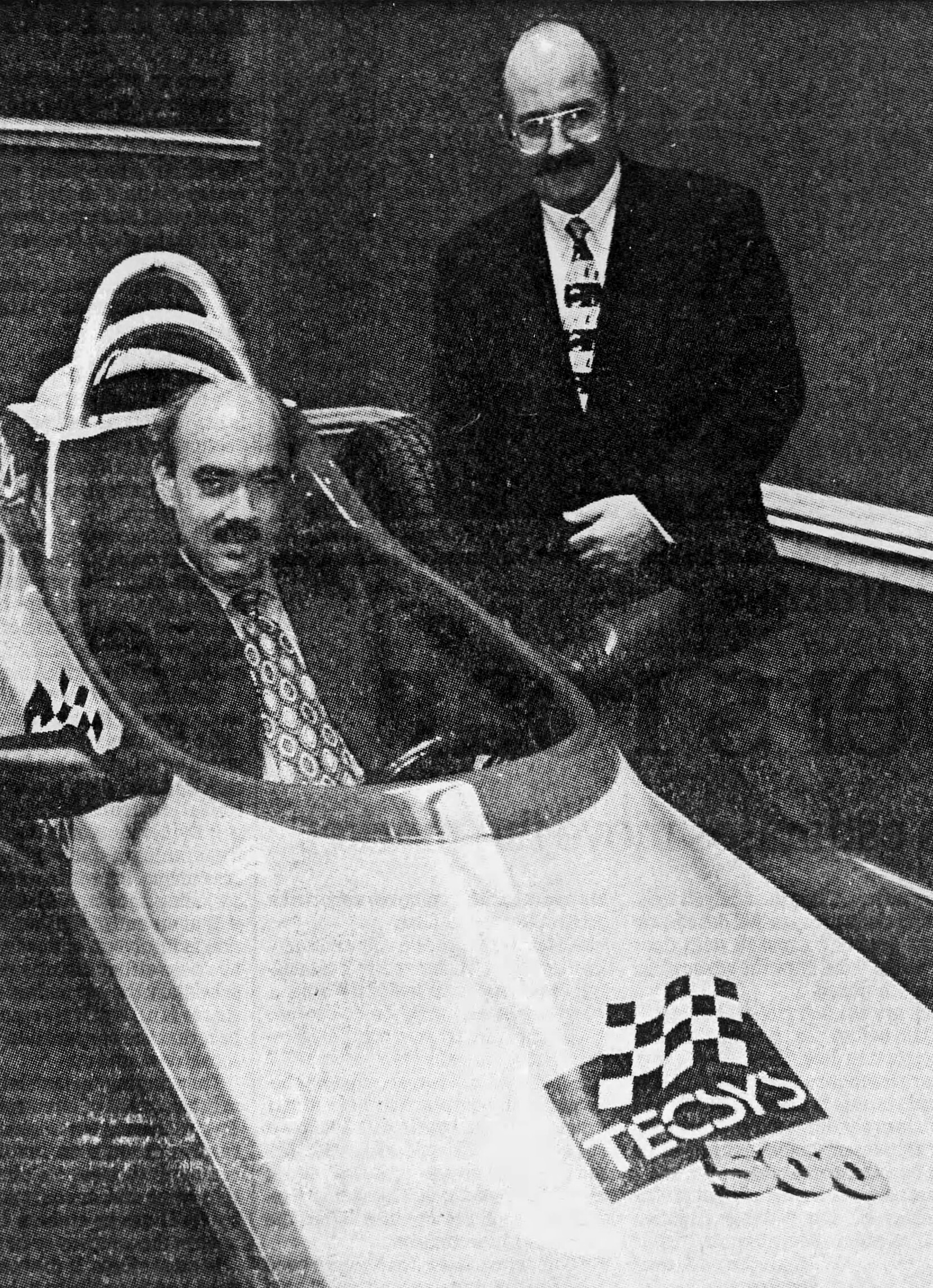
Look back at the archival photograph of Peter and Dave, pictured with a racing car in 1999, and there is an easy temptation to turn everything into a race. His career suggests a less tidy image: a long series of practical adjustments, made with other people, under changing conditions. The Nova got him to Montreal. The work was deciding where to go after that.
Company figures released September 10, 2026. SaaS means software as a service.
Follow the work
Explore Tecsys, Peter’s LinkedIn and his writing.