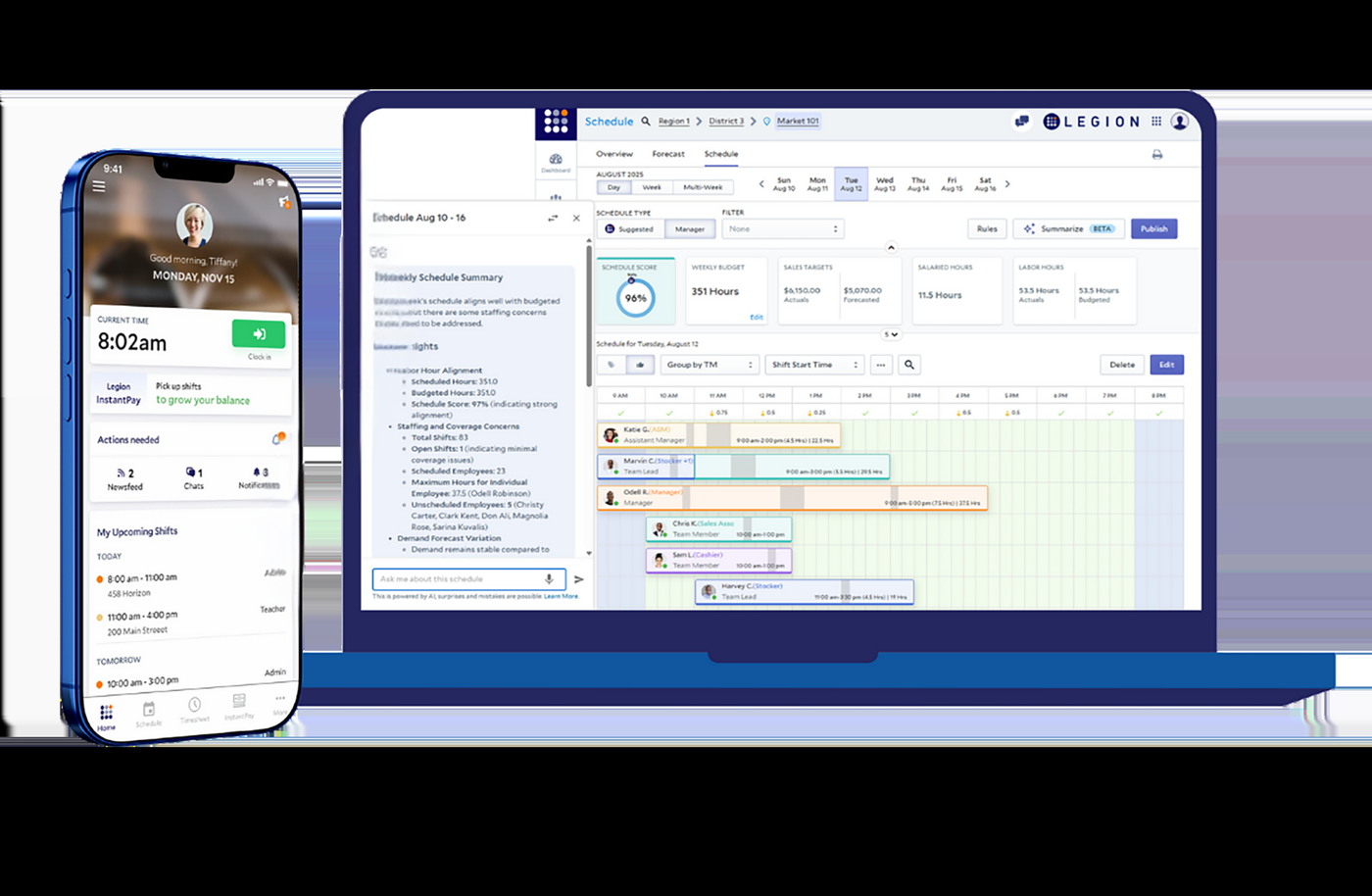
The AI platform quietly rewriting how the hourly workforce gets scheduled, staffed and paid - built on one stubborn idea: hourly jobs can be good jobs.
THE PLATFORM. Legion's AI-native workforce management suite - forecasting, scheduling, time, and pay for frontline teams. Redwood City, California.
More than half the American workforce is paid by the hour, and for decades those workers ran on some of the least sophisticated software in the enterprise - paper schedules, spreadsheets, and time clocks that predated the smartphone. Legion Technologies exists to close that gap. The Redwood City company builds an AI-native workforce management platform - WFM, in industry shorthand - that automates the messy machinery behind every shift: forecasting how busy a store will be, building a schedule that matches demand to who is available, tracking time and attendance, keeping the whole thing compliant with local labor law, and, increasingly, getting people paid faster.
The pitch to a retailer or restaurant operator is blunt: labor is usually the largest controllable cost in the building, and most companies manage it badly. Legion's platform promises to shave that cost while - and this is the part the company insists on - making the job better for the person actually working it. Founder and CEO Sanish Mondkar frames the entire company around a single sentence: turn hourly jobs into good jobs.
Sanish Mondkar did not arrive at hourly scheduling by accident. Before founding Legion in 2016, he spent years as Chief Product Officer of SAP and Ariba, where he was responsible for procurement and business-network products representing more than $1 billion in annual revenue. That is an unusual resume for someone who chose to spend the next decade on retail shift swaps.
The bet was that the least glamorous corner of enterprise software hid the biggest unsolved problem - and that the constraint math behind scheduling (demand you cannot predict, availability that shifts, compliance rules that change by city) was exactly the kind of thing machine learning is good at and humans with spreadsheets are not.
We exist to turn hourly jobs into good jobs. The great thing about being in the labor space is there is really no horizon to how many problems we can solve.
The AI-native backbone spanning demand forecasting, scheduling, time and attendance, and labor optimization.
Machine learning, optimization and generative AI over an enterprise data pipeline - now powering a generation of AI Assistants.
Auto-generates compliant, budget-aware schedules matching demand to availability and preferences ~96% of the time.
A mobile app unifying work, pay and communication, with self-service shift swapping for frontline staff.
Earned Wage Access - draw a portion of earned wages before payday. Users show markedly better clock-in behavior.
Automated time capture, labor-policy enforcement and compliance tracking wired directly into the schedule.
Forrester's Total Economic Impact study attributes Legion's returns to three levers. The share of modeled savings breaks down roughly like this:
Bars scaled to percentage share. Study modeled a 10,000-employee deployment.
Legion sells to enterprise and mid-market operators of hourly labor across retail, hospitality, food service, healthcare and fitness. The customer list mixes discount retail with premium lifestyle brands - a sign the underlying problem is universal.
Demand is hard to predict, availability shifts daily, and labor law varies by city. Legion encodes those constraints so schedules are compliant and budget-aware by default.
Rigid schedules and slow pay drive attrition. Self-service swapping, flexibility and Earned Wage Access are aimed squarely at retention.
Workforce management is not an empty market. Legion competes with entrenched suites like UKG, Workday and Dayforce, and with scheduling-first tools such as When I Work, Quinyx and Deputy. What Legion argues sets it apart is the combination of two things incumbents usually treat separately: hard-nosed labor optimization for the employer, and a genuinely employee-centric experience for the worker.
Its recent releases push the category from software that recommends toward software that decides - what the company calls autonomous workforce decision automation. Rather than surfacing a suggestion for a manager to approve, Legion AI increasingly executes forecasting, scheduling and labor decisions on its own.
Legion pairs employer-side labor optimization with a frontline mobile experience - work, pay and communication in one app.
AI Assistants move beyond dashboards to automate the decision itself across the labor lifecycle.
Legion is a B2B enterprise SaaS business. It licenses its cloud platform on subscription - typically priced per employee and location - to mid-market and enterprise operators, then expands each account with added modules like InstantPay, engagement, and AI assistants, plus integrations with HCM, POS and task-management systems. Reported annual revenue is around $68M, with 216% growth cited in 2025 and four consecutive years on the Inc. 5000 and Deloitte Fast 500.
| Round | Amount | Year | Selected investors |
|---|---|---|---|
| Seed | $10.5M | 2017 | First Round Capital, XYZ Ventures, Webb Investment Network |
| Growth rounds | part of $195M | 2018–2022 | Norwest, Stripes, Workday Ventures, NTT DOCOMO Ventures |
| Growth (Venture) | $50M | 2024 | Riverwood Capital |
| Venture debt | $50M | Dec 2024 | Silicon Valley Bank (First Citizens Bank) |
Total funding to date: approximately $195M. Figures compiled from public filings and press releases; some round details are approximate.
Ex-SAP CPO Sanish Mondkar starts Legion in Palo Alto to modernize workforce management for hourly workers.
Early seed capital arrives from First Round Capital, XYZ Ventures and Webb Investment Network.
A mobile-first experience unifies work, pay and communication for frontline staff.
Earned Wage Access gives employees early access to earned wages - and improves clock-in behavior.
A $50M Riverwood growth round and $50M in SVB venture debt bring total funding to $195M.
216% revenue growth, a fourth Inc. 5000 appearance, and 11 industry awards including AI Breakthrough.
90+ new features and a new generation of AI Assistants push workforce management toward autonomous decisions.
Recognized across AI and workforce management categories in a single year.
Fourth consecutive AI Breakthrough and AI Excellence Awards.
Named Best HR Tech Company of the Year.
Four straight years on America's fastest-growing private companies list.
Repeat placement on the technology fast-growth ranking.
2025 Retail Technology Innovation Hub award winner.
Product demos, founder interviews and platform overviews are published across Legion's channels.
▶ Legion product demos on YouTube
▶ Sanish Mondkar founder interviews
Legion provides an AI-native workforce management (WFM) platform that automates demand forecasting, employee scheduling, time and attendance, and labor optimization for employers of hourly workers.
Legion was founded in 2016 by Sanish Mondkar, the former Chief Product Officer of SAP and Ariba. He remains Founder and CEO.
Enterprise and mid-market operators of hourly labor in retail, hospitality, healthcare and fitness - including Dollar General, Five Below, Mattress Firm, Alo Yoga, SoulCycle and Deckers Brands.
Approximately $195M in total, including a $50M Riverwood Capital growth round and $50M in venture debt from Silicon Valley Bank in 2024.
Its main competitors are UKG, Workday, Dayforce, When I Work, Quinyx, Deputy and Rippling.