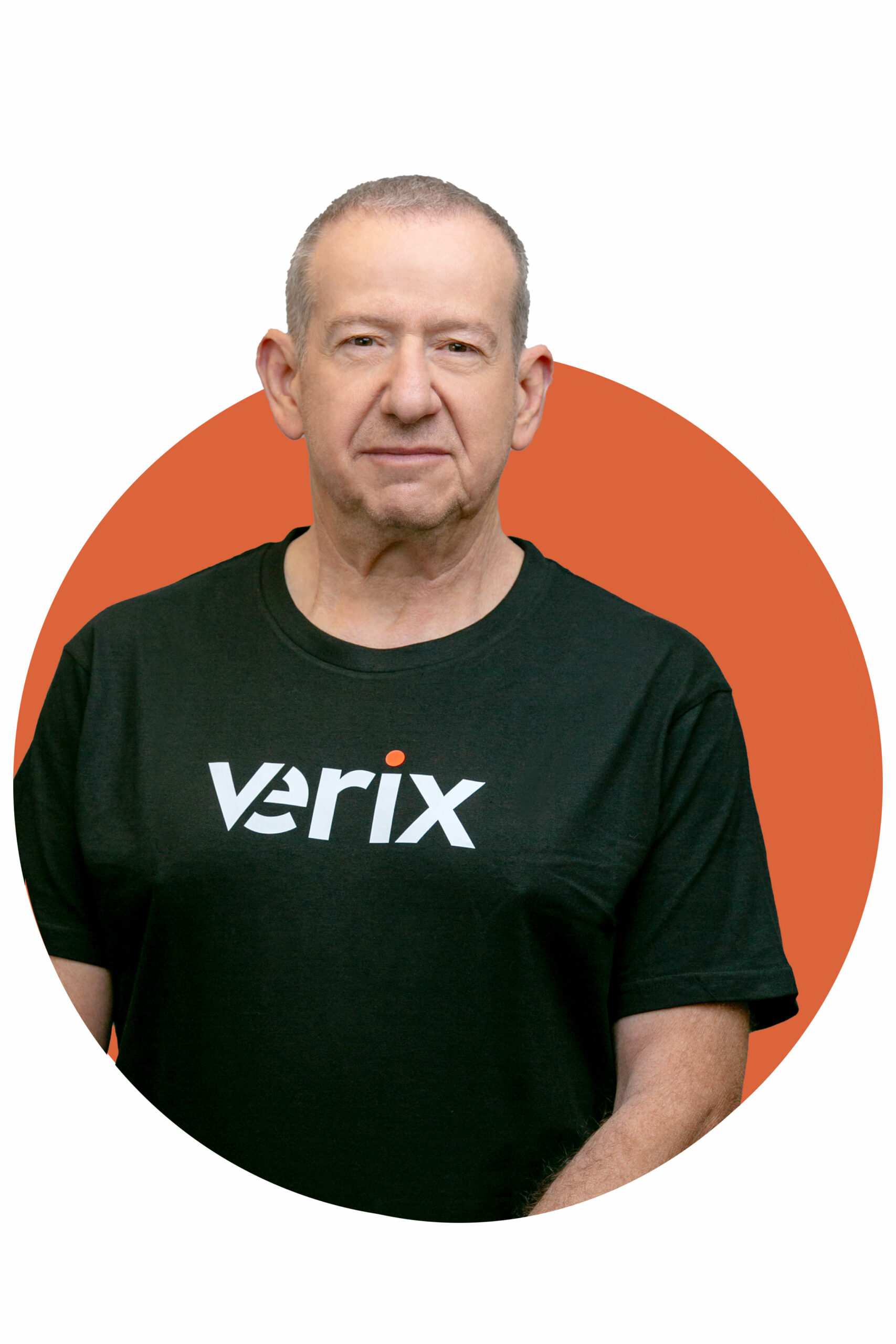
President & CEO, Verix — the AI that tells pharma what to do next
Two companies. Two pivots. One thesis: data beats intuition every time. From workforce software to pharmaceutical decision intelligence, Doron Aspitz has spent 20 years building systems that tell organizations what to do before they know they need to ask.
Doron Aspitz • Santa Clara, California
"Verix is not a conventional analytics solution - it's a decision engine."- Doron Aspitz, President & CEO, Verix
The Company
The pharmaceutical industry has a strange problem. It is simultaneously one of the most data-rich and most data-paralyzed industries on the planet. A single mid-sized pharma company might have data from claims, electronic health records, prescription trends, sales force activity, market research, and patient support programs - all in separate systems, all requiring different specialists to interpret, and none of it updating fast enough to be actionable by the time a sales rep is standing in a physician's waiting room.
Verix's Tovana platform was built specifically for that gap. Aspitz describes it not as analytics software but as a decision engine - a distinction he holds firmly. Analytics tells you what happened. A decision engine tells you what to do. Tovana ingests commercial pharma data, applies machine learning models trained specifically on life sciences datasets, and surfaces prioritized actions: which healthcare providers to target, which channels to use, which messages will move the needle on prescribing behavior.
In March 2024, Aspitz launched the GenAI Database Explorer on top of Tovana - allowing commercial teams to query their own data in plain English. Ask it which HCPs are showing early adoption signals in a specific therapeutic area. Ask it where your field force should focus next quarter. The technical moat isn't the language model itself - it's the pharma-specific training data and the integration layer that makes the answers trustworthy enough to act on.
That trustworthiness comes, in part, from the 2023 acquisition of start-up.ai - a specialist AI firm that had been a Verix partner. Aspitz brought the team in-house rather than continuing to license their capabilities. The rationale was direct: if the LLMs powering your commercial decisions need to understand clinical trial data, patient journey patterns, and HCP engagement dynamics, you can't outsource that understanding.
Identifies which healthcare providers represent the highest-opportunity segments for specific brands and indications.
Surfaces patient identification signals from claims and Rx data to guide field force prioritization.
Coordinates rep visits, digital outreach, and sampling to maximize engagement across every channel simultaneously.
First Act
Blue Pumpkin Software didn't get famous for its name. It got acquired for $75 million because Aspitz built it to be profitable and resilient during the years when the rest of the enterprise software industry was imploding. The company's workforce management solutions for contact centers solved a specific, measurable problem: scheduling agents at the right time, in the right numbers, with the right skills, to handle call volume that was inherently unpredictable.
The 2005 acquisition by Witness Systems (NASDAQ: WITS) - a deal worth approximately $40 million in cash and the remainder in stock - validated the approach. Witness Systems was building out a full suite of contact center intelligence tools, and Blue Pumpkin's workforce management capabilities were a missing piece. The integration made strategic sense on both sides.
What Aspitz carried from Blue Pumpkin to Verix wasn't just a track record. It was a methodology: find industries where decisions are made manually that should be made systematically, build the system that makes those decisions better, and get out of the way. The contact center was one such industry. Pharmaceutical commercial operations turned out to be another - bigger, more complex, and harder to crack.
Blue Pumpkin at a Glance
How It Works
Career Arc
Achievements
"Verix operates on $12.7M in total funding while serving the same Fortune 500 pharma companies that spend billions annually on commercial operations. That gap is Aspitz's competitive argument in every sales call."- YesPress analysis
Behind the Decisions
While dot-com companies were burning through venture money chasing growth at any cost, Blue Pumpkin ran lean and focused on profitable revenue. When the market collapsed in 2000-2001, Blue Pumpkin kept scaling. The discipline of that era shaped how Aspitz thinks about capital efficiency - Verix's entire journey on $12.7M total reflects the same instinct.
When Aspitz decided to acquire start-up.ai, he was essentially buying back the capability he'd been renting. The rationale wasn't cost - it was control. Pharma commercial AI needs to be tuned to specific datasets, regulatory constraints, and therapeutic context. You can't maintain that tuning through a licensing relationship. You have to own the team that does the tuning.
The November 2025 Citius Oncology partnership put Tovana at the center of commercializing LYMPHIR, a cancer treatment. This is pharma AI at its most consequential: the difference between a well-executed commercial launch and a poor one affects how many patients find their way to a treatment. Aspitz has said very little publicly about this deployment. The partnership itself does the talking.
Worth knowing
Aspitz holds degrees in both Economics and Statistics AND Management Information Systems from Tel Aviv University - the economist's eye for incentives plus the systems architect's eye for data, in one person.
"Tovana" is the Hebrew word for understanding or intelligence. For an Israeli founder building decision intelligence for American pharma companies, the name is either a quiet joke or a sincere statement of purpose. Probably both.
Before pharma, Aspitz optimized call-center scheduling. The industries look nothing alike. The underlying problem - thousands of actors making thousands of decisions without enough signal - is identical.
Verix has raised just $12.7M total since 2004. Most enterprise SaaS companies at its market position would have raised 10x that. Aspitz's capital efficiency is either a constraint or a competitive flex. His clients treat it like the latter.
He writes for MedCity News under the author handle @daspit - a rare CEO who publishes thought leadership on the technical challenges his own platform is solving, including precision medicine commercialization and AI integration in pharma sales.
Senior roles at IBM and Tandem Corporation preceded the founding era. That's not just resume decoration - enterprise software companies are built by people who know how enterprise software actually gets purchased, deployed, and used.
Topics & Context
Aspiration
The Citius Oncology partnership for LYMPHIR's commercial launch is the clearest signal yet that Aspitz is moving Verix upstream - from analytics vendor to strategic commercial partner for launches that matter.
Connections