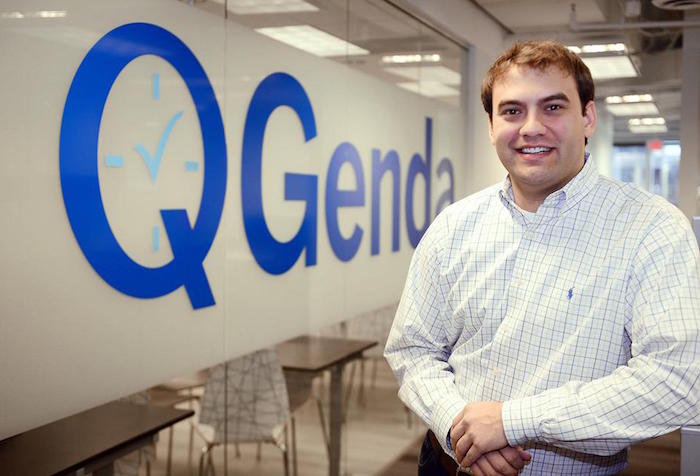
Greg Benoit sometimes arrived to train customers without telling them he was the chief executive. There was software to explain and work to finish. The person learning it did not need a ceremony. In 2014, he described going out with QGenda’s implementation team at least twice a month, watching people use the product and listening to what made their jobs difficult. A founder could learn quite a lot by leaving his title out of the introduction.
The habit offers a useful way into his story. Benoit is QGenda’s founder and CEO, a computer science graduate of Miami University and an investor in other Atlanta software businesses. His early writing also contains something less polished and more interesting: the working notes of someone absorbed in how a company functions. Sales calls, office rent, employee lunches and customer questions all receive attention. The spreadsheet has quite a supporting cast.
The customer never met the CEO
His introduction to scheduling came as a teenager, when a family friend offered him $1,000 to tackle a troublesome work calendar. Manual scheduling eventually became a software business, founded in 2006. The first software customer went live in 2008. Between accepting a task and selling an application lay years of learning what people actually needed from a schedule.
Benoit attended Miami University from 2002 to 2006 and earned a computer science degree. The sequence matters. He had encountered the work before he had finished acquiring the technical education to automate it. By the time QGenda became a software company, the problem already had customers attached.
His later list of priorities as a growing-company CEO was similarly grounded: recruit and keep good people, support existing customers, develop the product and learn from mentors. Those responsibilities competed for his time. Customer visits brought several together. Training someone exposed the parts of the application that needed explaining; a long conversation could reveal something worth building.
There is a practical advantage to that sort of proximity. The person using the software has a task in mind. Watching where they pause can be more useful than hearing a feature described in a meeting. Benoit’s account of those visits suggests an executive trying to preserve access to that ordinary, revealing experience as his company grew.
A sales process, with the numbers left in
In August 2013, Benoit took readers inside QGenda’s sales effort. During 2012, a small sales team had performed around 250 demonstrations and brought in 104 customers. The reported close rate was 41 percent. Then the company started investing in a more deliberate, repeatable process.
By the time he wrote, the sales team had expanded from two people to fourteen. Its roles included business development representatives, account executives and sales leadership. Over the first six months of that effort, QGenda recorded 399 demonstrations and 110 new customers, with a reported close rate of 28 percent.
Read the percentages alone and the story looks disappointing. Add the volume and the calendar, and it changes: more new customers in half the time. The comparison is a reminder to keep the period beside the metric. Benoit was describing a process under construction, with enough numbers visible for a reader to question how it worked.
His New Year’s Day account of 2015 was just as particular. QGenda had completed 998 qualified demonstrations, added 379 customers and brought in $5,009,294 of new-customer annual recurring revenue. The team had grown from 48 employees to 100, while customer retention stood at 97 percent.
The precision is part of the appeal. Five million dollars is a milestone. The additional $9,294 makes it feel like an operating report someone has actually opened. He also set out plans for the coming year, including more hiring and more space. Ambition appeared beside a list of things that would have to happen.
The pizza-box school of management
For all those figures, Benoit’s account of company culture could be wonderfully domestic. In May 2014, he recommended four inexpensive practices: a Friday email celebrating employees’ accomplishments, a weekly catered pizza lunch, annual Costco memberships and monthly car washes paid for by the company.
Each had a recognizable purpose. The email made colleagues’ work visible. Lunch brought people together. A membership or a clean car was a small benefit an employee could use outside the office. Culture, in this version, sometimes involved a parking lot and a person with a bucket.
He presented these as affordable ways to influence a workplace. There was no suggestion that a pizza could resolve every management problem. Still, the list gives texture to a company that might otherwise disappear behind revenue figures. Employees had ordinary lives, appetites and errands. A growing organization could acknowledge them without commissioning a grand theory of belonging.
A year later, his inventory of QGenda’s software tools showed the same interest in practical arrangements. He described five departments and the applications supporting them, from customer management to accounting and development. His caution was straightforward: expensive tools could wait until a business had established its product, customers and culture. Buying the equipment was the easy part.
His view of an early hire was demanding. Writing about ProRata’s first employee in January 2016, he listed prospecting, demonstrations, implementation, account management, recruiting and trade shows among the responsibilities. A startup’s first job description could consume a respectable portion of the company’s to-do list. He also thought founders should try to perform their first 500 demonstrations themselves.
The hiring process he described in 2013 included an office tour, introductions to existing employees and a written test with logic questions. Candidates also worked with others at a whiteboard. One opening question invited them to talk about something absent from their résumé. The combination is characteristic of his early writing: a process to follow, with some room to discover the person inside it. Building a team required attention to both.
When growth needs another floor
The cost of growth became particularly clear in Benoit’s January 2016 comparison of office leases. QGenda had negotiated its Buckhead move in 2013. Nearly three years later, it was discussing another 12,800 square feet, taking the planned total to 30,000. The surroundings had become more expensive.
The earlier deal had rent of $22 per square foot per year and eight free months within a five-year term. The expansion terms showed $31 and three and a half free months. Parking allocations had fallen too. The building, once 60 percent occupied, was now more than 95 percent full.
Annual rent per square foot. Benoit also documented changes in free rent, parking and expansion rights.
He calculated that the less favorable economics added more than half a million dollars over the lease’s life. This was a founder examining another system of constraints: people could join faster than suitable office space became available. A company needed room to grow, while a lease wanted commitments written down years in advance.
The detail helps explain why real estate belongs in his biography. A team outgrowing its quarters has a concrete problem, complete with desks and doorways. For a software entrepreneur accustomed to solving awkward workflows, the mechanics of finding another floor offered plenty to investigate.
Room for someone else’s company
By January 2016, Benoit had set a personal goal of investing in and advising at least one new startup each year. He named TapCue and ProRata as earlier investments. Later that year, he launched TechRise Ventures, whose first official investment was WideAngle, software for weekly one-on-one meetings.
His interest extended beyond writing a check. WideAngle had already been used at QGenda. The investment connected his experience as a customer with his experience building a subscription software company. It also put him alongside another Atlanta entrepreneur, Jon Birdsong, who led WideAngle.
Years earlier, Benoit had imagined a more encompassing environment for founders. His 2013 Tech Tropolis proposal included a building in West Midtown, furnished apartments on upper floors, offices below and meals during the working week. An initial investment would accompany a year of living and working there.
The proposal is revealing on its own terms. It treated housing, food and office space as demands on a founder’s attention. There were even suggestions for outings. Someone planning a software company might also appreciate dinner and an occasional trip outside. Benoit’s version of startup infrastructure remembered the inhabitants.
TechRise later gave his interest in space a physical expression through a Buckhead building intended for growing businesses. His concerns as an operator had found another outlet: helping other teams get beyond the stage at which their surroundings no longer fit.
“I want to make a generational impact and I believe that is best done through entrepreneurship.”
Greg Benoit · 2018
The next calendar entry
QGenda’s subsequent chapters brought larger organizations into the story. Francisco Partners invested in 2016; ICONIQ Growth followed in 2020. In August 2024, Hearst announced its agreement to acquire the company, with Benoit continuing to lead it. By July 2025, QGenda was announcing its own completed acquisition of New Innovations as a Hearst company.
In October 2025, Venture Atlanta inducted him into its Hall of Fame. The organization had hosted his presentation back in 2012. Recognition supplied a public marker for a career whose earlier record is full of less ceremonial work.
That record is what makes Benoit interesting. A founder visits customers, counts demonstrations, orders lunch, studies a lease and thinks about where the next company might work. None of these tasks comes with much theatrical promise. Together, they describe a person who kept finding consequential things inside the everyday business of getting organized.