Dan Rodrigues had already helped build a website that attracted millions of visitors when he discovered how slowly a software company could grow. Kareo, the business he started in 2004, took about six years to find a model it could scale. In the middle came a funding shortfall, a smaller team and a lesson in the difference between having interested customers and having a business that can pay its bills.
He would eventually lead Kareo into the merger that created Tebra. By December 2025, the combined company was announcing $250 million in equity and debt financing. That is a considerable distance from the early Kareo years. It is also an invitation to look past the financing announcement. The interesting part of Rodrigues’s career lies in the decisions made when the numbers were considerably less photogenic.
His route runs through baseball cards, a college search engine, an abandoned gaming idea and an unglamorous consulting assignment. It makes a persuasive case for paying attention to the work that happens between the company names on a biography.
A startup education in the living room
Rodrigues grew up in Orange County, California, with parents whose working lives brought computers and small businesses into the house. His father moved from flying and flight instruction into programming and consulting. His mother worked in administration and desktop publishing. She was an early employee at both Upper Deck and the company behind Hooked on Phonics.
Founders met with her in the family living room. Young Dan could see an idea being worked on before it became a recognizable product. Entrepreneurship came with packaging, projects and people trying to get something finished. There was no need to wait for a university lecture to encounter it.
At school, he edited the newspaper and yearbook. Later came computer science studies at the University of Washington, then UCLA, where he completed his bachelor’s degree in 1998. Software jobs at Visio and RealNetworks gave him an early view of established products and rapid expansion. He was learning to write software while watching businesses acquire customers, employees and expectations.
The speed of Scour
At UCLA, Rodrigues joined four other students on a multimedia search project that became Scour. They indexed images, audio and video, starting with the pleasure of making something useful. Two founders’ parents supplied an initial $10,000 investment. That bought the young company a server’s place in a data center.
Rodrigues was 21 when an investor group put $4 million into the business. He later recalled a peak of 15 million unique visits a month. For a student project, this was rather more audience than the usual demonstration in a computer lab. Scour belonged to the early scramble to make the internet’s growing collection of media searchable and accessible.
The ending was difficult. Scour entered bankruptcy, and its assets went to CenterSpan Communications for $9 million in cash and stock at a December 2000 auction. Listen.com and Liquid Audio also bid. A popular service could attract an enormous audience and still find itself at an auctioneer’s disposal.
That episode belongs in the same biography as Tebra’s later financing. Rodrigues’s career contains both the excitement of discovering demand and the consequences of trying to turn demand into a durable company.
The business hiding inside a client project
After Scour, Rodrigues and former colleagues spent ten months developing an online competitive gaming concept. They imagined a league with physical events and a subscription service. As they prepared to seek financing, the September 11 attacks changed the economic setting. They shelved the plan.
Rodrigues then helped establish Skematix, a software consultancy that grew to roughly 15 engineers. One client wanted a better way to connect with its customers. Its existing routine depended on faxed documents and paper reports. Over about 18 months, a modest assignment expanded into a much broader office management system.
Here was a different way to discover a market. Instead of attracting a crowd and working out a business around it, he was working for someone who already had a reason to pay. The project also gave him time to understand the customer’s daily work. A consulting invoice can be a surprisingly effective research instrument.
In 2004, he left the consultancy, acquired the project’s intellectual property and signed the original client as Kareo’s first customer. A team of five developers worked to turn custom software into a product other businesses could buy. The official product launch followed in early 2005.
His initial intention was to bootstrap. Introductions from Listen.com founder Rob Reid led to investor meetings, and CNET founder Halsey Minor became an early backer. The company that had begun with one paying client was now learning to work with outside capital.
When the next installment did not arrive
Kareo raised $2 million in 2005. Across two early rounds, Minor committed a total of $6.5 million. Rodrigues built a team of about 30 and initially pursued distribution through businesses that could introduce the software to many end users at once. The reasoning was straightforward: one relationship might open several doors.
Adoption took longer than the forecasts allowed. The product still needed features customers expected. When an anticipated funding installment failed to arrive, Kareo had about four weeks of cash left. Rodrigues cut the team from 30 people to seven, gave up the office and moved the remaining group to remote work.
Collections moved toward online card payments. The company improved its online selling and stretched its remaining money. Eleven months later, it reached positive cash flow. These were painful changes, involving jobs as well as spreadsheets. They also forced decisions about how the business could operate with the money it actually had.
“I think that time was very focusing for us.”
Dan Rodrigues, reflecting on Kareo’s lean years
The plainness of his description suits the episode. There is little glamour in collecting a payment sooner or making a support team more effective. There is considerable value in being able to keep operating long enough for those improvements to matter.
A customer should not need an appointment to buy
Rodrigues developed a practical approach to selling software to busy small business owners. Online marketing could meet people when they were already looking for a solution. A clear website, an accessible demonstration and a trial could help them evaluate the product on their own schedule.
He explained that approach publicly in 2013: remove unnecessary work from adoption and make the purchasing process understandable. It is easy to admire a product’s sophistication from the company’s side of the desk. The customer still has to find time to learn it. Kareo’s sales method acknowledged that inconvenient detail.
By 2010, the company had about $4 million in revenue and 17 employees. OpenView bought out the original investors’ stake. In 2012, revenue exceeded $20 million. Rodrigues credited maturity across the product, sales and support, together with growing demand for cloud software. Several parts of the business had finally begun working together.
The sequence matters. The revenue chart begins after the expensive experiments and the cash shortage. Anyone arriving at the upward bars would have missed a substantial part of the job.
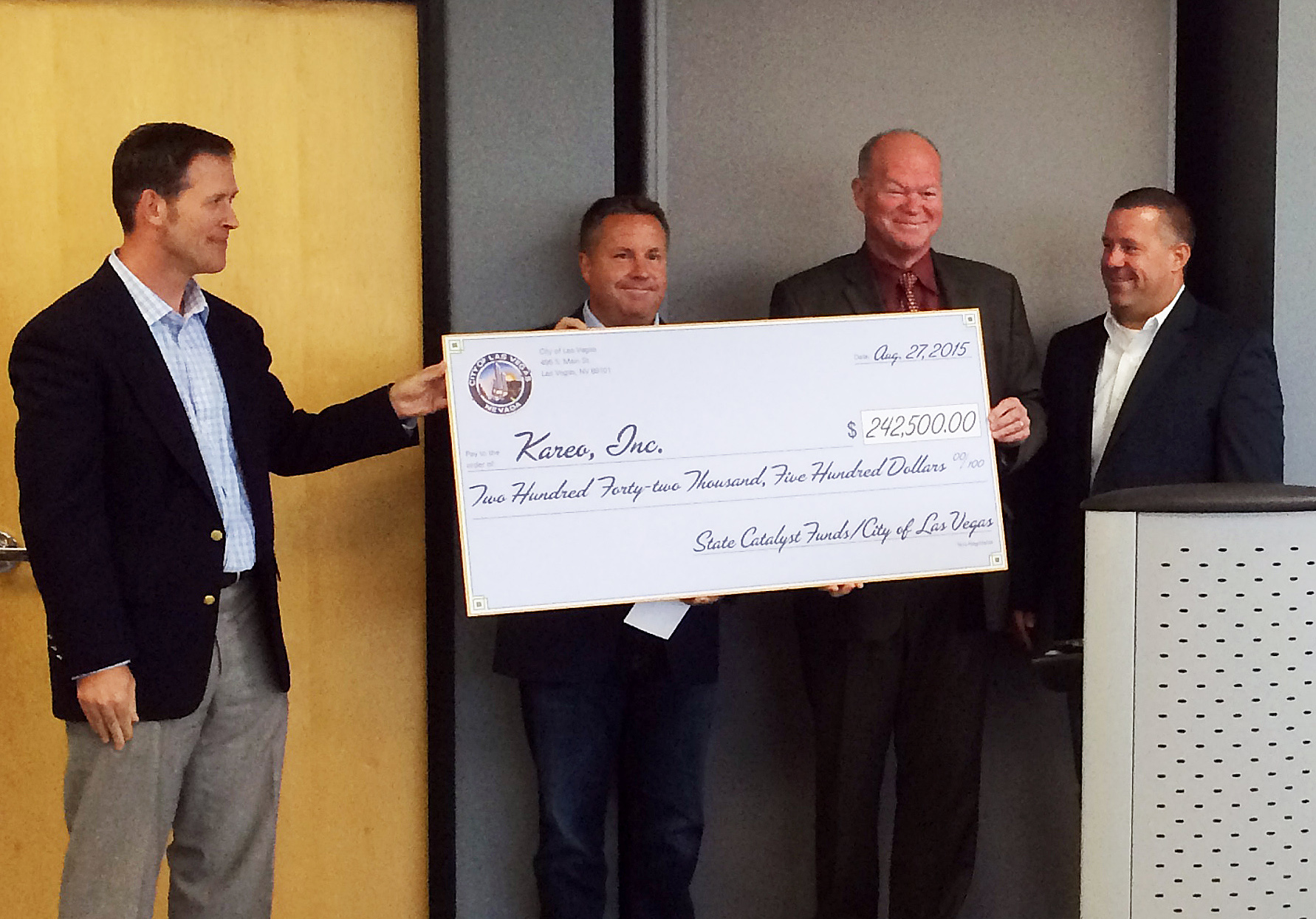
By August 2015, Kareo employed about 100 people in the Las Vegas Valley. At its Summerlin office, local officials presented a $242,500 state Catalyst Fund check. Rodrigues said the company expected to add another 200 to 300 area employees. It was a different kind of company-building photograph: an office, a regional workforce and a ceremonial check large enough to obscure the people holding it.
Old connections, a larger company
The relationships from Rodrigues’s earlier career continued to matter. Travis Kalanick, a UCLA contemporary and Scour colleague, became an early Kareo investor and joined its board in 2018. Rob Reid joined the board too. The connections linked an early internet venture to a company working through the less conspicuous problems of business software.
In November 2021, Kareo and PatientPop merged to form Tebra, with Rodrigues as chief executive. PatientPop’s co-founders, Luke Kervin and Travis Schneider, joined the combined leadership team. The plan brought operating software and growth tools into the same business. The founders were taking on the difficult work of joining products, teams and customer relationships.
The name came from “vertebrae,” expressing the company’s intended role as a backbone for its customers. In 2022, Tebra announced more than $72 million in financing at a valuation above $1 billion. The vocabulary of the business had changed considerably since the first consulting assignment. Its recurring interest in how small organizations run was still recognizable.
The next project still needs builders
In December 2025, Tebra closed $250 million in new financing, primarily equity led by Hildred alongside a J.P. Morgan debt facility. Existing investors also participated. Rodrigues described AI as another platform shift in software. The announced investment would accelerate development and automation across the company’s products.
A recent LinkedIn hiring post adds a useful detail to that ambition. Rodrigues was seeking a head of AI engineering and enablement to work on how Tebra itself operates. He wanted someone who could build workflows, coach colleagues and help teams adopt what they built. The role would report directly to him. The emphasis was on implementation inside the company.
There is a personal life running beside this long sequence of companies. In a 2019 podcast conversation, host Carey Ransom described Rodrigues and his wife, Kate, raising five children while he built Kareo. Ransom also described him as an advocate for Orange County. His advice to entrepreneurs included loving the work and the place where they do it, being honest about the opportunity, and developing the resilience to continue.
Those ideas fit a founder whose public milestones stretch across decades. Rodrigues has experienced a student project’s sudden popularity, a company’s disappearance into an asset sale, and the slower satisfaction of making another business work. His story leaves room for ambition and for the mundane decisions that give ambition somewhere to go. Sometimes the next useful invention is a better way to get paid on time.