A leave request is an unlikely place to begin a technology story. It has little glamour, limited dinner-party potential, and an impressive ability to become somebody else's problem. Yet employee records and time off were among the first jobs Suwandi Soh chose for Sleekr, the HR software he co-founded before Mekari. Behind that modest starting point lay a question that would follow him for years: why should running a smaller business require so much avoidable administrative work?
Today, Soh is Mekari's co-founder and CEO, overseeing a business software company whose reach extends from payroll and accounting to customer communications and commerce. The interesting part of his trajectory is how consistently it returns to the same terrain. Before he sold software, he worked on processes. Before the growing product portfolio, there was a consultant paying attention to how work actually got done.
A career spent looking under the bonnet
Soh studied industrial engineering at Trisakti University, attending from 1999 to 2003. His early professional life followed a recognisable route through the mechanics of organisations: quality assurance at DNP Dainippon Printing in 2003, then Lean Six Sigma work at Premysis Consulting from 2004 to 2008. In June 2008, he became managing partner at SSCX, a role he held until April 2016.
Those titles belong to a world of measurement, quality and operational improvement. Mekari's account of his beginnings describes a consulting firm founded in 2008 to help Indonesian businesses apply Six Sigma and Lean Thinking. Industrial engineering had given him a way to think about the relationship between people, systems and results. Consulting supplied companies in which to examine it.
There is a useful continuity here. A consultant can recommend a better process; a software product can place that process inside a customer's daily routine. The route from one to the other makes Soh's move into technology easier to understand. Payroll and accounts may lack a consumer app's social sparkle, but they have the considerable advantage of needing to work again next month.
The weekend project meets the working week
In 2015, Soh and Dirman Suharno founded Sleekr, a cloud-based HR solution. Its beginnings were smaller than the later company might suggest: a weekend project, first used internally, developed while Soh still had a full-time job. The first scope was deliberately limited to employee information and time-off management. A business can accumulate an ambitious software wish list rather faster than a small team can build one.
Soh had noticed companies using manual records and spreadsheets to manage employee information. Business software already existed, but much of it came at prices associated with larger organisations. Smaller companies were being asked to make do. His opportunity lay in making useful software accessible to customers whose administrative needs were real even when their budgets were modest.
Early on, he also took customer-support duties. That put the founder in direct contact with people trying to use what his team had built. He watched which features mattered and which did not. His conclusion was that understanding users was harder for competitors to reproduce than a feature. The distinction made customer contact part of product development itself.
“Fitur bisa ditiru tapi pemahaman pengguna susah ditiru.”
Suwandi Soh, 2021
The early company considered an international market, partly because of concerns about local willingness to pay for software. Experience brought a more specific understanding of customer segments. Indonesia became the centre of the business. That change matters: an assumption about a whole market had to give way to the more exacting business of finding the customers who valued the product.
Accounts join the conversation
By February 2017, Sleekr was introducing mobile applications for HR and accounting. It had entered accounting through a merger with Kiper in late 2016. Its HR tools covered attendance, leave and reimbursements; the accounting product addressed matters including cash management and financial reports. The company was following the paperwork from one department to the next.
At the time, Soh explained that he wanted founders without a finance background to be able to manage their accounting. That is a revealing ambition. It puts the owner who needs a usable answer ahead of the specialist who already knows the terminology. Software has a sporting chance of being helpful when it does not require customers to become different people before they can use it.
The original HR focus was broadening into the infrastructure of running a company. Accounts and employee administration meet in obvious places, starting with salaries. A customer may buy one tool for an immediate problem, then discover that the neighbouring problem has been waiting patiently. Sleekr's expansion made that adjacency part of the business.
When competitors share a table
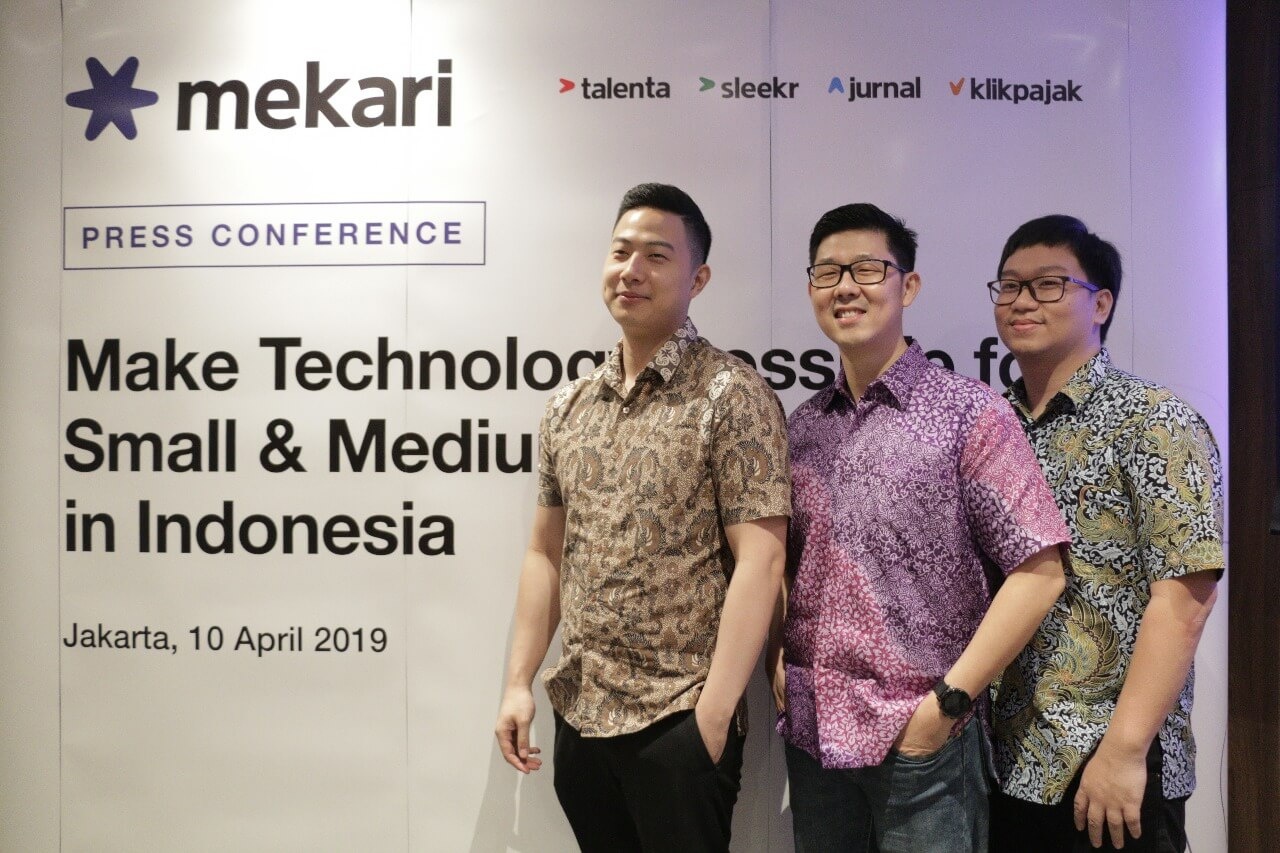
In 2018, Sleekr, Talenta and Jurnal came together; the Mekari identity was introduced publicly in 2019. The chronology is worth keeping straight. The combination preceded the new name. Soh's company had acquired a rival in Talenta and joined forces with accounting software business Jurnal, bringing previously separate capabilities into the same organisation.
It also brought together people with their own histories and expectations. In the photograph of the consolidation announcement, Soh stands alongside Anthony Kosasih and Daniel Witono, both associated with Jurnal's founding. A corporate announcement can make a combination look instantaneous. The people in the picture still have to build a working company together after the cameras leave.
The result gave Soh a broader proposition for customers: business tools spanning HR, accounting and tax. It also changed the unit of ambition. A company that began with a particular administrative chore was now assembling software for several connected parts of an organisation. The everyday work remained familiar; the responsibility for making those parts work together had grown.
SSCX consulting
Sleekr co-founded
Mekari takes shape
Desty acquired
The CEO who kept the arithmetic
Growth did not erase Soh's interest in the economics underneath it. In 2021, he discussed sustainability and profitability together, describing both as necessary for a company that wanted to expand and endure. Mekari paid attention to the relationship between customer lifetime value and the cost of acquiring a customer. The abbreviations are less entertaining than a launch party; the bills are more persistent.
His position was practical: accelerate growth while preserving the ability to earn and survive. It would be a mistake to turn that preference into a claim that Mekari has always been profitable. What it tells us is how Soh framed the problem. Selling productivity to other companies invites a certain scrutiny of one's own spending.
By June 2022, he was describing tenfold growth over the preceding four years. He also said cloud delivery could make the company's software substantially less costly than conventional alternatives. These were his figures and comparisons at that time. Their significance in his story is the connection he drew between access, price and adoption: a product's usefulness has to survive the customer's budget meeting.
Growth over four years, as described by Soh in June 2022.
Historical company claim. No growth measure was specified in the report.Learning goes both ways
Soh's own formal education continued while he was running the company. He completed an MBA at the University of Illinois Urbana-Champaign between 2021 and 2023. The sequence is pleasingly untidy: engineering degree, professional practice, consulting, entrepreneurship, then business school. His career had supplied quite a few questions before the MBA arrived.
Education also appears in his work beyond the chief executive's desk. He mentored founders through DSLaunchpad Ultra in 2021. A Startup Studio Indonesia podcast that June focused on finding product-market fit in Indonesian B2B software, including the difficulty of establishing how urgently prospective customers wanted a problem solved. Experience was being turned into material other founders could question and use.
There are glimpses of his working relationships, too. In a published conversation about Mekari's CEO office, Arvy described Soh as treating him more like a business partner than a subordinate. He connected that relationship to trust, flexible communication and regular check-ins. It is one colleague's description, but a concrete one: cooperation expressed through how decisions and conversations happen.
Soh's interests have also extended to interviewing others. A Long Speech podcast appearance discussed his own podcast, Industri dan Orang-orangnya, alongside Sleekr's beginnings and the work of merging teams. For someone whose business depends on understanding organisations, a programme about industries and their people seems an apt extracurricular activity.
From the back office to the shop floor
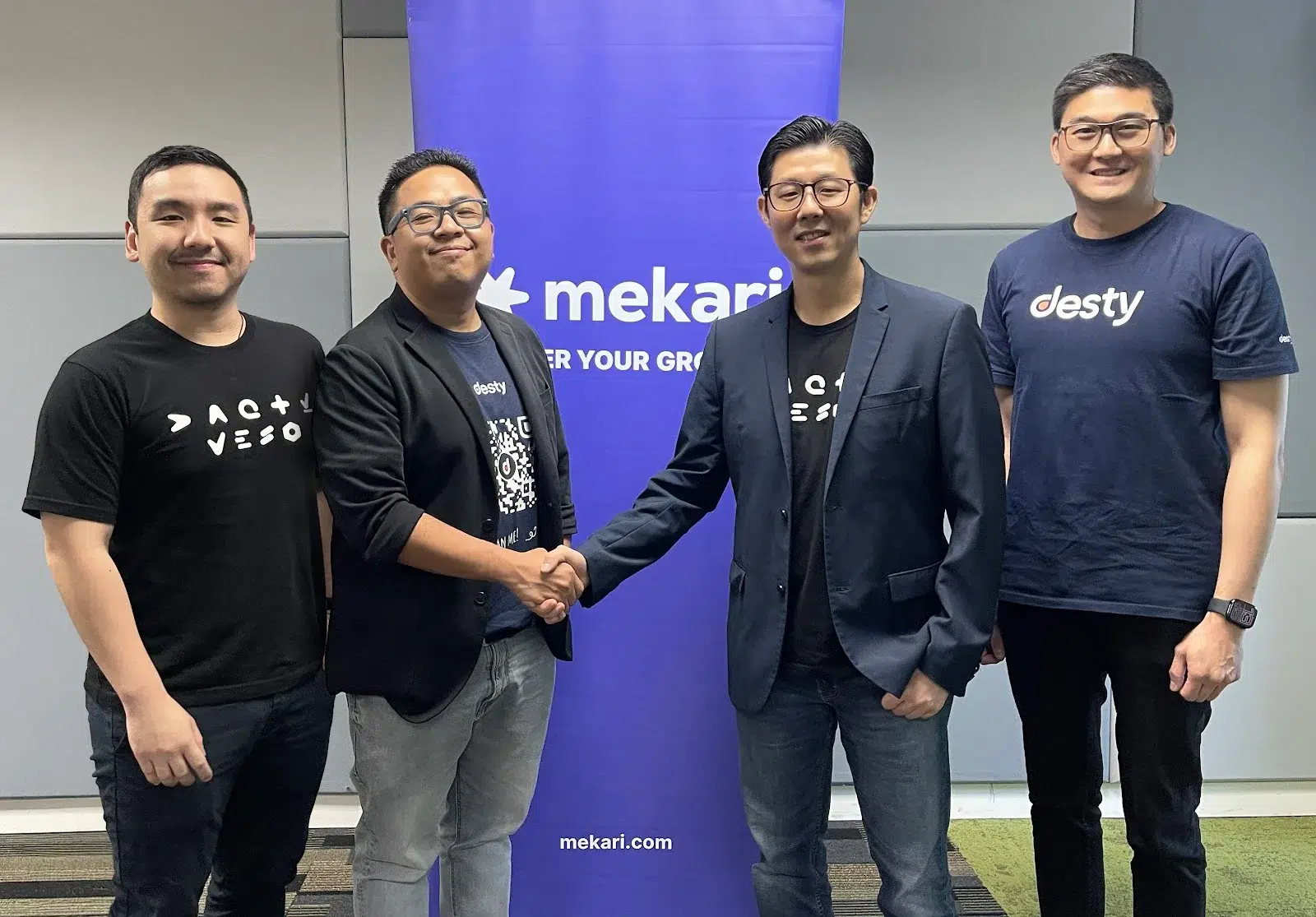
On 27 August 2025, Mekari announced its acquisition of Desty, adding commerce tools for merchants managing sales across channels. The company said it served more than 35,000 businesses and one million professionals across Indonesia at that point. Those are different measures: a business customer and a professional using software are not interchangeable units.
Desty's inventory, order and marketplace capabilities extended the portfolio further into merchants' daily operations. Soh described the ambition as making technology once associated with larger companies accessible to smaller businesses as well. The subject had expanded from the leave request to the movement of stock, yet the underlying concern about access remained recognisable.
In May 2026, Mekari launched a point-of-sale product for food businesses and retailers. Soh's explanation returned to operational control: expanding businesses needed to keep hold of their own data as outlets multiplied. By September, he was discussing AI at work with former communications minister Rudiantara at Mekari Conference 2026, where the company revealed Mekari Envoy.
The vocabulary keeps changing: cloud, omnichannel, AI. Soh's career offers a quieter way to follow the changes. Ask what happens to the ordinary working day. Can someone find the number, approve the request, reconcile the account, or understand the next branch? The founder who started with employee records is still occupied with the machinery underneath ambition. Even a blossoming business has to get the payroll right.