A billing company signed up. The forecast looked sensible. Within three to six months, Kareo expected that customer to move its doctors onto the new software. In practice, the rollout took about 18 months. For a young company selling monthly subscriptions, the distance between those two calendars was a very expensive place to live.
- Kareo began with billing software for small medical businesses.
- The PatientPop merger added finding patients to treating and billing them.
- Today’s Tebra sells connected workflows, with AI priced separately.
That early mismatch explains something about Kareo, now part of Tebra. Healthcare software can look attractive in a presentation and still take an unexpectedly long time to become useful. The interesting part of this company’s history is how often the customer’s working day forced it to reconsider the plan.
01 The customer behind the customer
Dan Rodrigues started Kareo in 2004 after working on a medical billing application at his consulting firm. He acquired the intellectual property, retained the original client, and hired five developers to make the custom system sellable to other businesses. The product launched in early 2005. One real customer had supplied both the problem and the first revenue.
The first distribution idea was appealing: sell through billing companies, each already serving numerous doctors. But rollout assumptions ran ahead of reality. Rodrigues later explained that the software still lacked capabilities customers had in older systems. Enthusiasm for the idea could not substitute for those missing features.
Early billing-company rollout cycle, as recalled by Rodrigues in 2013.
Then an expected funding tranche failed to arrive. Rodrigues recalled:
“We had a month of cash flow left.”
Meanwhile, doctors were approaching Kareo directly. Their interest helped expose a different route to market: the individual practice. The lesson is uncomfortable and useful. A distribution partner’s customer list is potential reach; adoption still has to happen one office at a time.

02 A chart, a claim, a new patient
Kareo’s original job was helping practices manage the administrative and financial side of medicine. Its tools covered appointments, insurance eligibility, claims, and getting paid. In February 2013, it launched a free electronic health record. The company said customers had asked for clinical software alongside their practice management and billing services. Free was the launch offer, not today’s price.
In November 2021, the boundary moved again. Kareo merged with PatientPop to create Tebra. Kareo brought clinical and financial operations; PatientPop brought websites, search marketing, online booking, and other growth tools. Rodrigues became the combined company’s CEO. The merger announcement described a business already supporting more than 100,000 providers across the two companies.
- 01 / Be foundWebsite → booking
- 02 / Deliver careIntake → chart → visit
- 03 / Get paidClaim → payment
An editorial map of the combined platform’s workflows.
The combination makes commercial sense. A practice can have excellent billing software and an empty appointment book. It can also attract patients and struggle to collect. Connecting those jobs is Tebra’s proposition. Its specialty is the independent outpatient business, including primary care, pediatrics, and mental health, alongside the billing companies serving practices.
That puts it in an overlapping market with athenahealth and AdvancedMD. Integration alone is hardly an exclusive claim in this category. Kareo’s distinctive through-line is the small office: the clinician, receptionist, and biller trying to keep the same business moving. Tebra’s stated culture reinforces that focus with values around customers, simplicity, and entrepreneurial problem-solving.
The platform also borrows expertise. A July 2025 WoundZoom partnership brought wound imaging and reporting into its partner ecosystem. November’s DrFirst integration added prescription notifications and educational information through RxInform. These are specific, unglamorous connections: documenting a healing wound, or helping a patient remember a pharmacy pickup. They show where a general practice platform needs specialist help, and why the details of an integration deserve attention during a demonstration.
03 Put the price beside the promise
Tebra’s published standard physician rates are $599 per provider per month for Practice Essentials, combining EHR, billing, and telehealth, and $799 for Practice Automation, which adds patient experience tools. Two physicians therefore mean $1,198 or $1,598 monthly before extras. Non-physician and low-volume tiers differ. This is a subscription business, with optional products and additional fees.
AI Note Assist, for example, lists at $99 per provider monthly for up to 400 generated notes, then $0.25 for each additional note; a $0.99-per-note option also exists. Implementation, migration, prescribing integrations, and other applicable charges belong in the comparison. The useful buying document is a complete quote matched to the practice’s work.
Low-volume pricing introduces another wrinkle. Tebra says practices exceeding its 100-claim monthly threshold for three consecutive months move to standard rates. Growing the appointment book can therefore change the software bill. Its pricing page also says non-clinical staff can use the system without extra seat charges. For an office manager, those details matter together: count the clinicians, forecast the claims, and include the reception and billing teams in the evaluation. The cheapest starting tier tells only part of the story.
04 The next unit of value is a minute
Tebra launched AI Note Assist in June 2025. It listens during visits and drafts clinical notes inside the EHR, with suggested diagnosis codes for review. In December, Tebra announced $250 million in equity and debt financing, primarily equity led by Hildred with a J.P. Morgan debt facility, to accelerate AI and automation development.
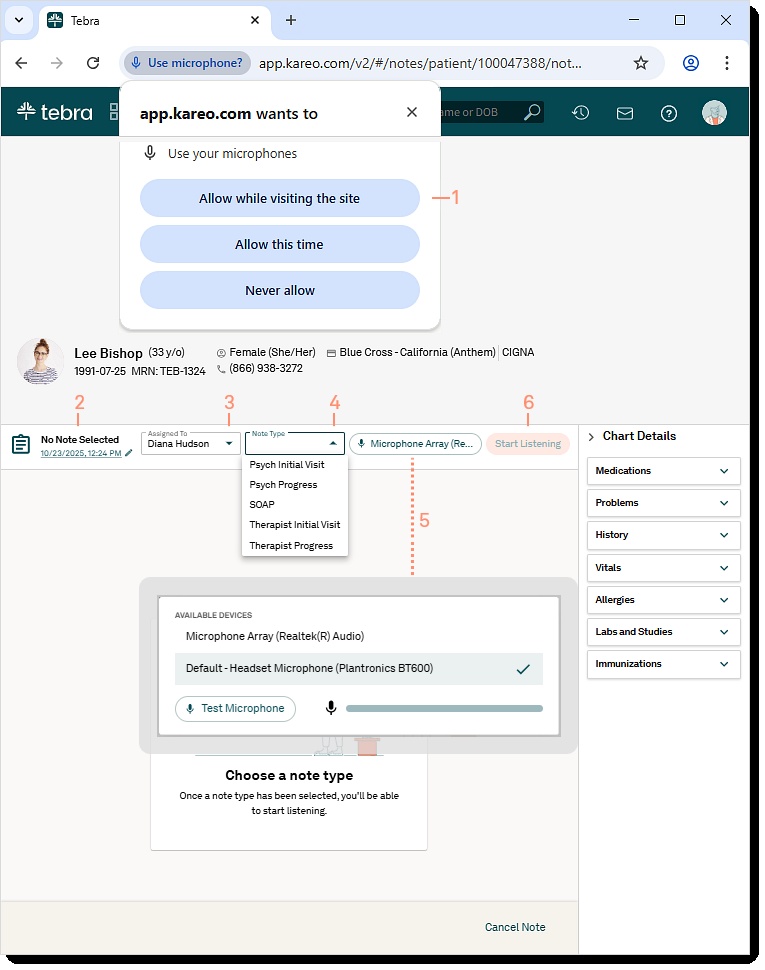
By October 2026, the company reported more than a million AI-generated notes. Its paired customer survey responses suggested documentation time fell from approximately 23 minutes to 14. Those are self-reported estimates using time-range midpoints, rather than directly measured work. They offer a useful signal, with less certainty than a stopwatch would provide.
About nine minutes saved, according to Tebra’s customer survey. Individual results vary.
The help documentation supplies the practical boundaries. Providers must review the draft and add required structured information. AI Note Assist does not support group or third-party telehealth sessions, and its documented experience excludes mobile browsers and the mobile app. A practice built around those workflows cannot assume the advertised convenience will transfer.
For a buyer, the copyable idea is simple: ask for a demonstration that follows one sample patient from booking through documentation to payment. Count the handoffs and the work left over. The staff doing that work should help decide whether a new system improves it. Kareo’s early customers taught it that software succeeds at the pace of the office using it. That remains a better test than the length of a feature list.