The fax is a clue. Among ethizo’s offerings, alongside electronic health records and telemedicine, sits a hybrid fax service. It combines fax, email, and electronic signatures, then links documents to patients. A technology company could treat this as an embarrassing relic. DocToMe, the company behind ethizo, gives it a product of its own. That tells you something about the problem it has chosen: healthcare information arrives in inconvenient forms, and somebody still has to put it where it belongs.
- Ethizo connects clinical records with billing and communication.
- Its customers include outpatient groups and providers working across care facilities.
- Its testing reveals a useful distinction: a feature can work without being adopted.
Look at the product this way and the crowded menu becomes more intelligible. There is scheduling, insurance eligibility, prescribing, remote monitoring, a patient portal, and an automated telephone system. The common thread is the journey between tasks. A patient calls. An appointment happens. Information moves. A claim follows. DocToMe’s bet is that those transitions deserve as much attention as the chart itself.
A chart with an accounts department
Ethizo is a cloud-based electronic health record and practice management platform. Its practice management tools check insurance eligibility, flag incomplete or incorrect billing elements, post electronic insurance payments, and track patient balances. Dashboards expose accounts receivable, denials, and collected revenue. These are the mechanics of getting paid for work already performed, rather than leaving the financial consequences of a visit in a separate administrative universe.
The design makes an argument about where mistakes become expensive. Check eligibility before the appointment. Review claim details before submission. Give staff a view of outstanding balances while they are working with the patient’s information. The appeal is straightforward: fewer occasions for a person to discover, too late, that an earlier step needed attention.
One visit. Several jobs. Information has to travel.
This is business software sold to healthcare organizations, with licensing and associated services behind the interface. The provider app is free to download. A practice evaluating the system should still price the entire arrangement: software, migration, interfaces, staff time, and support. The economically useful comparison is the cost of running the workflow, including the labor it consumes.
The doctor who leaves the building
Ethizo’s stated customers include outpatient practices, federally qualified health centers, and post-acute and long-term care providers. Those settings help explain the emphasis on coordination. Its website advertises a bidirectional PointClickCare interface, lab connections, state immunization registries, and prescription monitoring interfaces. For a clinician moving between facilities, the question is whether the information needed for the next decision travels with the work.
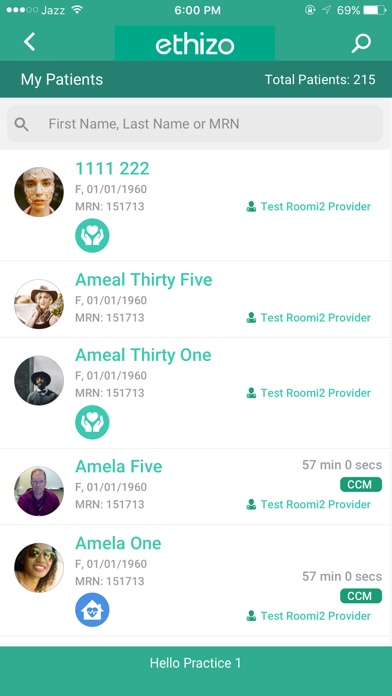
The mobile provider app extends that idea. Its published description includes care plans, interventions, patient goals, trackers, electronic prescriptions, and communication with patients, caregivers, and other doctors. Vezo, the telemedicine product, adds virtual waiting rooms and participation by other team members. Chronic care management tools cover enrollment, care plans, recorded activity, and billing. Each feature reaches beyond the moment when a physician types a note.
A roster.
A clock.
A next step.
6,732 requests. And a revealing zero.
One of the most informative documents about ethizo is its 2025 real-world testing report. Across eight participating sites, its standardized API processed 6,732 requests, with 63 failures and a reported 99.1% success rate. Failures were mainly associated with invalid query parameters and expired authentication tokens. These are scoped interoperability results, rather than a measurement of everything the platform does.
2025 developer testing · eight sites · four specialties
Two other certified API capabilities recorded zero production requests. The report attributes that to absent customer demand and a lack of deployed third-party applications. Structured testing with test records validated the functionality. Here is the distinction a feature checklist tends to obscure: technical readiness and routine use are separate achievements. The connection can exist while the habit of using it has yet to form.
Trust has to be earned in the workflow
Co-founder and CIO Richard Hussain describes a related problem in an interview about his technology work. Ethizo’s AI listens to clinical conversations and assists with documentation. His account of the early obstacle centers on trust: people were skeptical about letting software interpret consequential conversations. He describes responding with validation steps, human oversight, and feedback, keeping the clinician responsible for decisions.
“Open your mind and think big.”
Richard Hussain · co-founder and CIO
Hussain says the experience changed his view of AI’s place in product design. His most transferable point is the attention paid to review. An automatically generated note still needs to be accurate, legible, and useful to the next person. The value of drafting it quickly depends on what happens when someone checks it.
Public App Store reviews supply a less tidy perspective. One reviewer praises integrated calling, fax, and scheduling; others describe problems with imports, dictation, formatting, or support. These are individual accounts, not a representative survey. They nevertheless identify sensible things to test during a demonstration: can a clinician finish a note reliably, and can staff resolve trouble when the workflow stalls?
Count the handoffs before the features
DocToMe reported $5 million sold in an equity offering filed in September 2025. The product’s commercial case, however, comes down to small operational questions. Can the right document reach the right chart? Can a claim move forward without another round of retyping? Can the team see what needs doing next?
A buyer can copy that method of inquiry. Take one appointment through eligibility, documentation, follow-up, and payment. Count every repeated entry and every moment a staff member must switch systems. Test the specific facility connections the practice depends on. An integrated platform earns its place when those handoffs improve. Where interfaces do not fit, staff cannot adopt the workflow, or review takes longer than the work saved, the promised convenience becomes another task.