At ID Labs, the laboratory work was only part of the job. According to MedCare MSO’s account of the engagement, provider enrollment records were wrong or missing, claims were being denied, and paper checks were going astray. The lab could deliver a service and still have trouble collecting the money. Somewhere between the test and the bank deposit, the administrative machinery had slipped.
- MedCare MSO runs billing and collections for US healthcare providers.
- Practices can buy the service, use its software, or target an old-claims backlog.
- Its case studies make a practical argument: fix the handoffs before chasing more volume.
MedCare says it corrected the lab’s payer records, pursued enrollment applications, repaired electronic claim setup and arranged electronic payments. Its published case reports $347,050 recovered from UnitedHealthcare. That is a company-reported result from one engagement. But the mechanism is wonderfully concrete: make the provider recognizable to the payer, make the claim deliverable, make the payment traceable.
The bill has a journey of its own
MedCare MSO occupies the business side of healthcare. Its customers include physician practices, laboratories, imaging centers and hospitals. The work extends from checking insurance eligibility and coding services to submitting claims, posting payments, appealing denials and pursuing overdue accounts. A patient leaves the building; the financial work continues.
The company dates its operations to 2012. Founder and CEO Salman Ali Maqsood leads a business whose offer now spans both staff and software. That combination matters. A practice may need people to work a queue, a tool to expose the queue, or someone to discover why the queue keeps growing. Those are related purchases, with different demands on the buyer.
- 01VerifyCoverage + enrollment
- 02DocumentEncounter + codes
- 03SubmitClaim + payer edits
- 04ResolvePayment + follow-up
Here is the useful distinction in MedCare’s pitch: it says it can operate inside a practice’s existing systems. Buying its billing service does not automatically require moving every clinical record. Alternatively, a customer can adopt the company’s own tools. The choice lets a practice address a staffing problem without necessarily turning it into a software migration.
That flexibility also makes comparison shopping more demanding. A software subscription, a team of billers and a focused recovery assignment solve different parts of the problem. A practice should compare the work included in each offer, alongside the price, and decide which responsibilities its own staff will retain.
The missing appointment problem
Consider another company-published case, ODAT Services. MedCare describes missing claims, authorization errors and completed appointments that had never been billed. The initial failure was basic reconciliation: encounters and claims were not reliably matched. More appointments would have fed the same broken process.
The response included manual reconciliation of eight months of claims, corrections and payer follow-up. MedCare then established weekly checks linking appointments, authorizations and billed services. The habit is easy to borrow: give each completed encounter a visible billing status, then investigate the exceptions every week. Software helps maintain that discipline; someone still has to own it.
“Regular updates and good communication were very appreciated.”Bret, Co-Owner at PCP · company-published testimonial
Four names, one financial thread
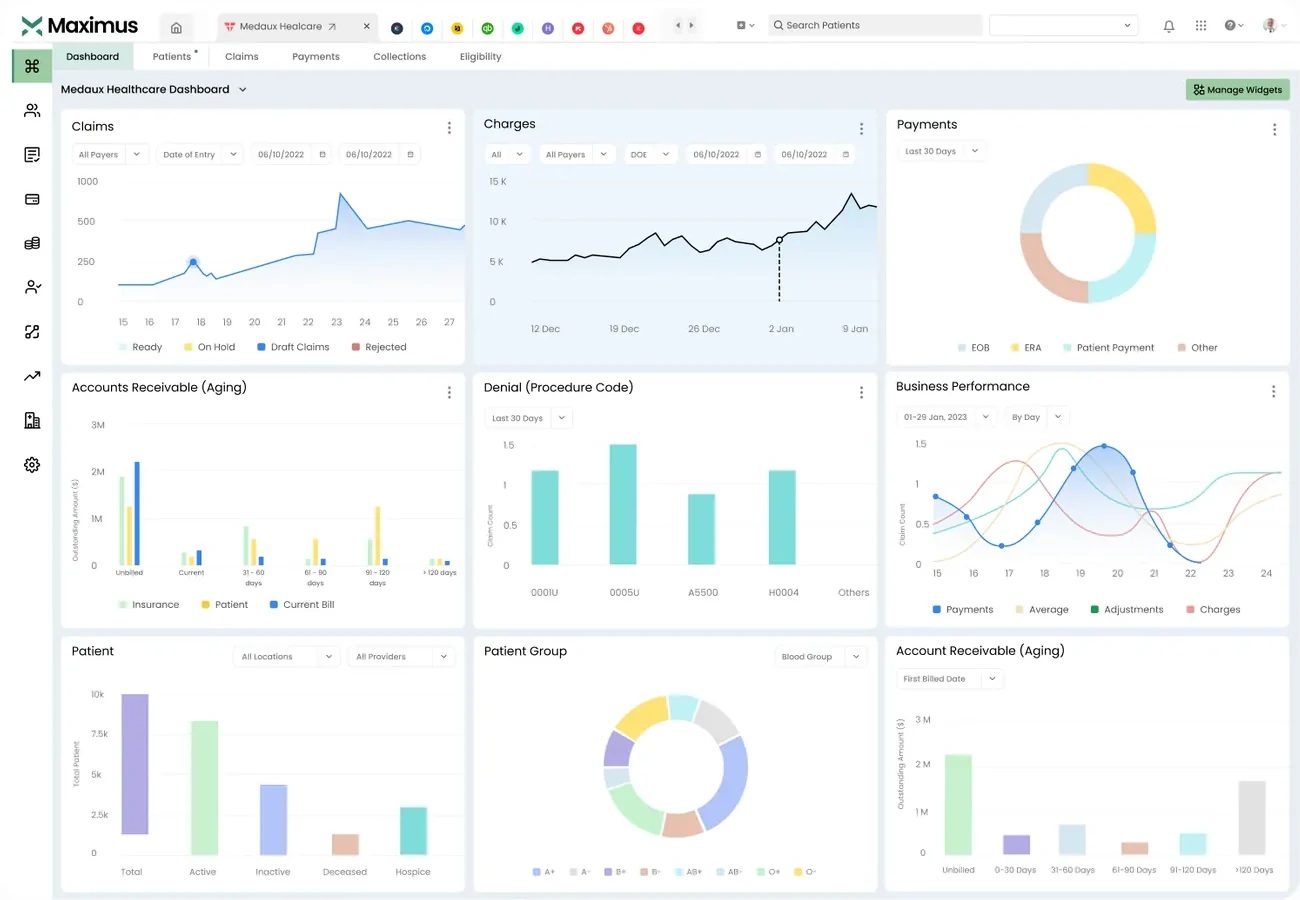
Maximus is the practice management and billing platform. MedCare describes pre-submission claim checks, electronic payment posting, denial workflows and financial reporting. These features address the repetitive movement of information: checking coverage, transmitting the claim, matching the remittance and flagging a stalled balance. The dashboard is useful only if it leads to the next action.
HealUs supplies the electronic health record: charting, scheduling, laboratory information, e-prescribing and a patient portal, with billing connected to the clinical workflow. It brings the revenue question closer to the encounter that created it. The same visit should not require staff to reconstruct its meaning in several disconnected places.
Salus, the AI scribe, works earlier in the sequence. It generates structured encounter notes and suggests codes for review. Its published plans begin at $99 per provider per month for 200 notes; higher tiers add capacity and features. The clinician reviews and signs. A draft becomes useful when it accurately represents the visit.
Sophus addresses coding. In a laboratory case covering more than 50,000 claims over three months, MedCare reports average coding time falling from 150 seconds to 32 seconds, with 95% average accuracy. The rollout proceeded in stages, with experienced coders moving toward auditing and review. Speed was paired with a continuing quality-control role.
Less time per claim.
The price is tied to the collection
For outsourced billing, MedCare describes a negotiated percentage of net collections. The fee depends on specialty, volume and service scope. Its service page presents 3-7% as a typical outsourced-billing range, rather than a universal MedCare quote. Buyers need the actual agreement: what counts as collections, which tasks are covered, and how old balances are charged.
MedCare also offers old-account recovery separately. A practice can ask for help with overdue claims without outsourcing everything. The recovery team evaluates collectability, prioritizes deadlines, corrects claims and follows up with payers. Some claims expire or lack the documentation needed for payment. Faster processing cannot erase those conditions.
Start with the exception list
MedCare sits where healthcare software and outsourced revenue operations overlap. The alternatives include an internal billing team and integrated vendors such as eClinicalWorks. Its case for being hired rests on taking responsibility across several connected tasks, with the option to supply the underlying tools.
For a buyer, the sensible starting point is a sample of real work: missed encounters, denied claims, aging balances and the steps staff repeat by hand. Ask how each would move through the proposed service. The lesson of the lab case travels well beyond medicine. Before adding volume, find out whether the work already completed can make it all the way to payment.