A patient visit can end long before the work attached to it does. The clinician finishes an examination. A note needs signing. A code needs checking. A claim must reach an insurer. Somewhere along that route, a practice can lose time, money, or both. Saisystems Health has built its business around keeping those steps connected.
- For: physician groups caring for patients in nursing facilities and other post-acute settings.
- The offer: PacEHR clinical software, billing services, enrollment, charge capture, and analytics.
- The buying question: can one connected workflow reduce the work between a visit and payment?
That last question matters because the customer is easy to misunderstand. Saisystems concentrates on the practitioners and physician groups working in post-acute and long-term care. Their work crosses facilities, patient records, and reimbursement requirements. The company serves groups nationwide. Its organizing idea is that the clinical record and the practice’s finances should move together.
The claim begins before the claim
Consider payer enrollment. Before a practice can reliably collect, its providers need the appropriate registrations and renewals. Saisystems handles CAQH profiles, Medicare enrollment and revalidation through PECOS, and commercial payer enrollment. It also arranges electronic funds transfers. These are small administrative nouns with considerable power over a practice’s cash flow.
The company’s offering therefore reaches upstream of medical billing. A practice can buy help with the conditions that make billing possible, then with the documentation and collections that follow. Its stated goal is to prevent payment interruptions. The useful insight is architectural: a problem that appears in accounts receivable may have begun several steps earlier.
- 01EnrollProvider and payer
- 02DocumentVisit and clinical note
- 03CaptureCodes and charges
- 04CollectClaims and follow-up
The patient list gives it away
PacEHR, introduced in March 2021, makes the specialization tangible. Its patient census can be sorted by facility. A practitioner can move between patients without returning to the main window. There are encounter templates, customized macros, voice-to-text options, and information carried forward from previous encounters. These features address repeated movements inside an ordinary working day.
The product also includes documentation and reporting for quality measures and chronic care management. Current company materials describe real-time ICD and CPT coding assistance. Coding suggestions are part of the workflow; they do not, by themselves, establish that a claim is correct or payable. For a buyer, the revealing demonstration would use the practice’s actual encounter types and review process.
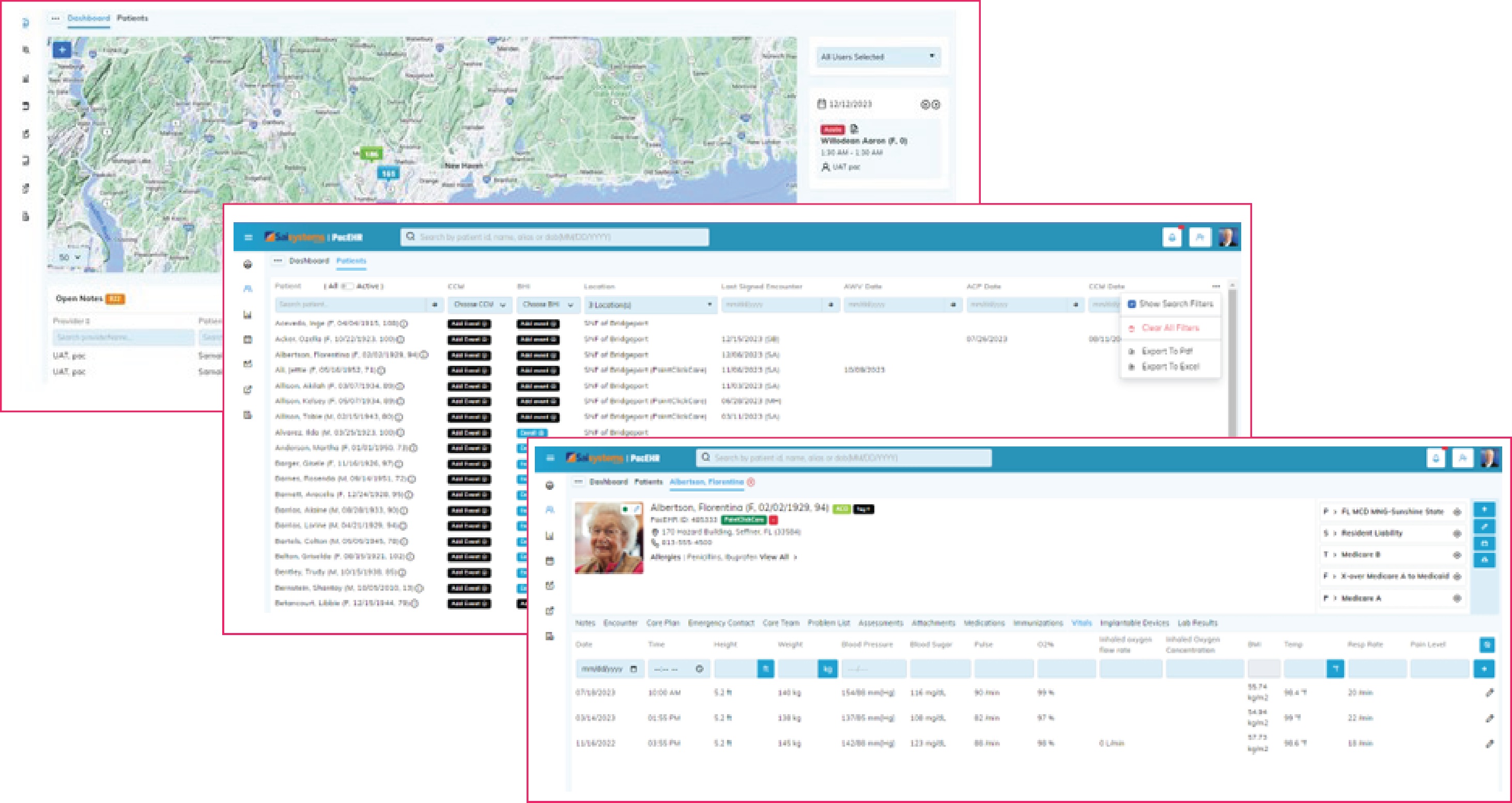
An unsigned encounter filter is another telling detail. It connects a seemingly clerical task with the timing of billing. So does billEHR, the company’s mobile charge-capture application, which provides code search, capture-error checks, and web access for office staff. The physician’s screen and the billing office’s queue are different views of connected work.
The software comes with people
Saisystems sells a combination of software and managed services. Revenue cycle management includes billing and coding expertise, reporting, and collections support. Practices receive designated relationship and account management. Its navigatEHR business intelligence tool supports the work of examining financial trends. Customers can bundle the RCM service with PacEHR, giving the company responsibility across more of the operating chain.
Connections remain necessary. A 2021 NetDirector partnership addressed cloud integration across TheSNFist suite, the umbrella for Saisystems’ products and services. Official materials describe a PointClickCare connection, while the price list also includes MatrixCare integration. Facility systems remain part of the picture. The differentiation is the combination of practitioner-specific software and back-office work around it.
A separate partnership with Opus EHR extends billing and analytics into behavioral health and substance-use treatment centers. That relationship is a useful reminder that the company’s billing expertise can travel beyond its core nursing-facility setting. The clinical workflows still need to fit the customer.
There is a separate trust question. The developer’s disclosure records ONC certification for PacEHR v20.22.11.01 on December 29, 2022. In August 2025, the company announced a SOC 2 Type 2 controls milestone. These address different concerns: specified health IT capabilities and the operation of internal controls over time. A practice still needs to evaluate its own requirements and the configuration it is purchasing.
Price the whole trip
The public PacEHR market list puts contracted licenses at $350 monthly. Speech-to-text is listed separately at $85 per provider per month; prescribing is $60 per provider per month. PointClickCare integration has a monthly facility option and a per-encounter option. There are also transaction-based AI options and separately priced integration work. The configured service determines the bill.
The published statement of work describes a three-year initial term, subsequent two-year renewals, and a 90-day termination-notice window. Migration, additional training, and custom work deserve attention alongside subscription fees. A practice needing only a lightweight record system may find the broader arrangement excessive. A group comparing outsourced billing with an in-house team needs to compare responsibilities as carefully as prices.
From mail-order PCs to a narrower problem
The originating Saisystems business began in 1987 as a mail-order computer operation and hardware testing laboratory. Ramesh and Sunita Wadhwani founded it; their son Manoj later joined the company. Its documented progression runs through technology consulting, the addition of revenue-cycle services in 2009, and a healthcare-services commitment in 2014. The Health identity arrived with a 2017 rebranding.
That chronology helps explain the product. Billing expertise preceded PacEHR. The company came to the clinical record with an existing interest in what happens after an encounter. Its parent organization also describes a culture built around dharma, doing the right thing, and seva, service. The operating proposition is equally practical: provide some of the back-office capability a practice would otherwise assemble itself.
New capital, familiar work
In March 2026, Saisystems announced investment from Serent Capital. Deal adviser Capstone describes a majority recapitalization that closed in December 2025. The stated priorities include AI automation, product development, and commercial expansion. President and CEO Manoj Wadhwani described the goal as simplifying post-acute care:
“so physicians can focus on patients, not paperwork”Manoj Wadhwani · March 2026
The lesson a reader can copy is to follow one encounter from enrollment through collection. Count the transfers, repeated entries, and unresolved ownership questions. Then ask a vendor to demonstrate that exact journey. Saisystems Health’s proposition becomes easier to judge at that scale: one patient, one signed note, one claim that reaches its destination.