Talal Bayaa’s company once gave away software that customers liked enough to pay for. The awkward part was noticing. Years after Bayzat began, the decision to charge for that software would help change the business again. By then, changing the business had become a recurring item on the founder’s agenda.
There is a pleasing mismatch between his education and his eventual occupation. Bayaa studied bioengineering. He worked in finance. He became the chief executive of a company concerned with the daily machinery of employment. His route suggests that a degree can provide a starting point without furnishing the whole itinerary.
To understand him, begin before the funding rounds and the workplace platform. Begin with a young graduate returning to the Gulf, a school friend and a question that banking customers kept asking. Bayzat would grow by following that question into other questions. Each answer gave the company another job.
A graduate arrives at the wrong moment
Bayaa was born in California and moved to the Gulf with his family at six. Childhood meant moving between countries. University took him back to California in 2004, where he studied bioengineering at the University of California, Los Angeles. He graduated in 2008.
His recollection of entering finance has a date attached to it: September 2008, shortly before Lehman Brothers collapsed. A first job usually introduces a graduate to the habits of an industry. This one arrived as those habits were being subjected to a rather public examination.
He went on to work in private equity and corporate finance as well as investment banking. He also became a CFA charterholder. The eventual technology founder had spent time on the other side of the spreadsheet, learning the vocabulary of investment before asking investors to back his own company.
The geographical pattern mattered too. California and the Gulf were both familiar territory. When he encountered online financial comparison services in the United States, he had a reference point for something he felt the UAE market lacked.
A small question about a crowded market
The questions came from clients who wanted help choosing banking products. Searching online was the obvious first move. Bayaa found that comparing similar offers was harder than it ought to be. In a market with many banks, choice could create work for the person doing the choosing.
The original proposition was straightforward: bring the options together and make financial decisions easier. Credit cards, deposits and loans could be compared in one place. It was a practical ambition, with the appeal of a well-organised shelf in a shop that had previously stored everything in separate rooms.
The name fitted. Bayzat means cash or change in Emirati Arabic. When the English-language platform launched in April 2013, the company’s identity was tied to helping people navigate financial products. The workplace business familiar to later customers was still ahead.
An early company can look deceptively definite from the outside. It has a name, a website and an explanation. Inside, it is still learning which of those things will remain useful.
The school friend and the family connection
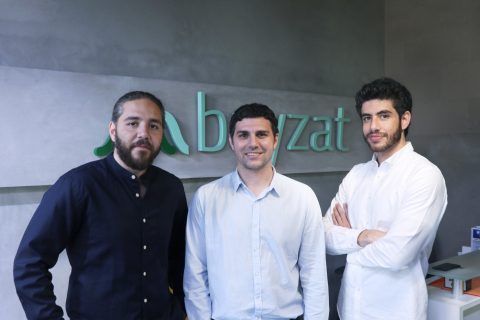
Bayaa began developing the idea with Brian Habibi, a friend from school. They were working on it by 2011. An account from early 2014 puts their own funding at $200,000 over two years. Bayaa continued working in private equity while the platform took shape.
This gives the launch a less theatrical beginning than the customary leap from employment into entrepreneurship. There was a period of overlap: paid work, development work and money committed before the public product arrived. The company acquired a team and ran a pilot with five banks.
His father had already built a finance advisory business in Dubai. Bayaa had seen the demands of running a company close at hand. The family connection later became part of Bayzat’s working structure too.
His brother Tarek advised the company from 2013 and joined full-time as chief commercial officer in April 2015. Tarek’s responsibilities included building the sales team and customer service. A school friendship and a sibling relationship had become business relationships, with the less sentimental requirements of roles, customers and results.
- 2011Development begins
- 2013Comparison platform launches
- 2017HR administration expands the remit
- 2022$25m Series C announced
The paperwork keeps answering back
By 2017, Bayaa was describing a company whose work had spread into employee administration. Records, holidays and payroll were being handled manually in many businesses. The original customer problem had opened a door into the office behind it.
His explanation was that solving one problem exposed others. The company kept working through them. That account has an appealing lack of tidiness. A finished business description can conceal how much discovery was required to reach it.
He also acknowledged that timing and luck had helped. This is useful candour from a founder. A business can make good decisions and benefit from circumstances it did not create. Giving chance its due leaves room to examine the decisions more closely.
Bayaa said his motivation centred on solving problems. The resulting work was often ordinary administration: information that needed updating, requests that needed processing, payments that needed preparing. Such tasks have little glamour. They do, however, have the reliable habit of returning tomorrow.
Free has a cost
In 2018, Bayzat’s proposition included an HR platform offered at no cost. Employees could use an app for payslips and leave requests; companies could manage records and payroll. Revenue came from transactions elsewhere in the offering. Bayaa described a business serving around 800 clients and 19,000 employees at that time.
The target customer helps explain the approach. Smaller firms, including those with 20 to 100 staff, could struggle to budget for dedicated HR software. Offering the platform without a software fee reduced one obvious obstacle to adoption.
It also made pricing a question the company would eventually have to revisit. A product can become useful before its maker has settled how that usefulness should support the business. Free is a price with consequences, even when the invoice is pleasantly brief.
Looking back in August 2026, Bayaa discussed severe cash constraints and identified charging for previously free software as a consequential change. Customers had been telling Bayzat they valued it. The business had to put that value into its commercial model.
The founder moves out of the centre
In a leadership essay published in 2020, Bayaa examined another assumption worth revisiting: how much control should stay with executives. He described cross-functional teams, called tribes, whose members did not include top management. Executives would debate, coach and support their work.
His argument about ownership was especially specific. An employee share plan offered financial ownership. Meaningful ownership also involved having a say in the company’s present and future, and understanding how an individual’s role contributed.
That asks more of a leader than issuing an enthusiastic memo. Participation has to affect something. Otherwise the invitation to contribute becomes another document for employees to read before returning to decisions made elsewhere.
Bayaa wrote about the discomfort of letting go. The connection with the product story is striking: both involve allowing information from other people to alter an existing answer. Customers can change the roadmap. Employees can change how work gets done. The chief executive must leave room for both.
“Leadership requires openness to change.”
Talal Bayaa
The unglamorous details of expansion
Bayzat announced a $25 million Series C round in December 2022. The company reported serving more than 127,000 employees across over 1,500 GCC businesses, and named Saudi Arabia as an expansion priority. These are dated milestones in the company’s development, rather than a substitute for the story of how it worked.
Bayaa’s emphasis on local requirements gives the expansion a practical character. Workplace software has to handle the rules and routines of the place in which it operates. A payroll screen can look reassuringly familiar while the payment process behind it differs.
Bayzat’s reported integration with the UAE’s Wage Protection System illustrates the point. Through a partner, the company connected payroll to the payment process, reducing the steps customers had to take. The administrative detail is the product.
In an interview published in 2025, Bayaa also discussed finance features and broader international use. He described reversing decisions as his thinking changed. Expansion, in that account, requires continued revision rather than the faithful enlargement of an original sketch.
Bayzat’s announced Series C round, with Saudi expansion among the stated priorities.
A rejection should leave you with a question
Bayaa’s advice to founders in 2017 was practical enough to survive changes in startup fashion. Understand the problem in detail. Expect investors to say no. Ask questions when they do, and use the answers to improve the pitch.
He also advised founders to be themselves and seek partners with compatible values. Fundraising, in this view, includes finding out whether the people involved can work together. Telling an investor only what they want to hear postpones that discovery.
Those principles sit comfortably beside a career built through revisions. Learning from rejection requires some willingness to hear an unwelcome answer. Finding compatible partners requires candour about what you intend to build and how you intend to behave.
The later responsibilities are different. By 2026, Bayaa was openly discussing the obligation to provide eventual liquidity for shareholders. Investors’ money carries a future claim on the founder’s attention. The funding announcement is one moment; meeting the obligations attached to it takes longer.
The next answer is still being built
There are other sides to the person running the payroll company. His official biography lists travel and time outdoors among his interests. His background combines an engineering education with finance credentials. His closest business connections include people who knew him before Bayzat had customers.
That makes his story less a procession of titles than an extended education in choosing what to do next. The school friend stayed in the picture. The brother joined the business. The comparison website acquired responsibilities its first version had never carried.
Bayaa’s willingness to revise an answer provides the thread. A founder has to commit enough to build something, then remain receptive enough to change it. Bayzat’s history gives that tension concrete form: the idea, the team, the records, the payslip and, eventually, the bill.