Osama AbouElkhir’s daughters once gave him a Father’s Day present that made the usual executive uniform considerably more appealing: a cookie shaped like a shirt, complete with a tie. He shared it on LinkedIn in June 2022, enjoying the edible neckwear and asking other people what they had received. Here was the co-founder and CEO of TachyHealth, briefly occupied with a very small, very successful product launch.
The detail is pleasing because so much of a founder’s public life comes dressed for work. There are investment announcements, conference invitations and company milestones. A shirt cookie slips past the business vocabulary. It gives us a father amused by his daughters, happy to let the joke stand without attaching a leadership lesson. Sometimes a tie is simply better when you can eat it.
AbouElkhir’s larger professional story involves a company founded in 2018, a seven-figure seed round announced in 2021 and a $5 million Series A reported in October 2025. Between those milestones are smaller public gestures: an invitation to visit a booth, a thank-you to an investor, a message to colleagues at the end of a year. Those gestures make a useful way into his career. They show who he chooses to acknowledge as the business grows.
The work before the founding date
Based in Dubai, AbouElkhir came to entrepreneurship through management and consulting. His career includes EY, where he worked from 2013 to 2015, followed by a management director role at Smart Yotta from 2015 to 2017. He also worked with GLG and IQVIA before taking the chief executive role at TachyHealth in November 2018. The sequence places the startup after several years of professional experience.
His education includes an entrepreneurship specialization through the Wharton School and a deep learning specialization through DeepLearning.AI. Wharton appears on his public profile with 2017 dates. These are specializations, a useful distinction when describing a founder’s education. Together, they put business formation and artificial intelligence on the same résumé, shortly before TachyHealth’s founding year.
The company’s own description of his responsibilities follows that progression: overseeing its development from inception toward scale. That is a broad assignment, stretching from the first version of an organization to the problem of making it larger. It also explains why a profile of AbouElkhir needs more than a funding number. His job encompasses the company that must operate between announcements, when the celebratory photograph has been taken and everyone returns to work.
Colleagues have supplied another view of the earlier career. In a public recommendation, Amel Farrag described him as organized, creative and effective in a team, with an ability to analyze data and find solutions. Mohammed Magdy Hosni’s recommendation emphasized his cheerfulness, support for colleagues and contribution to teamwork. These are colleagues’ assessments, and they give the professional chronology a human dimension. Alongside titles and dates, they record how people who worked with him chose to describe the experience. The recurring attention to teamwork fits comfortably beside his later public thanks to employees and partners, without turning a recommendation into a personality test.
TachyHealth’s founding year.
A seven-figure round is announced.
Tawuniya leads the round.
A business with several addresses
TachyHealth began in the United States. By its November 2021 seed announcement, it had a presence in the US, the United Arab Emirates, Saudi Arabia and Egypt. The same announcement described a team of 40, including engineers and developers. Those are historical markers: a picture of the business at that point in its life, three years after it was founded.
The seed round brought together Propeller, Oman Technology Fund’s Wadi fund, Jordinvest and a Saudi investor. Its announced purpose included further technology development and growth across the Middle East and North Africa. The geography matters to the founder’s story. AbouElkhir was based in Dubai while building a company whose incorporation and operating presence already crossed national borders.
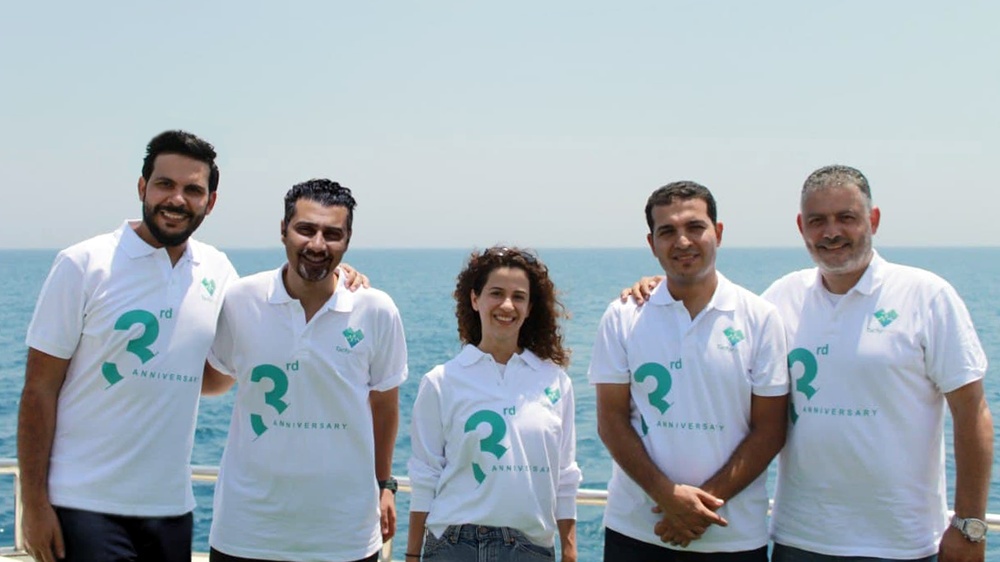
The photograph accompanying that announcement offers a lighter record of the same moment. Five people stand beside the sea wearing white polo shirts marked with the company’s third anniversary. Arms rest on shoulders. It is a company birthday rendered in the universal language of matching clothes. The image belongs in the story because a funding round has people on the other side of the number.
Directions to the booth
In October 2022, AbouElkhir invited people visiting GITEX in Dubai to find TachyHealth at Za’abeel Hall 6, Area D. He thanked Oman Technology Fund for its support that year. The message was practical as well as enthusiastic: it supplied an actual destination. Anyone wanting to turn an online connection into a conversation had somewhere to go.
The replies had their own familiar register. Jamil Hussain wished him luck. Joe Hawayek said it was good to see him. Mohammad Khadra, TachyHealth’s technology executive, complimented his appearance. A public company invitation had become a small exchange among people who recognized the person posting it. The comment about looking sharp was especially appropriate for a founder whose other memorable shirt that year had been made of cookie.
Read alongside the seed announcement, the thank-you to Oman Technology Fund is a modest but specific sign of continuity. The fund had appeared among the investors in 2021; a year later, AbouElkhir was acknowledging its support at an event. There is no need to turn that into a grand theory of loyalty. The sequence itself is interesting: an investor’s name reappears in the everyday public life of the company.
The names inside the thank-you
As 2022 gave way to 2023, AbouElkhir posted a reflection on the startup’s journey. He described starting with an idea, encountering challenges and achievements, and feeling grateful for what the company had learned. He directed his thanks toward the team, clients, partners and others who had supported it. The emphasis was collective, even though the message came from the chief executive’s account.
A year-end message is a small genre with a large temptation: every business can sound as though it has personally invented January. AbouElkhir’s contribution is more revealing in its list of recipients than in its seasonal optimism. Employees, customers and partners all get space. His recollection of starting out also leaves room for the unpredictability of the journey. The company’s later milestones had yet to happen.
This is one reason to keep his story in sequence. The third-anniversary picture, the booth invitation and the year-end thanks come before the later Series A. Reading them in that order preserves the scale of each moment. A company can celebrate a birthday, arrange a meeting and acknowledge a difficult year without knowing exactly what its next funding announcement will say.
A seat in Riyadh
In February 2025, his invitation at LEAP was again straightforward: he was looking forward to seeing people and wanted to meet anyone nearby. By May, his public calendar included the Saudi-US Investment Forum in Riyadh. Ahead of the May 13 event, he said he would represent TachyHealth and looked forward to connecting with participants from both countries.
Afterward, he described watching Jensen Huang of NVIDIA and Tareq Amin of HUMAIN announce their alliance. His post dwelt on the proposed computing infrastructure, including a 500-megawatt deployment and 18,000 GPUs. He also noted TachyHealth’s participation in NVIDIA’s AI program. Here the founder was recording a development in the wider technology environment, as an attendee with a company of his own to build.
The size of the announcement drew his attention, but the personal continuity lies in attending and sharing what he had seen. The same account that provided directions to a Dubai booth now described a Riyadh investment forum. The settings differ considerably. In both, he made his participation public and treated the gathering as a place to encounter other people and their work.
Letting people take a closer look
The $5 million Series A in 2025 put another number beside TachyHealth’s name. Tawuniya led the round. AbouElkhir’s account of fundraising emphasized access: prospective investors were given a closer look at the company and opportunities to see its technology through pilots. He also described approaching people who already knew the founders before the seed round.
“That warm meeting beats cold emails every time.”
Osama AbouElkhir, on early fundraising
His advice is easy to recognize in the invitations and acknowledgments scattered through his public posts. An existing relationship can make a meeting possible; a demonstration then gives the discussion something concrete. In his telling, strategic partners also contribute introductions and knowledge of local markets. The money sits within a relationship that continues after the transaction.
The most engaging portrait of AbouElkhir therefore keeps the numbers and the small exchanges together. He leads TachyHealth from Dubai. He has worked in consulting and management, studied entrepreneurship and deep learning, and helped build a business operating across several countries. He has also told people where to find his booth, thanked those who supported the company and shared his daughters’ joke. A founder’s public story can accommodate a funding round and an edible tie. His does.