Ahmed Mahmoud remembers selling assets to keep DXwand going. Customers were losing revenue or stopping operations. The company had little funding to absorb the damage. Some colleagues accepted partial salaries; others worked without pay. In his telling, survival was a collective undertaking, with people choosing to stay when a spreadsheet would have given them plenty of reasons to leave.
It is a sobering opening for a business built around conversation. Before a machine could help a company understand its customers, Mahmoud needed his own team to believe there would still be a company. The polished funding announcements came later. This part of the story belongs to the employees who kept working through uncertainty, and to a founder whose decisions had become expensive in a very personal way.
Today, Mahmoud is DXwand’s co-founder and chief executive, based in Dubai. His company develops conversational and generative AI for businesses across the Middle East and North Africa. Its original problem sounds modest beside the sweeping promises of artificial intelligence: people should be able to speak naturally and be understood. That modest requirement has been quite enough to build a career around.
The customer had an accent. The software had a problem.
Mahmoud’s route into entrepreneurship passed through software engineering, Vodafone and Microsoft. He studied computer engineering at Ain Shams University, graduating in 2003. Large organisations gave him experience of digital transformation and the practical negotiation involved in introducing technology. A working system needs technical competence, certainly. It also needs people in different departments to agree that using it is worth the trouble.
At Microsoft, he noticed a recurring mismatch between the AI being offered and the customers expected to use it. Tools developed elsewhere struggled with spoken Arabic and regional dialects. The customer could be expressing an entirely ordinary request. The software still had difficulty recognising it. For a business promising convenient service, asking people to adjust their language to suit a machine is an awkward sort of convenience.
The opening interested him because it was specific. There were customers, conversations and a problem that could be tested. He joined the Lean Startup Program, where DXwand received a grant at demo day. The company dates its founding to 2018; Mahmoud has also described starting the work in 2017. The first client arrived in 2019. He then left Microsoft to work on the business full time.
That sequence gives the departure its character. He had spent years seeing how organisations bought and used technology. Now he would have to persuade them to buy his. A familiar problem had become his responsibility, including the less glamorous questions of pricing, implementation and whether a customer would come back.
- 2018DXwand founded
- 2019First client; leaves Microsoft
- 2024$4m Series A
A payroll is a rather severe editor
DXwand initially worked on chatbots for small businesses, handling sales and delivery conversations. Mahmoud has described investors in 2019 struggling to evaluate a company operating in deep technology. Early angel backing helped, but sales had to carry much of the load. The business could not spend indefinitely waiting for the market to appreciate its technical ambition.
Then came the period when customers’ operations contracted and cash became scarce. Looking back, Mahmoud described the team continuing with reduced or absent salaries and the sale of assets. Those details deserve more space than the usual sentence about perseverance. Unpaid work has consequences outside an office. It asks something of people whose names rarely appear in the photograph accompanying a financing round.
His account credits those colleagues. That matters because a founder’s story can easily gather everyone else’s labour into one person’s reputation. Here, the decision to continue depended on a group. Their willingness bought the business time. Time offered another chance to find customers, revise the product and make the arithmetic work.
The company’s direction changed. By 2021, DXwand was moving toward enterprise use and helping organisations make their own information usable in conversations. The original language problem remained. The commercial problem grew wider: a system needed to understand a request and reach the relevant knowledge inside a business. Fluency alone would leave plenty of customers waiting.
“We sold every asset that we own.”Ahmed Mahmoud, recalling DXwand’s early financial strain
The answer is somewhere in the paperwork
A company may possess manuals, contracts, policies and years of internal guidance while still making a simple answer difficult to obtain. Mahmoud’s work moved into that gap. DXwand’s tools are designed to connect conversations with organisational information, so that employees and customers can retrieve useful answers through the channels they already use.
The phrase knowledge mining is less picturesque than a talking robot. It is also closer to the everyday difficulty. Information exists, but someone has to find it, interpret it and apply it to the question at hand. A business can have plenty of documents and surprisingly little accessible knowledge. The filing cabinet has enjoyed a long career as a place where answers go to become unavailable.
DXwand’s January 2024 financing announcement described software serving customers, employees and government users through text and voice. It also described applications for technical crews needing access to institutional knowledge. The ambition reaches beyond replying politely. A useful answer has to fit the task, the organisation’s information and the person asking.
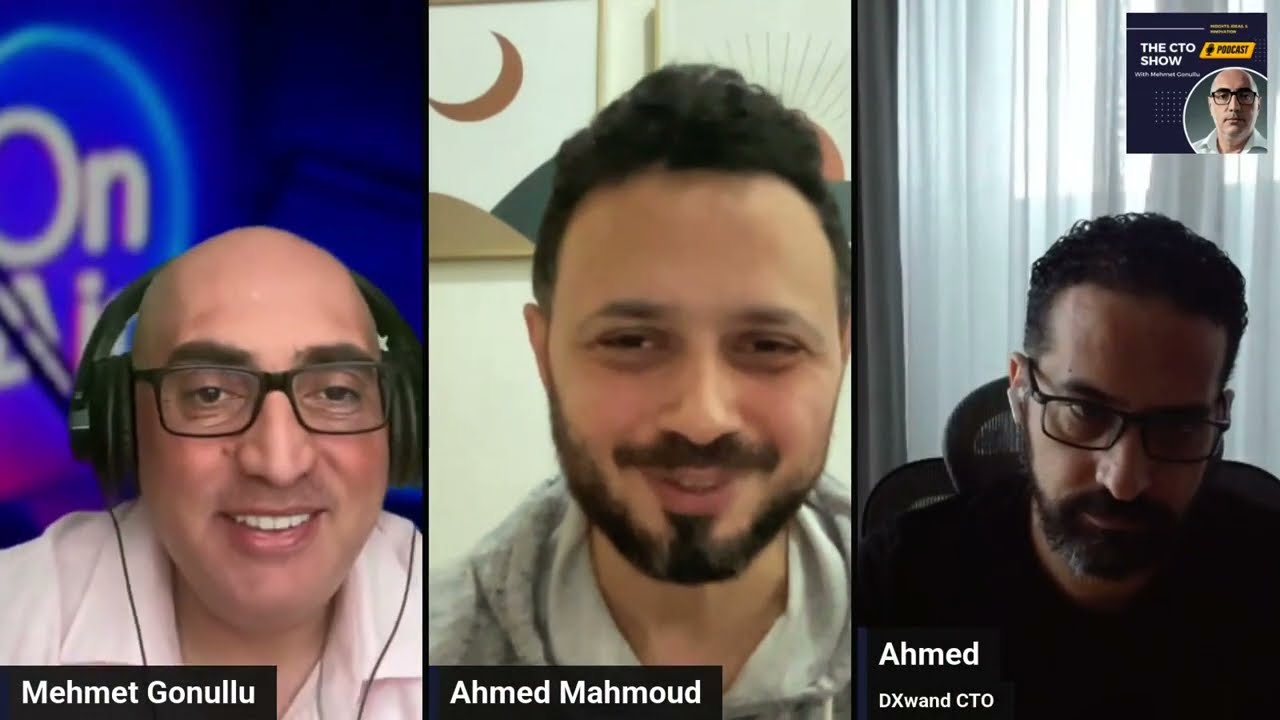
In a joint conversation with CTO Ahmed Elshahawy, Mahmoud discussed document intelligence, multilingual requirements and the challenges of introducing generative AI into enterprises. Their discussion included hallucinations, security and privacy. These subjects belong in the product conversation because a confident answer can still be wrong. An organisation must decide where the information comes from and what the system is permitted to do with it.
This is where his experience with large clients becomes relevant again. Technology enters an existing workplace, with existing duties and constraints. A customer may admire a demonstration and still decline to deploy it. The distance between those two reactions is full of work for an operator.
The investor who came back
In January 2024, DXwand announced a $4 million Series A led by Shorooq Partners and Algebra Ventures, with Dubai Future District Fund participating again. The stated uses included regional expansion and further development of generative AI and retrieval augmented generation. The latter connects a model’s response to retrieved information, a practical concern for a business answering questions about its own rules.
Mahmoud’s public celebration contained a smaller, more revealing detail. Tamer Azer had been the first investor he pitched roughly five years earlier. That pitch had failed to produce an investment. Now Azer was involved in the new round at Shorooq. A rejection had become the beginning of a relationship whose next chapter took years to arrive.
It would be convenient to treat this as proof that every refusal eventually turns into a cheque. Mahmoud’s experience supports a narrower observation: the business and the relationship had time to develop. When he thanked the people involved, he also thanked his team. The announcement marked a financing milestone, but his account kept returning to the people who had made the milestone possible.
Expansion brought another form of proximity. In 2024, he outlined plans for a Riyadh office and work with local partners, including AstroLabs. His approach emphasised people who understood the country’s business conditions and customers. A company founded to address local language could hardly ignore local knowledge when entering another market. Geography brings its own vocabulary.
Led by Shorooq Partners and Algebra Ventures, with continued participation from Dubai Future District Fund.
Small models, smaller businesses, larger questions
In February 2025, DXwand announced Prism v1.0 at Web Summit Qatar. The small language model came in one-billion- and three-billion-parameter versions, fine-tuned from LLaMA 3.2 for Arabic and English. Its design focused on business questions and lower computing requirements. Those choices made cost and deployment part of the product story, alongside language.
Mahmoud also returned to small businesses through Merlinx, described as an AI sales and customer-success agent. It is an interesting turn in a company that began with smaller customers and later concentrated on enterprises. The return asks whether experience gained serving large organisations can be made affordable and manageable for companies with fewer resources.
By July 2025, he was describing substantial willingness among Egyptian SMEs to try agentic AI as costs fell. He also recounted a deployment at Kuwait’s education ministry that users adopted without the introductory support he had expected. Teachers could work with curriculum-based material; students could practise and explore subjects. His surprise concerned the speed with which people put the system to use.
That is a useful measure of the distance travelled from an early market that needed convincing. The founder who once had to explain why the technology mattered was watching users find reasons of their own. It does not settle every question about AI adoption. It does suggest that familiarity and accessible pricing can change the conversation.
in everyday language
from the organisation
suited to the task
The people who make the machine possible
Mahmoud’s writing on workplace community recommends collaboration across departments, mentorship and opportunities to keep learning. His more recent reflections describe developing junior engineers alongside experienced colleagues and recruiting technical talent from Malaysia. The connection to the early years is plain: a company’s capacity depends on the people willing and able to build it.
Away from work, he has spoken about audiobooks, ping pong and time with his children. Masters of Scale was among the books he enjoyed. These are ordinary pleasures, a welcome counterweight to the financial stakes of his professional life. There is room in a founder’s day for learning from another entrepreneur, and room for a game in which the ball offers fairly immediate feedback.
His stated ambition includes helping young people in the region build technology for wider markets. As of his February 2026 reflections, he was focused on Africa, Saudi Arabia, continued product development and technical talent. The aspirations are connected: expansion needs people who can build, and those people need opportunities to do consequential work.
The thread through Mahmoud’s career is attention to what gets lost between a technology and the person expected to use it. A dialect can be lost. An answer can disappear into a document collection. A colleague’s contribution can vanish behind a founder’s name. His story is most interesting where he notices those losses and has to do the work of repairing them. Being understood sounds simple. He has spent years discovering what it costs.