By 2010, Gupshup had reached 70 million users in India, according to Beerud Sheth’s account. People could publish updates, follow interests and receive messages on ordinary mobile phones. A social network could fit into a text message. It was an appealing invention, particularly if your phone had little interest in becoming a computer.
The company paid to deliver those messages. Its founders expected SMS prices to fall as volume increased. They did not fall as hoped. Advertising in the footers was supposed to help cover the expense, but regulatory constraints blocked that route. Each new user could make the service more popular while making its finances more uncomfortable.
For the co-founder, the question became personal. He had built a consumer service people wanted, then had to ask his team to leave that business behind. In 2011, Gupshup shifted towards enterprises. Companies would pay for messaging infrastructure that consumers expected to use for free. The machinery survived; its customer changed.
That decision offers a useful way into Sheth’s story. His résumé contains computer science degrees, bond trading, a freelance marketplace and conversational AI. The continuity is easier to see in the work itself: connecting people, discovering what the connection costs, and finding someone prepared to pay for it.
Users of the consumer SMS network, in Sheth’s account. Each message still had a delivery cost.
A boy who preferred the harder exam
Sheth was born and grew up in Mumbai in a middle-class family. His mother worked in insurance; his father worked in steel. Studying well mattered at home. Mathematics suited him, and he remembers enjoying the challenge of understanding a problem more than the task of memorising an answer.
He has described a small academic paradox: harder examinations often suited him better than easier ones. When recollection was the main requirement, he could struggle. When a question demanded understanding, he had more room to work. It is a pleasing early detail for someone whose businesses would eventually need rather more than the correct answer on a familiar form.
At IIT Bombay, he studied computer science and earned the Institute Silver Medal. He completed his B.Tech. in 1991, then went to MIT, earning his master’s in 1994. The route looked orderly on paper. His appetite for learning was already taking him beyond the boundaries of a single department.
MIT offered a question of its own
Graduate school brought a kind of freedom he had to get used to. After years of prescribed courses, MIT asked him to decide what he wanted to explore. He took business and economics courses alongside computer science. Curiosity acquired a timetable, although it was a timetable he could help write.
At the Media Lab, his graduate research involved autonomous learning agents for personalised news filtering. Long before today’s customer-service agents, he was working on software that could learn something about a person’s preferences. The practical setting was different, but the interest in making computers more useful to individuals was already present.
He entered a PhD programme but decided against an academic career, leaving with his master’s. Wall Street became his next classroom. At Citicorp Securities and Merrill Lynch, he modelled, structured and traded fixed-income securities and derivatives. Finance gave the computer scientist experience of markets as working institutions, with prices, participants and consequences.
The office had a bedtime
In the late 1990s, Sheth saw a mismatch. He knew talented people in India and elsewhere. In New York, he heard people complain that they could not find someone to do a particular job. The emerging commercial internet offered a way to connect them. His trading experience suggested that a marketplace could handle services as well as securities.
In 1998, he co-founded Elance with Srini Anumolu and Sanjay Noronha. The early office was a two-bedroom apartment in Jersey City. Noronha could live there at night; the company could work there during the day. Around 20 people eventually worked in the space. Silicon Valley had garages. This enterprise had a residential lease.
The first financing came through relationships, including IIT alumni connections. The founders raised roughly $1 million from angel investors. The early supply of freelancers also involved people Sheth knew: he approached students junior to him at IIT Bombay about taking projects online. Earning dollars while sitting in Mumbai made the proposition pleasantly concrete.
A marketplace has an awkward opening act. Clients want available talent; talented people want available clients. Neither side is especially moved by the promise that the other will arrive shortly. The apartment, the alumni network and the student projects show how much of an ostensibly digital business begins with very ordinary human introductions.
- 1998Elance begins
- 2004Webaroo begins
- 2011Gupshup pivots
- 2015Upwork gets its name
Sheth had left Elance’s daily operations before the Upwork rebrand.
A company can outgrow its founder’s job
Elance’s path included the dot-com downturn and a move towards enterprise software. Sheth later stepped away from an operating role, while remaining involved at board level. The business continued changing after he left its day-to-day work. That distinction matters when telling the story of the company that became Upwork.
Elance and oDesk eventually merged, and the combined business adopted the Upwork name in 2015. Upwork listed on Nasdaq in 2018. Sheth had helped establish the original marketplace years before those milestones. He was already occupied with another business by the time the name most people recognise appeared.
In 2004, he co-founded Webaroo with Rakesh Mathur. Its initial idea concerned offline search. That approach did not work out as intended. Mobile phones offered another opportunity, and SMS offered reach across devices. The company’s subsequent evolution into Gupshup would require a second change of direction, after the consumer network’s success brought its delivery costs into focus.
Keep the engine, change the passenger
The enterprise pivot preserved a capability built under difficult conditions: handling large volumes of messages. Businesses needed notifications for purchases, deliveries and transactions. A customer waiting for an order update has a specific reason to read a message. A company sending that update has a specific reason to buy dependable delivery.
For Sheth, this became a platform business. Gupshup could connect enterprises to different messaging channels through an API, reducing the work required to add another channel. A business already using SMS could extend its customer interactions to WhatsApp and other services. Behind a familiar chat window sat a less visible set of connections.
The distinction changes how to read the earlier failure. Seventy million users had demonstrated demand and forced the company to build infrastructure. They had also exposed a model that could not support its own popularity. Sheth’s eventual answer depended on recognising that the useful part of the company could be carried into a different commercial arrangement.
It also required persuasion. A founder asking a team to abandon a consumer product cannot offer the comfort of a completed proof. Sheth has spoken about the trust involved in that decision. The people around him had to attempt the enterprise business before anyone could point to its later results.
A schematic of the 2011 pivot, rather than a revenue comparison.
Money for another turn
In April 2021, Gupshup raised $100 million in a round led by Tiger Global at a reported $1.4 billion valuation. Another $240 million followed that year. Sheth’s announcement said the additional funds would support growth and a share buyback for employees and existing investors. The company that had once struggled with the price of texts could now give some early believers liquidity.
In July 2025, Gupshup announced more than $60 million in combined equity and debt financing from Globespan Capital Partners and EvolutionX Debt Capital. Its stated destinations included India, the Middle East, Latin America and Africa. The geography is central to Sheth’s thinking: many of the customers he wants to reach already conduct much of their digital lives on mobile messaging services.
Gupshup’s current company page reports more than 50,000 customers across more than 130 countries and 120 billion messages annually. These are company-reported figures. They describe the reach of the infrastructure today; they do not erase the work of finding a sustainable business for it.
A shop with a conversation at the counter
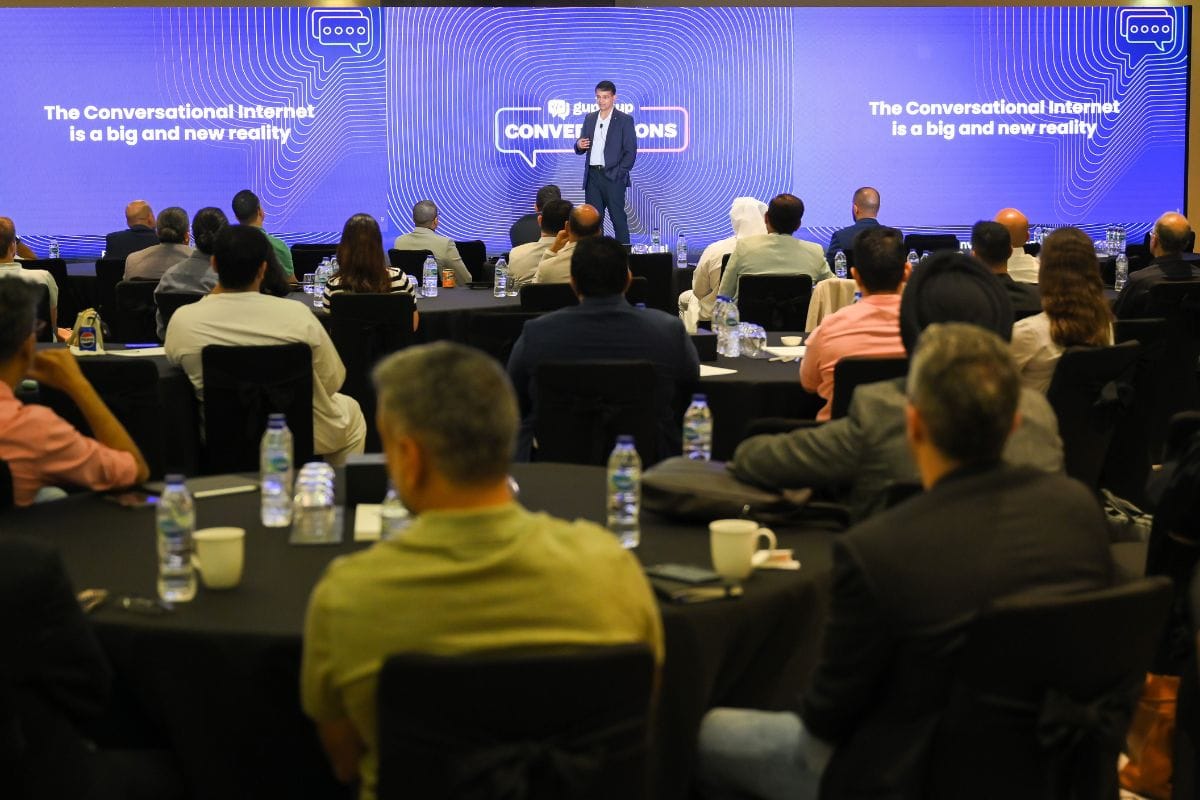
Sheth’s present argument starts with how people actually use the internet. In mobile-first markets, messaging apps can serve as a front door to digital services. He sees an opportunity for businesses to meet customers there, letting them ask questions and complete tasks through a conversation rather than navigating a sequence of pages.
A familiar shopping interaction helps explain the appeal. A customer asks about an item, clarifies a detail, then wants to know what happens next. An interface organised around that exchange could keep the thread intact. The ambition is to make digital service feel closer to asking someone at a counter, while supporting the volume an enterprise handles.
His December 2024 discussion of multilingual conversational AI places this ambition in emerging markets, where mobile behaviour and language needs differ from those of desktop-first users. Designing for those differences gives the product a particular audience. A chat interface that assumes everyone speaks the same language would miss much of the point.
By September 2026, his public writing had extended the argument to voice. In “AI Agents Find Their Voice,” he considered ordinary business calls that go unanswered and the role agents might play in handling them. His examples included restaurant orders and sales enquiries. The question was practical: how much business disappears while a phone rings?
In a September 2026 conversation with Saurabh Agrawal, he also discussed moving marketing from clicks towards conversations, the importance of context, and situations where an AI agent should hand over to a human. These ideas remain proposals for how companies should operate. Their usefulness will depend on what customers can actually get done.
“A fringe benefit of an unusual name like mine is that it works in almost any namespace.”
Beerud Sheth
The meeting can go for a walk
Away from the platform, Sheth has said he enjoys hiking and sometimes holds meetings while walking. The habit offers a modest change of scenery for a career spent building ways to communicate. There is something agreeable about a messaging executive allowing a conversation to proceed without a screen.
His humour surfaces in smaller details. One of his dogs is named Pi, with a mathematical joke attached to the choice. He describes reading books and blogs and listening to podcasts as ways to keep learning. These are recognisable habits rather than a founder’s ceremonial list of virtues.
Asked how people could follow him, he once joked that his unusual first name made it easy to claim an online handle. It is a tidy observation from someone who has spent years thinking about how people find one another online.
The next chapter of Gupshup will test another connection: between the capabilities of AI and a customer’s everyday patience. Sheth has been early to an idea before. He has also had to change an idea after building it. The experience leaves him with a useful question to carry into any new conversation: who needs this enough to make it work?
Continue the conversation
Explore his work and hear him tell the story.