A light switch is an unforgiving benchmark for a software company. Nobody attends a webinar to operate one. There is no certification, no guided tour, no colleague leaning over a shoulder to explain which menu contains the darkness. In 2022, Mukul Jain proposed roughly this standard for HR technology: however complicated the underlying system, using it should be as easy as switching lights on and off.
It was a revealing comparison for the founder and CEO of HONO. Enterprise software generally has plenty to say about its own sophistication. Jain was talking about the effort required from the person using it. “Technology has to serve People,” he wrote. The capital P was his.
Four years later, HONO publicly announced a conversational HR system designed to replace navigation through menus with requests in natural language. The announcement belonged to the AI era. The irritation it addressed was older: an employee has a job to do, and the software has assigned them another one.
The plumbing came first
Jain’s route into this problem ran through enterprise operations. Before HONO, he was a co-founder and CEO of Mynd Integrated Solutions. His experience spans HR, accounting, supply chain management, customer relationship management and IT services. These are fields in which an elegant idea eventually has to survive a reconciliation, an integration or a deadline.
His public professional record contains a small, useful example. Stijn Hoegaerts, writing a LinkedIn recommendation, described Jain supervising an interface between EmployeeWise, a local payroll system, and SAP HCM, a corporate HR system. Business requirements had to become technical requirements. The systems had to communicate. The delivery date had to hold.
Hoegaerts recalled that most business scenarios worked at the first user validations. The remaining issues were corrected, and the interface went live as planned. More than three months later, he remained satisfied with its quality. This is the sort of praise enterprise software earns when it has behaved itself: the machinery works, and everyone gets on with something else.
The episode offers a more concrete introduction to Jain than a string of executive adjectives. He was involved in the space between what a business needs and what a system actually does. His education includes the Institute of Chartered Accountants of India, listed on his LinkedIn profile for 1995 to 1999. There is a practical cast to this background: processes matter because people depend on their results.
“Technology has to serve People.”
Mukul Jain, 2022
When the customer wrote the cheque
By May 2022, HONO had a customer relationship that was about to become something more. Aakash Chaudhry, then managing director of Aakash+Byju’s, led a $5 million funding round. He invested $4 million personally. The remaining $1 million came from Hemant Sultania, Amit Khanna of Amaya Ventures and Harsh Gupta of Udayat Group.
Chaudhry’s organisation had already been a client. He spoke about a constructive relationship developed over years. For Jain, this meant the lead investor arrived with experience of the product and the people behind it. The relationship had passed through the unglamorous examination room of being a customer.
A customer relationship became an investment relationship.
The company reported more than 300 clients and over a million employees on its platform at the time. Its expansion plans covered India, the Middle East and Southeast Asia. The round also came with ambitious targets, including supporting five million people in FY23. That figure described the destination Jain was aiming for.
His strategy extended beyond adding names to a client list. In a July 2022 conversation, he described entering developing markets where businesses faced related problems but had different levels of HR maturity. Some needed foundational systems; others were ready for more advanced work. The product would have to develop alongside those customers.
There is a particular kind of humility built into that proposition. A company can take software abroad in a suitcase, metaphorically speaking. Local practices tend to require rather more luggage. Jain’s stated approach was to understand where each market stood, then help customers improve their practices while improving HONO itself.
A decision at the end of the dashboard
At SHRMTech22 in Hyderabad, Jain stood behind a lectern and addressed how HR could lead business transformation. A photograph catches him gesturing above the microphones, his enlarged image filling the screen behind him. The topic was a larger role for a function often occupied by the necessary business of keeping an organisation running.
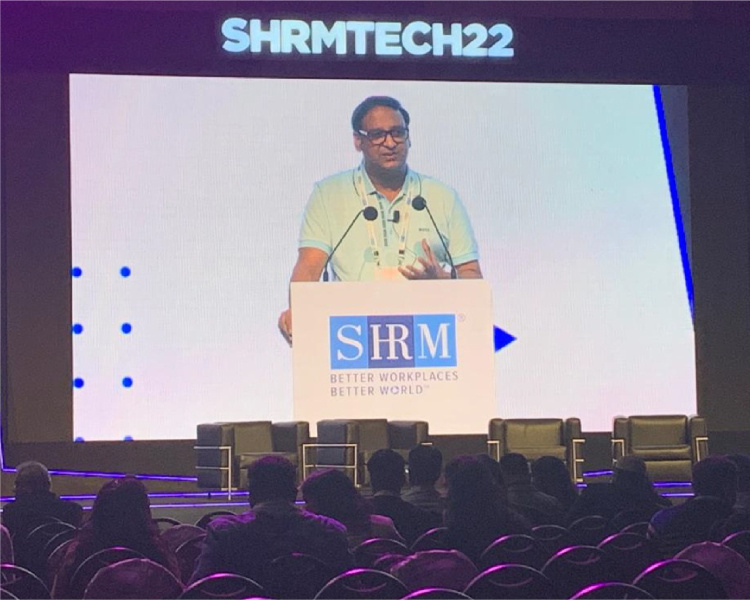
The gathering supplied a pleasingly tangible detail. At HONO’s stall, Jain joined colleagues and visitors presenting a book of HR transformation case studies. The company was giving people something to take away from a conversation about software. Even a technology business sometimes finds a use for paper.
Jain’s argument about HR’s role had an analytical side. In 2022, he discussed making workforce analytics understandable and actionable. A record of departures could describe a pattern. The more demanding question was how future departures might affect the movement of talent through an organisation. That asks the system to connect an observation to a consequence.
He also emphasised the quality of the data and the way insights were communicated. Managers had to trust what they were seeing and understand its relationship to the wider business. A report can be technically accomplished and still fail to give its reader a reason to act. In Jain’s account, that last distance between information and action deserved attention from the product team.
An editorial guide to the progression in Jain’s public arguments about analytics.
That concern helps explain why his earlier light-switch comparison was more than a demand for prettier screens. Ease of use affects whether information travels. If the employee struggles to complete a transaction or the manager struggles to interpret a report, the organisation inherits the friction. A better-looking dashboard alone cannot settle the matter.
The menus begin to disappear
On May 7, 2026, HONO publicly announced its Zero UI HRMS. The proposal was to let employees and HR teams ask questions, retrieve information and execute operations through a conversational layer. The system would interpret intent and select the relevant application programming interfaces to carry out the work.
For Jain, the premise was that the traditional interface had reached a limit. The launch described permissions, governance and connections to other enterprise tools alongside the conversational experience. The plain-language request still needed a carefully controlled system behind it. A light switch is simple partly because someone has done the wiring.
One colleague’s account makes that wiring visible. Prasanth Padharthi, HONO’s co-founder and CTO, describes joining the company in May 2023 after a career at Ramco Systems. Virender Aggarwal, his former chief executive and a HONO adviser, had encouraged the move. Padharthi credits Jain with giving him the opportunity to build the HRMS product.
The work included moving an existing PHP-based platform to a modern architecture. Padharthi describes serving an established enterprise customer base while making that change. His own spark for the conversational direction came from watching engineers use AI tools through chat, then wondering why HR users should still have to click their way through work.
It is a useful glimpse of how the company’s direction took shape across different people. Jain supplied a longstanding usability ambition. Padharthi brought an engineering account of how interaction could change. Aggarwal connected experience and people. The product emerged from those relationships as well as from a founder’s stated intent.
Work still needs people
In June 2026, Jain appeared in a discussion with Manu Wadhwa, chief human resources officer at Sony Pictures Networks, about evaluating HR technology. His emphasis included building the internal capability needed to adopt increasingly connected systems. New technology arriving at the door does not automatically give an organisation the ability to use it well.
A conversation with Publicis Groupe’s Jolene Huang at TechHR Singapore, covered the following month, returned to a related problem. Using AI for separate transactions could improve efficiency. Jain argued for looking at its contribution to insight, decisions and business outcomes. The discussion placed work design and developing people’s capabilities alongside the tools themselves.
This gives his conversational software ambition a second test. Reducing navigation should make everyday work easier. The larger question is what an organisation does with the time and information that become available. His public conversations keep bringing that question back to HR leaders, managers and the people carrying out the work.
His description of his own management habits is similarly practical. He plans his day around priorities and says a leader should begin by helping others move forward. Asked for a question to assess a prospective leader, he chose: “Tell me about a major failure and what you learned from it.” It leaves considerably less room for a polished victory lap.
Jain says he would invest in talent earlier if starting again. His stated priorities include product improvement, expansion and building organisational capability. The founder trying to simplify an employee’s interaction with software is also asking how colleagues become more capable of doing the work behind it.
Return to the light switch and the comparison acquires some weight. The person in the room wants the light to come on. Making that ordinary moment dependable calls for connections, engineering and people who understand what happens behind the wall. Jain has spent much of his professional life around that hidden work. His wager at HONO is that the employee should have less of it to think about.
Follow the conversation
Explore Jain’s work, interviews and public appearances.