A half-empty bin has a surprisingly expensive habit: it can summon a collection crew. Put it on a repeating route and someone will arrive, inspect it and empty it, whether the visit was needed or not. Across a city, those little obligations become a working day. REEN UK sells councils and waste businesses a way to question the appointment before the vehicle leaves.
The pitch has a useful number attached. Derby City Council reported a 53% reduction in visits to street bins in its sensor trial. The authority fitted 200 street bins with technology that monitored how quickly they filled. Some needed more attention; others could wait. The overall result was fewer unnecessary stops and capacity for other work, according to its account published by the Association for Public Service Excellence.
That distinction gives REEN’s business its shape. The company supplies the information and planning tools used by people managing waste. Its practical test is whether the next instruction to a driver improves on the old one. A colourful dashboard has to earn its place in the cab.
The old route had a blind spot
Derby’s enhanced collection round once worked through a paper list, then started again. Until operatives arrived, they could not see whether the next bin was overflowing or barely occupied. Experience and complaints helped determine the work, but neither supplied a current reading from every container. A predictable itinerary was compensating for unpredictable demand.
“The REEN system has helped us track when bins are full.”
Lee Wheatley, Derby City Council
REEN’s April 2023 UK launch announcement
REEN CMS Volume provides those readings through sensors fitted to containers, including existing bins. The cloud service makes fill levels visible, allowing collectors to plan around need. REEN Advanced Routes adds route and resource planning, taking account of operational variables such as vehicle type, timing and traffic. The two products answer related questions: which bins need attention, and how should a crew reach them?
The company’s technical explanation is more interesting than a broad promise of artificial intelligence. Forecasting waste generation and solving a vehicle-routing problem are different jobs. REEN describes combining predictive methods with combinatorial optimisation, including heuristics that handle collection constraints. Its Hub supplies analytics and planning; an in-cab app helps drivers follow routes and register collections. An open API is offered for connections to customers’ existing systems.
- 01 / MeasureA sensor reports the bin’s fill level.
- 02 / DecideForecasts and operating constraints shape the collection list.
- 03 / DispatchThe route reaches the driver; completed collections feed back.
Put a price on the skipped stops
Derby’s November 2022 cabinet proposal set out a lease covering sensor hardware and software, with hardware liability retained by the provider. Its four annual figures were £76,215, £75,952, £78,231 and £80,578. Added together, that is £310,976. The report identified existing cleansing and grounds budgets to fund the proposal. These were costs for that programme at that time, rather than a general REEN price list.
For a buyer, the arithmetic needs a second column. A skipped stop may save fuel, release minutes for another task or help avoid overtime. Those benefits have different financial consequences. If the same employees and vehicles remain on the payroll, a faster round can improve service without producing an equivalent reduction in expenditure. Treating every percentage improvement as cash would make almost any software purchase look irresistible.
The sensible comparison is therefore between the full service cost and the work it changes. Track mileage, time, complaints and collections before and after deployment. Decide which released hours can be used productively. Keep fewer overflows as a service outcome in its own right. Residents judge the bin by what is spilling out of it, not by the elegance of the spreadsheet.
At Salford Quays, the gulls had a vote
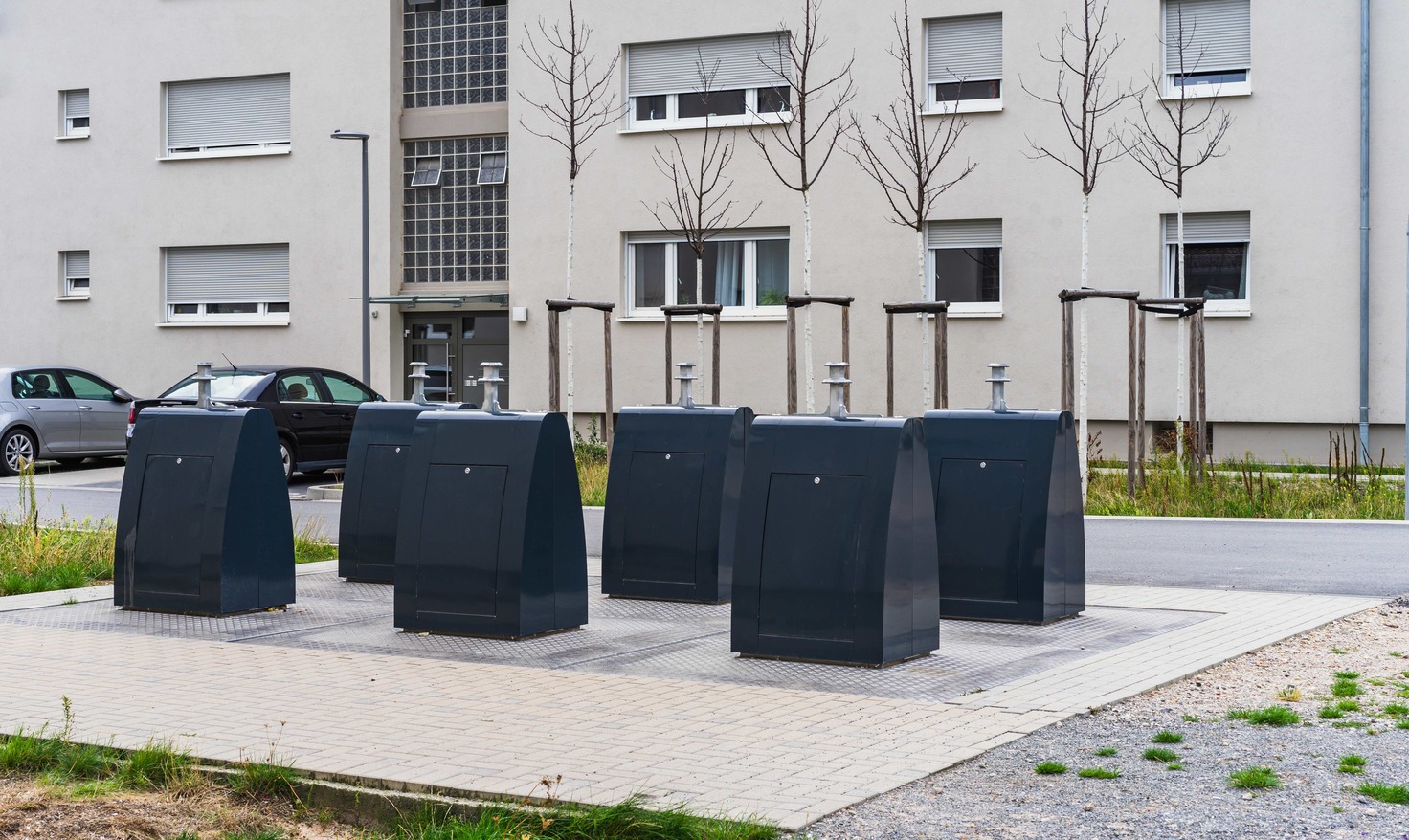
Salford’s problem was partly physical. A supplier case study describes 180 bins around the Quays, including older open-topped, 90-litre models. Wind and gulls helped redistribute their contents onto the street. The collection burden also competed with litter picking, graffiti removal and fly-tipping work. Better route mathematics alone would not put a lid on that situation.
The council reduced the network to 82 bins, standardised the bins and housings, and deployed REEN’s volume monitoring. Its case material described approximately 30% time savings over the first six months; REEN’s April 2023 UK launch release presented the figure as anticipated. The practical lesson is the combination: review where containers belong, improve the containers themselves, then change when they are emptied.
The £800 bin that went missing
One of REEN’s more memorable UK cases involved a container taking an unscheduled trip of its own. Textile collector Lontex Exports installed CMS Volume sensors in its clothes banks to improve visibility of their location, condition and fill levels. Shortly afterwards, one of the larger banks was stolen.
According to REEN’s July 2023 account, the technology confirmed the bank had left its assigned location and helped track its movement. It narrowed the location to roughly a one-mile radius. A local resident then supplied the precise spot, allowing recovery and avoiding an £800 replacement. The detail matters: the device helped organise the search; a person finished it.
That is also an unusually clear example of the company’s customer support. Lontex’s Tom Dugdale described repeated phone contact with REEN during the recovery. A product bought to improve collections had become an asset-recovery tool, with staff helping interpret its readings. The value extended beyond the original route-planning calculation.
A new name on an older operation
The UK business carries more history than a 2021 founding label suggests. Companies House records show Enevo UK Limited was incorporated on 9 December 2014 and became REEN Technologies Limited in July 2021. The company’s contact page lists its Nottingham-area office in Keyworth; its registered office is now in Stoughton, Leicester. The operational address and the legal address serve different purposes.
REEN itself emerged from the Norwegian telematics business ABAX. A June 2021 announcement described its acquisition of Enevo operations, bringing sensor and dynamic-routing expertise into the group. The announcement included offices in Larvik, Finland and Nottingham, and named ABAX and Norsk Gjenvinning as supporters. That lineage helps explain the product mix: understanding vehicles, containers and collection work belongs in the same conversation.
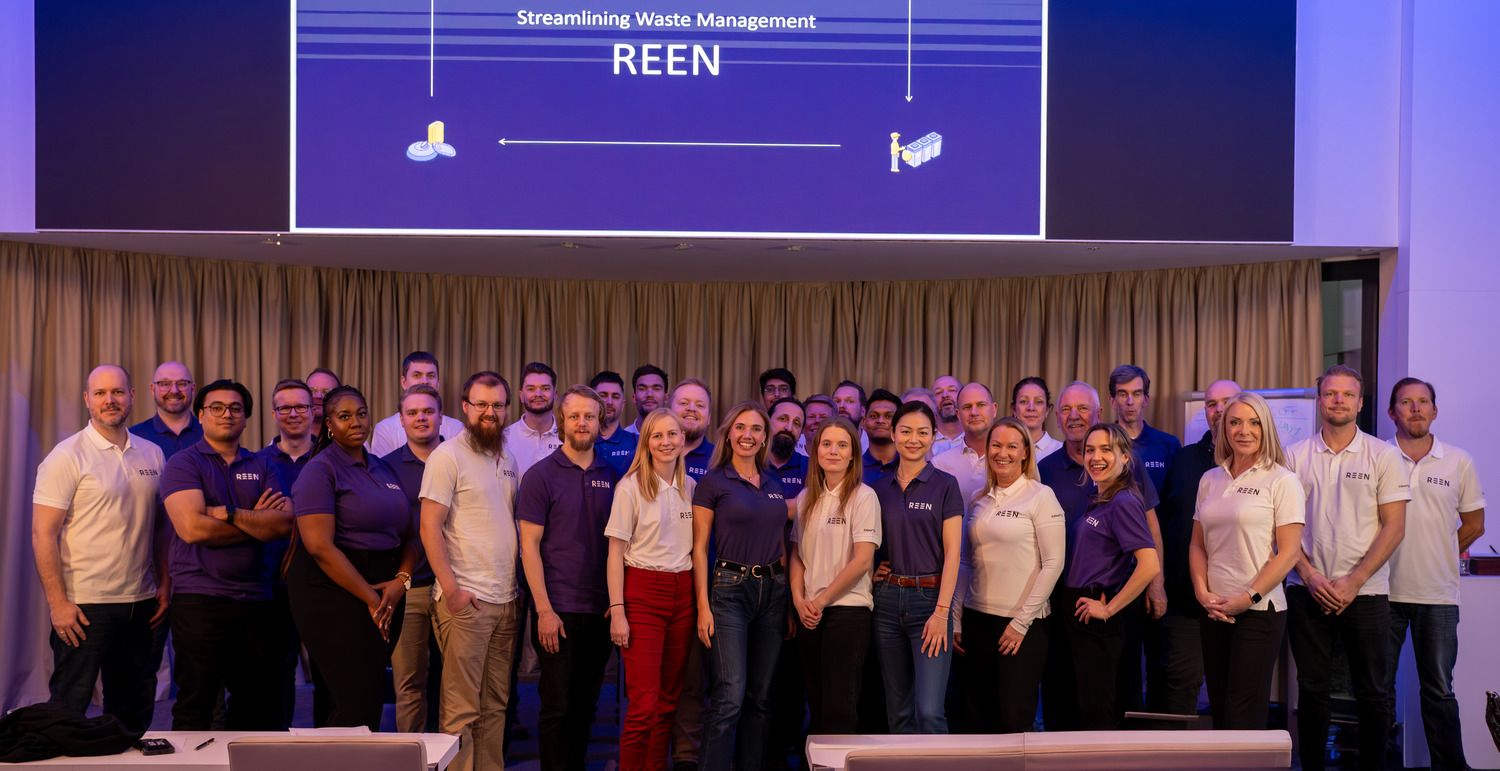
The group’s public workplace motto is brisk: “Love it. Own it. Get the job done.” Its 2025 acquisition of Swedish company Bintel added another set of products and customers. The announced plan brings Bintel’s Insight, Brain and Go platforms into REEN’s offering, with a Swedish hub under the REEN AB name. CEO Nora Johanne Sørsdahl framed the deal as progress towards 300,000 connected devices, an ambition rather than a reported installed total.
Beyond the bin round
REEN’s products reach into the waste room as well as the street. Control addresses commercial buildings where several tenants share disposal facilities and have limited visibility into their own waste. Hospitals, care settings and large kitchens are another target: measuring discarded food can help managers reconsider purchasing, preparation and meal provision. The purpose is to make waste attributable enough for someone to act on it.
CMS Asset handles container identification, tracking and lifecycle information, using technologies including Bluetooth Low Energy and QR codes. Drive supplies vehicle visibility, trip statistics and utilisation reporting. These tools connect several everyday irritations: finding the right container, locating a vehicle and understanding how heavily each asset is used. REEN’s published testimonials include NG Metall and Kongsberg Hospital alongside its UK council work.
That places REEN in the market for connected waste operations, where companies including Sensoneo, Nordsense, SmartEnds and Waste Vision also compete. Sensor monitoring is an established product category. REEN’s case rests on the combination of retrofit monitoring, routing, asset management and waste measurement, supported by named operating examples. For a council, fitting that combination into its existing workflow may matter more than any single hardware feature.
Whitespace illustrates why the buying decision is not always a clean contest between two logos. It offers sensor-linked collection requests and municipal job management, and Derby’s cabinet report describes its workforce software as part of the council’s operations. Buyers need to understand which system holds the jobs, which supplies the readings and how the two exchange information.
Start where the extra journey hurts
Derby’s proposal excluded frequently cleansed city-centre and shopping areas from the main rollout, where crews already emptied bins during routine cleaning. It also warned that revealed demand could require additional resources. A heavily used bin may need more collections once its true filling pattern becomes visible. Better information can uncover work as well as remove it.
The deployment lesson follows: choose a defined patch with avoidable journeys, establish a baseline and let the crew challenge the proposed rounds. A sensor earns its keep when the organisation can change an action because of its reading. Where the schedule cannot move, or a worker must visit anyway, that opportunity shrinks. REEN’s proposition becomes persuasive at the point where a council can safely cross an unnecessary stop off tomorrow’s list.