The house had plenty to say. Its pipes had frozen and burst. Water was wrecking the interior. What it lacked was a way to tell Alex Hawkinson. In the winter of 2011, his family’s mountain getaway in Colorado became an expensive demonstration of how little a building could communicate with the people responsible for it.
A nearby handyman could have turned off the water. The missing ingredient was notice. Hawkinson was struck by the absurdity: a phone could bring him updates from friends, yet something consequential could be happening inside his own house without reaching him. The internet had become very good at delivering news of lunch. Plumbing remained outside its jurisdiction.
He began working on sensors. That effort became part of the origin of SmartThings, which he co-founded in 2012 and led as its founding CEO. The immediate problem was domestic, but the question had room to grow. How many things do people discover only because something has already gone wrong?
A red light is an instruction, apparently
Hawkinson had been building companies before the house intervened. He studied cognitive science at Carnegie Mellon, graduating in 1994, and his career included Apptix, SMBLive and ReachLocal. That history matters because SmartThings required more than an interesting piece of hardware. It needed software, distribution, developers and customers willing to let a young company into their homes.
He also had a family background in entrepreneurship. He described growing up around startups, an upbringing that made starting a business feel familiar. Familiarity, however, offers limited protection against the customer who interprets your product differently from the engineer who designed it.
One early SmartThings lesson arrived courtesy of a status light. The hub flashed red and then went dark. Customers understandably assumed something was wrong. Some unplugged it. A system intended to make life easier had begun by asking its owner to decipher a distress signal. Hawkinson could laugh about the mistake, but his answer about the essential ingredient in consumer electronics was plain: ease of use.
“Ease of use.”
Alex Hawkinson, on building consumer electronics
The smallness of the error makes it useful. A company can have an ambitious view of the future and still lose the room with a blinking bulb. Getting the system to work includes getting a person to understand what it is doing, particularly when that person has other plans for the afternoon.
The backers were building something, too
SmartThings went to Kickstarter in August 2012 with a $250,000 goal. It finished with $1,209,423 from 5,694 backers. Those figures supplied money and a public test of demand. They also brought something Hawkinson specifically wanted: people who would help turn a connected-home kit into an ecosystem.
Almost 4.84 times the target. Thousands of invitations to see what a house could do.
The early mental picture had been modest: roughly a thousand households and a hundred developers. Interest exceeded that. By January 2014, the developer community had grown beyond 5,000. Hawkinson talked about giving those developers tools, documentation and access to the core technology team through weekly office hours.
That was an organizational choice as much as a software choice. A household contains objects made by companies that have no particular obligation to cooperate. SmartThings offered a place where someone could make the connections. A useful idea could come from a person with a specific irritation at home, then travel to somebody else’s house.
The company’s early ambition therefore contained a deliberate concession: its own team would never imagine every useful application. Allow other people to write them. When SmartThings Labs opened up ways to publish apps and device connectors, it made that belief more practical. The product could acquire uses its founders had never ordered.
The front door becomes a distribution problem
Samsung acquired SmartThings in August 2014. Hawkinson stayed on to lead it, carrying a young company’s open-platform ambitions into a business with an international consumer-electronics footprint. He remained at SmartThings until 2018. The acquisition changed the available reach; it also made the promise of interoperability a question customers would keep asking.
At IFA in 2015, the second-generation hub supplied an answer to a different, painfully relevant question: what happens when connectivity fails? It included battery backup and could run some automations locally. The detail brings the story back to the Colorado house. A system that observes the world also has to contend with the world’s habit of interrupting its electricity.
Hawkinson described the new Smart Home Monitor around a question a homeowner might actually ask: was everything all right at home? Notifications and video could help someone decide whether to call a neighbor or a plumber. This was the kind of product explanation that could survive a conversation outside a technology conference.
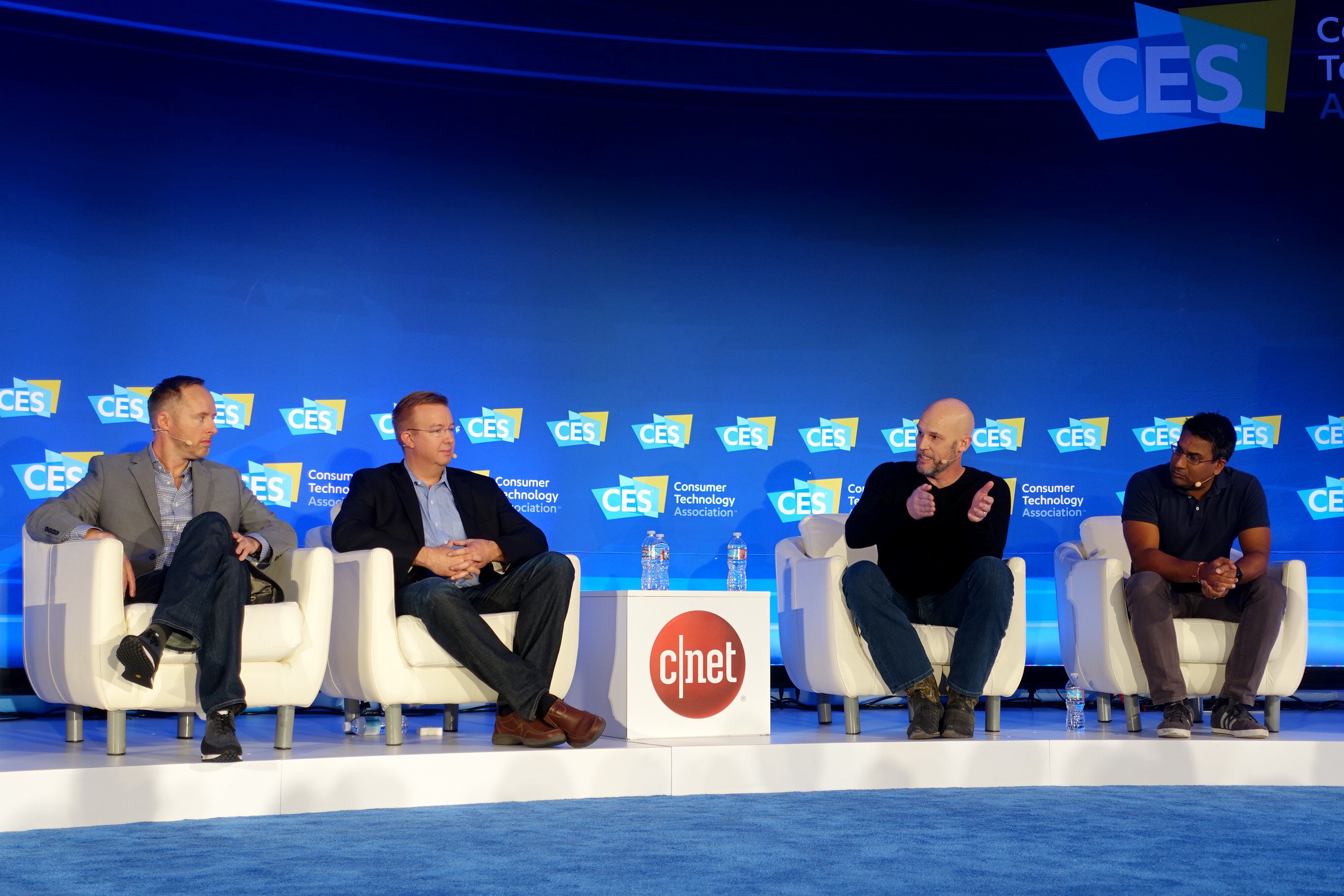
By CES 2017, he was sharing a stage with executives from August Home, Amazon Alexa and Google Home. Their discussion included cost, security and difficulty of use. Those are stubbornly ordinary obstacles. The industry could see a future full of connected devices; a customer still had to decide whether the installation would consume Saturday.
For Hawkinson, there was a domestic check on enthusiasm as well. He later recalled an experimental lighting routine that switched on indoor and outdoor lights when his wife came downstairs during the night. The effect was closer to a party than a helpful home. A technically successful automation can still receive an unfavorable review from the household.
Taking the question down the manhole
BrightAI, founded in 2019, took his attention into the infrastructure beyond those households. Water networks, power equipment and industrial machinery supplied another version of the original problem: important things happening out of sight, with people depending on inspections to find them.
Its platform, Stateful, combines observation, interpretation and action. Sensors collect signals from physical equipment. Models look for patterns and problems. Information then reaches the people who can do something useful with it. The company works across areas including water, power, oil and gas, pest control and manufacturing. Each has different equipment; all have reasons to care about discovering trouble earlier.
Consider the work with Azuria Water Solutions. BrightAI added sensing and AI to pipeline systems so robots could navigate, assess conditions and help build a digital picture of the network. The attraction is straightforward. A buried pipe is difficult to inspect, and a better understanding of its condition can help determine what to repair. The intelligence has to meet an actual maintenance decision.
Hawkinson’s account of building BrightAI emphasizes close customer relationships before outside funding. He wanted to understand the work well enough to sell something valuable, rather than begin with an attractive demonstration and search for a buyer afterward. That approach gave the company a demanding audience: operators with equipment to maintain and limited patience for ornamental software.
In July 2025, BrightAI raised $51 million in a Series A co-led by Khosla Ventures and Inspired Capital. Hawkinson described the next steps in practical terms: expanding the team, developing the technology and bringing it to more industries. Money enlarged the assignment. The test still happened wherever a customer needed equipment to keep working.
There is also the sky
His interests extend well above the pipes. Hawkinson is an astrophotographer, sharing images of the night sky under the name Gazing Outwards. In one public sequence, he explored the star responsible for illuminating a region of the North America Nebula. The images invite attention to details that an unaided glance would miss.
That interest has a business counterpart. He co-founded OurSky with Dan Roelker, a former SpaceX software engineering executive. In December 2023, the company announced $9.5 million in seed funding for its space-data developer platform. Its network connects telescopes and software so developers can obtain observations without assembling and operating the entire observing system themselves.
There is a family resemblance to SmartThings: distributed hardware, software that coordinates it, and developers with applications the platform’s builders need not invent. A telescope and a leak sensor have very different views. Both become more useful when an observation can reach someone equipped to act on it.
Hawkinson is also a co-founder of Efficient Computer, alongside Carnegie Mellon researchers Brandon Lucia, Graham Gobieski and Nathan Beckmann. The company develops processors designed to reduce the energy needed for general-purpose computing. For devices operating away from abundant power, computation has a physical price. Even intelligence needs somewhere to plug in, or a battery willing to accommodate it.
Knowing in time
In a June 2026 conversation, Hawkinson described a change in BrightAI’s implementation pace. Early customers had taken two to three years to reach the benefits he discussed; he said newer deployments could show comparable progress within six to twelve months. He also spoke about going into the field, putting on hard hats and working alongside operators. The numbers are his account of the business, and the setting makes the ambition concrete.
His career keeps returning to the distance between an event and someone knowing about it. A red light can make that distance worse. An alert can shorten it. A robot or a telescope can carry observation into places where a person cannot conveniently stand and watch.
The Colorado house offered an unusually expensive introduction to that distance. Years later, Hawkinson is still working on ways to close it. A useful outcome can be wonderfully unceremonious: someone learns what is happening, calls the right person, and turns off the water.