A light switch has a useful advantage over most technology: nobody needs a demonstration. You reach for it, press it, and the room changes. Dimitar Dimitrov has built a business around adding possibilities to that familiar gesture. Shelly’s compact relays can sit behind existing switches, giving compatible lighting circuits app control and automation while keeping the old manual operation. The switch gets to keep its job. In an industry fond of asking customers to replace things, that is a rather civil opening proposition.
For Dimitrov, the proposition reaches beyond the wall. The Bulgarian entrepreneur is Shelly Group’s co-founder and co-CEO, with responsibility for research and development. His career has passed through software, cable television, technology publishing and telecommunications. Shelly is the chapter in which those interests converge: small pieces of hardware, software that gives them uses, and people who often have their own ideas about what the combination should do.
By September 2026, that combination had attracted Schneider Electric. Its proposed cash offer valued Shelly at approximately €1.2 billion. Dimitrov backed the transaction and committed to reinvesting part of his proceeds alongside the buyer. The announcement expected him to remain co-CEO with Wolfgang Kirsch. The founder who wanted customers to retain choices now faces a consequential choice about the company itself.
The familiar manual control stays in place.
A compact module fits a compatible circuit.
App control, schedules and integrations add options.
Before the relay, a printer and a horoscope
Dimitrov’s first encounter with a computer came at his father’s workplace when he was 12. It was a Pravets 8, one of Bulgaria’s early personal computers. Games caught his attention; writing programs soon followed. By 15, he had a computer of his own. As a schoolboy, he used an eight-bit machine and a printer to produce horoscopes for sale. His first customers were buying a glimpse of the future. He was acquiring a practical introduction to commerce.
He started his first business at 16. Later came REAL TV, a cable television business serving Bulgarian cities. His technology interests also became a publishing business: PC Review, Computers and Peripherals, and GSM Review. These were distinct ventures with a common subject matter. Computers and communications were becoming everyday purchases, and Dimitrov kept finding places to participate in that change.
In the early 2000s he helped establish Teracomm. Its services included mobile marketing and notifications, and its business expanded beyond Bulgaria. Svetlin Todorov became a long-term business partner. The operations that developed into Allterco would eventually turn toward connected devices. The names matter because Shelly did not arrive with a completely new cast. Dimitrov and Todorov brought an existing working relationship into an unfamiliar hardware market.
Today the partners have different executive responsibilities. Todorov leads Shelly USA; Dimitrov leads at group level and concentrates on development. Kirsch, whose background includes consumer electronics retail, is the other co-CEO. Dimitrov’s story is therefore also a story of working alongside people with different specialties. A device has to be conceived, produced and sold. Those activities seldom fit comfortably inside one person’s calendar.
The customers came with suggestions
In November 2021, as Allterco began trading in Frankfurt, Dimitrov described how the early Shelly audience had formed. A favorable review from an American YouTuber was followed by German technology influencers. Orders nearly outran production. The company had relied on word of mouth outside Bulgaria, and an audience was turning into a community. Its German community then numbered more than 35,000 people.
Dimitrov wrote that the team spoke with users daily and tried to resolve problems within a day or, at most, a week. He also made a useful distinction: Shelly’s code was not open source, but customers could customize their systems. People without programming skills could use the app and integrations; people with those skills could go further. Openness, in this account, meant room to act.
The physical design supports that approach. A retrofit relay supplements an existing installation rather than requiring a household to begin again. Different models serve different jobs, including switching and power measurement. The current Shelly 1 Gen4 offers Wi-Fi, Bluetooth, Zigbee and Matter support. Those names are technical, but the practical question is ordinary: will the thing you buy cooperate with the other things you own?
At Webit in Sofia in 2025, Dimitrov recalled the experiments behind the hardware. The team had come from software and found that available devices did not suit its plans for home automation. Building hardware became part of making those plans work. His recollection was refreshingly modest: “At first, we were just playing.” It is an appealing admission from someone whose experiments had acquired shareholders.
The play had become international. Shelly’s Webit account put cumulative sales above 23 million devices in more than 130 countries as of March 31, 2025. Dimitrov received a Webit Changemaker distinction in Entrepreneurship and Investment. Yet the detail that gives his account its character is the continuing conversation with users. The people installing the devices were also helping the company decide what to build next.
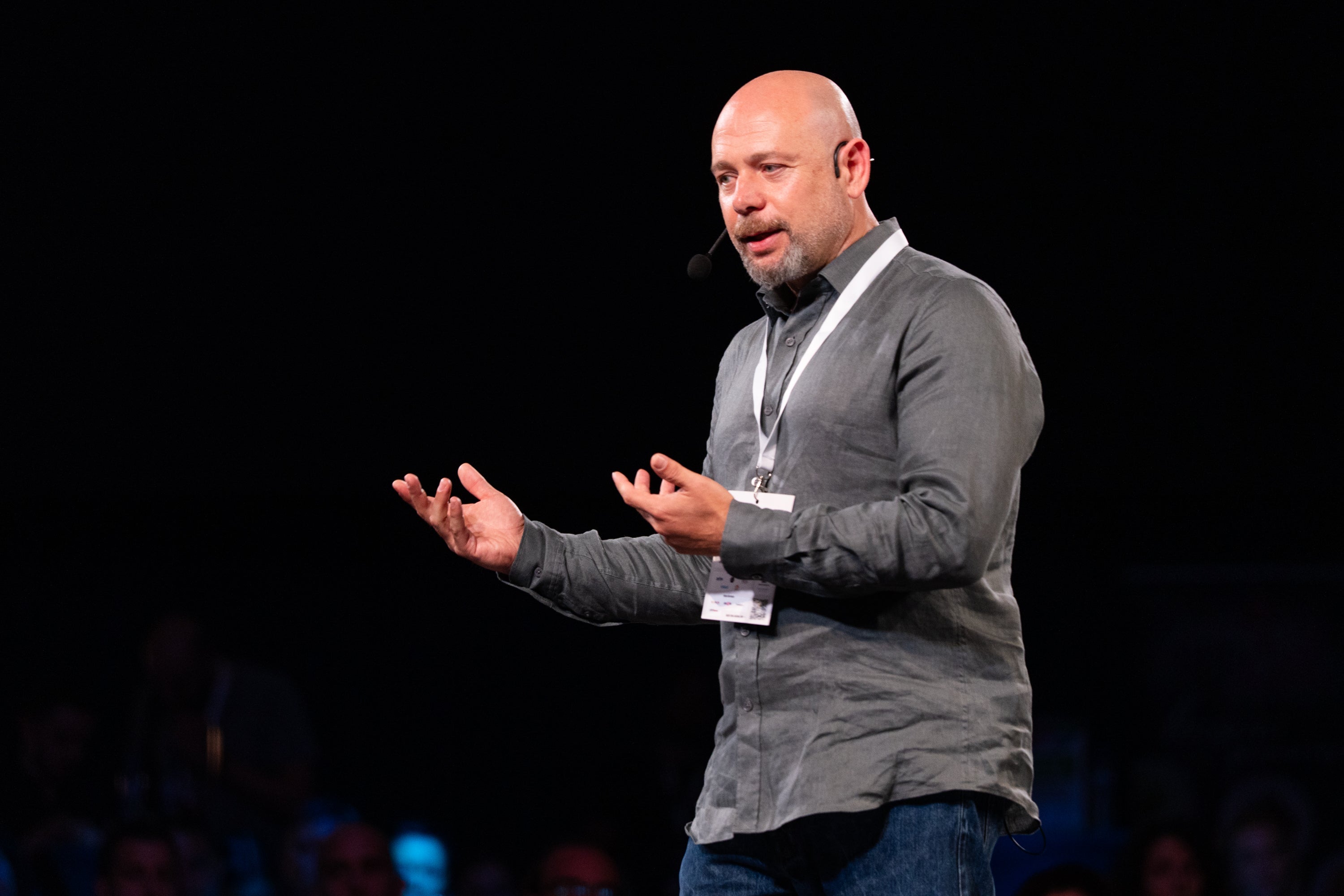
“At first, we were just playing.”
Dimitar Dimitrov · recalling Shelly’s early experiments, Webit 2025
Five millimeters, with ambitions attached
Dimitrov’s development work eventually ran into a physical constraint. The chips available to Shelly limited how small and flexible its devices could become. In July 2025, he described a customized chip developed in Taiwan from an existing design. It measured five by five millimeters and incorporated memory and other necessary components. The project took about nine months and cost roughly half a million Bulgarian leva.
His explanation was practical rather than ceremonial. Shelly bought enough components to negotiate changes it needed. A smaller package left more room for the rest of a device. He also described plans for module production in Plovdiv, using chips supplied from Taiwan. This was an announced manufacturing plan, with automation central to the proposal. Chip fabrication and assembling modules were separate parts of the project.
The longer ambition was to supply technology to other manufacturers. A company that already knows how to make an appliance could use Shelly’s connected hardware and software inside it. That gives Dimitrov a different development problem: making the underlying technology useful beyond products carrying his own brand. The humble relay becomes an introduction to a broader business in connecting other people’s equipment.
Dimensions of the customized chip Dimitrov described in July 2025. Diagram is symbolic, not to scale.
The founder acquires a larger calendar
Growth changes the work around an invention. By 2025, Dimitrov was describing the need to delegate and bring in specialists as a business expanded. He acknowledged that a larger organization demanded structures and management skills that a small team in one room had not required. His own job had changed along with the company. That admission gives the hardware story a recognizably human complication: success creates work the founder did not originally set out to do.
His public account of motivation is similarly concrete. In a February 2025 television appearance, he emphasized wanting to give customers value and seeing their satisfaction. He also described the pace of installations in units of seconds. For a developer, that is a different kind of scale from a stock price. Somewhere, another person is putting a product to work; somewhere else, another person may need help with it.
The company’s 2025 annual revenue reached €149.7 million, up 40.3% from €106.7 million in 2024. Those figures measure sales, rather than Dimitrov’s personal wealth or the value of the company. Keeping the distinctions clear matters in a story that now contains several large numbers. A business can have growing revenue, a quoted market value and a proposed sale price, each answering a different question.
Annual group revenue
€ million · full financial years
The 2025 investor report supplied another comparison: fourth-quarter revenue of €63 million exceeded the company’s entire annual revenue in 2022. A quarter had overtaken a year. The arithmetic helps explain why the founder’s role could not remain that of a colleague leaning across the same room. More products and more customers brought a different organization with them.
By June 2026, Shelly reported 2.9 million active cloud users and a network of 8,600 professional installers. First-half revenue was €68.3 million. In April, Dimitrov had been named Entrepreneur of 2026 at the Forbes Business Awards in Sofia. The award attached a name to the achievement; the installer network points to the many other people involved in getting the technology into buildings.
An offer, and the question that follows it
The September 24, 2026 announcement proposed €70 in cash for each Shelly share. Dimitrov and Todorov together held approximately 57% of the company. The transaction was conditional, with regulatory approvals and a 95% acceptance threshold, and completion was expected by the first quarter of 2027. It was a proposed takeover, with several steps still ahead.
On October 5, Shelly’s board said it considered the price fair and supported the offer. Its assessment also described an intention to keep the headquarters in Bulgaria and preserve the organization and workforce for at least three years after completion. For a company whose story began in Bulgaria and expanded through overseas customers, that continuity is a substantive part of the proposed arrangement.
Three days later, the operating business supplied its own update. Preliminary revenue for the first nine months of 2026 was about €112.8 million, approximately 30% higher than a year earlier. Third-quarter growth had accelerated. Full unaudited results were scheduled for November 10. The deal discussion was proceeding alongside the less theatrical business of selling devices and supporting the people who use them.
Dimitrov’s next chapter will be judged in both places: the corporate arrangement and the household installation. His public ambitions include wider uses for Shelly’s technology and a stronger software offering. The customer still has a smaller, more immediate concern. Will the lights work the way they want? A founder can spend decades expanding the scale of that question. The person standing by the switch is entitled to a simple answer.