For someone trained to turn a problem into working code, product management can feel suspiciously like an occupation invented by people who enjoy calendars. Josep Mingot remembers the adjustment. At CoverWallet, he found himself coordinating rather than producing the technical work himself. His phrase for it was “just moving information”. A programmer could be forgiven for wondering whether the information might prefer to move itself.
That small admission gives his career a useful starting point. Today, Mingot is co-founder and Co-CEO of Prosper AI. Before that came mathematics, computer vision, consulting and product leadership. The job kept changing the unit of work: a solution, an application, a decision, a team. Viewed this way, his route into founding a company looks like a continuing education in what it takes to get something used.
The strange business of moving information
Mingot joined CoverWallet in 2017. He had become more interested in choosing the problem and understanding its purpose. Product management offered him that work, although its output initially felt less tangible than code. He eventually came to see the value in helping an engineering organization deliver. The change was also deliberate preparation for an ambition to build a startup.
There is a practical difficulty hidden in that change of profession. A technical contributor can often identify a piece of work that belongs to them. A product leader spends much of the day on things that belong to several people at once. Progress depends on whether those people understand the same problem. The resulting work can be consequential and remarkably difficult to photograph.
“just moving information”
Josep Mingot, remembering the early adjustment to product management
The phrase is funny because it makes an ordinary management task sound faintly illicit. Yet information is what lets one person's work become useful to another. For a founder whose background includes machine learning, that offers a different way to read the résumé. The technical education continued. Its subject expanded to include organizations.
Before the boardroom, a camera
Long before those product meetings, there was a fairly literal exercise in teaching a machine to see. At MIT, Mingot worked on DetectMe, an application for object detection on the iPhone. The project put a research problem into an everyday object: a phone a person could hold, point and use.
The application's instructions were straightforward. Photograph the object you want the device to recognize. Train the detector with those pictures. Then let it find the object on the screen in real time. Mingot is credited on the project alongside Adrià Recasens, Antonio Torralba, Aina Torralba and Dolores Blanco. Even the credits offer a reminder that an application can have several authors before anyone starts calling it a product.
His final degree project describes a training process designed for someone without specialist knowledge. While taking a picture, the user could adjust a box around the desired object. The area outside that box supplied negative examples. Other users' detectors could also be used and improved. Beneath the camera interface sat a series of decisions about how a person would teach the software.
That is an engaging detail in a career now associated with AI agents. The work already required a bridge between an algorithm and somebody's intentions. A bounding box is a small piece of interface design, but it has a job: make clear which part of the world the user means. Without that, the mathematics has received rather poor instructions.
Two degrees and a habit of entering things
Mingot was born in Lleida and entered UPC's interdisciplinary CFIS program in 2007, the year he won medals in Spain's mathematics and physics Olympiads. He completed mathematics in 2011 and telecommunications engineering in 2013. His university years also included a scholarship to teach programming and help develop startups in Colombia through MIT Global Startup Labs.
Competition, teaching and building sit close together in that early record. They offer different kinds of feedback. A competition supplies a result. Teaching requires another person to understand. An application has to behave when someone uses it. Together, they make a more varied apprenticeship than a list of degrees alone suggests.
By 2016, he was judging HackUPC as a data scientist and Arcvi co-founder. The event advertised 400 hackers and 36 hours. Its judging criteria included creativity, polish, technical difficulty and usefulness. That last category is particularly pleasing: after all the ingenuity, somebody still had to ask whether anyone would want the thing.
A hackathon compresses that question into a weekend. The constraint is part of the appeal. There is limited time to explain away an unfinished idea, and another team is already plugging in its laptop. For a career moving between technical work and business decisions, it is an apt place to appear.
A product education, paid in meetings
CoverWallet gave Mingot a much larger organizational setting. The company sold business insurance online, bringing a digital purchasing experience to small and medium-sized firms. His founder biography describes a period in which the product organization expanded from three product managers to more than forty, alongside more than two hundred engineers. Those are team figures, a measure of the environment in which he worked.
Aon announced its agreement to acquire CoverWallet in November 2019 and completed the transaction in January 2020. At the announcement, CoverWallet had more than three hundred employees across functions including engineering, design, operations and data science, with offices in the United States and Spain. Mingot continued into a senior product role at Aon.
The acquisition brought a change in company scale. It also placed digital product work inside an established international business. Aon described plans to apply CoverWallet's technology more broadly across its client experience. For anyone interested in what happens after software is built, this was an unusually direct setting in which to watch the answer unfold.
A growing startup and a large corporate owner give a product leader different surroundings. The customer still needs something to work. The routes to delivering it become more crowded. Mingot's next company would ask him to bring the technical and organizational parts of that education together.
Two founders, different toolkits
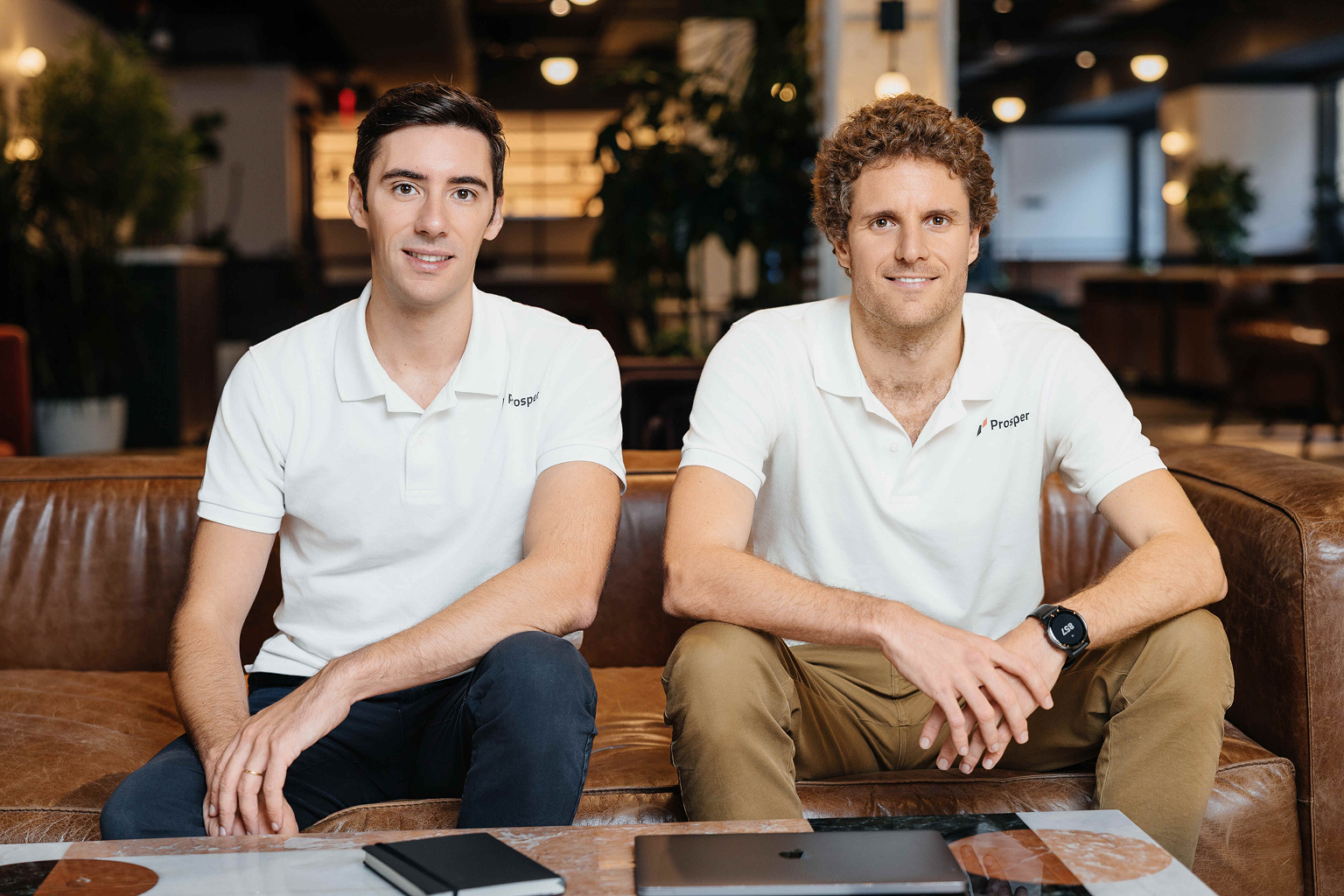
Mingot and Xavier de Gracia founded Prosper in 2023. The company joined Y Combinator's summer batch that year. Their backgrounds brought different kinds of experience into the same business: Mingot had built insurance products, while de Gracia had led large customer-support operations.
Their division of experience is useful to understanding the venture. Software that conducts conversations has to deal with the organization around the conversation. The call has a purpose, information has to move, and somebody needs to know whether the task finished. Product work and operating experience both have something to contribute there.
In September 2025, Prosper announced five million dollars in funding led by Emergence Capital. On June 22, 2026, it announced a thirty million dollar Series A led by Andreessen Horowitz, with participation from Base10 and existing investors. The June announcement also reported fivefold revenue growth since its previous funding announcement. The two announcements were separated by nine months.
The money creates room for another stage of work: developing the platform and bringing more people into the business. It also changes the questions a founder must answer. The application has to function, the organization has to deliver, and the new colleagues need enough shared direction to do their jobs. Moving information begins to look quite respectable.
The demo has to survive Monday
Mingot's description of his current work keeps customer operations close to the technology. He spends time understanding where work slows down, then works across customers, product, engineering and deployment. The aim is to get an agent to complete the underlying business process. A conversation is one part of that process.
In their SIGNAL appearance, the founders discussed deployment and feedback as part of the business's competitive position. Distribution through existing software was another theme. These are practical concerns for a company trying to make AI fit into an operation that already exists. The customers have jobs to finish while the technology is being introduced.
That puts a useful limit on the appeal of the standalone demo. A demonstration can show a conversation going well. Daily use has to deal with the surrounding systems and the next action. The distance between those two settings is where much of the product work lives. Mingot's career has given him several different views of that distance.
Barcelona stays in the picture
The geography of his work now connects New York with Barcelona. Prosper's expansion plans include strengthening the Barcelona hub, particularly in engineering, product and AI. Mingot has spoken publicly about building an international company from that base. Spain remains part of the operating plan.
His involvement also includes the local builder community. At the Project Barcelona hackathon, Prosper sponsored the grand prize and Mingot helped select the winner. Ninety-seven participants had twenty-four hours to build. He observed that the results were more complete than the rough prototypes he remembered from earlier events. “We need to redefine the M of MVPs,” he wrote. Apparently even the minimum is acquiring ambitions.
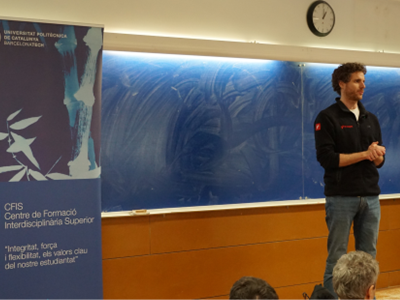
In 2026, Mingot returned to the CFIS company forum to discuss Prosper and its technical challenges with students. Several fellow alumni were already working at the company. The university named Edgar Moreno Martínez, Arnau Saumell Portillo, Marcel Ayora i Mexia and Eric Valls i Grünewald. The connection between his education and his company had become a working relationship.
It is a fitting place to leave him: back among students, now responsible for a company and with a rather broader definition of engineering. He once wondered about a job that seemed to consist of moving information. Today, the work connects people across teams, companies and cities. There is considerably more information to move.