In the first Fusemachines fellowship, a generous idea acquired an awkward complication. The company had selected 25 people to study AI. Nearly ten already worked for other businesses. Training them meant subsidizing somebody else’s workforce. In a 2018 interview, founder Sameer Maskey recalled the choice: “But we stuck to our words.” They stayed. A company trying to sell intelligence had decided to give some away.
- Train the builders: scholarship-backed AI education feeds a wider talent ecosystem.
- Sell the work: engineering services sit alongside AI Studio and recruiting agents.
- Watch the economics: new software ambitions meet a business still funded largely by services.
That decision offers a useful way into Fusemachines. Founded in 2013, the New York company has core operations in Nepal and a founder who also teaches at Columbia. It works on two shortages: businesses need help putting AI to use, and capable people need access to the skills those businesses buy. Connecting the two became its particular approach to enterprise AI.
01 / A classroom with commercial consequences
The 2026 Nepal fellowship is a six-month, mostly online program with a full scholarship, mentorship and project work. Fusemachines reports more than 1,100 certified fellows across several countries. The curriculum takes participants through data preparation, machine learning and building applications. Its practical promise is experience making something work.
There was a real bill behind the generosity. Back in 2018, Maskey put the cost of a cohort in one city at roughly $40,000-$50,000. That is a historical training expense, not today’s price. His account also described graduates becoming company engineers. Education could widen access while helping supply the expertise the business needed.
The company’s stated values include learning, teamwork and mentorship. A fellowship gives those words a visible mechanism: teach people, have them build projects, and connect their skills to professional opportunities. The arrangement requires patience before there is anything to invoice.
02 / The plumbing gets a product name
For customers, the proposition is more prosaic. A retailer needs a forecast. A lender needs documents checked. An engineering team needs an agent that survives contact with real company data. Fusemachines offers custom engineering alongside AI Studio, its platform for building and running business applications.
AI Studio describes four layers: applications for business users, an AI hub, a data hub and governance. The platform connects information, runs model and agent workflows, and provides controls around access and monitoring. Deployment options include SaaS, a customer’s cloud and on-premises infrastructure. Specific engines and accelerators address lending documents, retail fraud, pricing and demand.
That puts Fusemachines between several alternatives: an internal team assembling its own stack, a consulting engagement, or a specialist application. Its distinction is the combination of delivery expertise, reusable software and talent development. A buyer’s useful comparison is how much integration and ongoing engineering each option actually requires.
03 / Give the recruiter a better next question
On October 15, 2026, Fusemachines launched HireFoundry.ai. The progression was specific: an Interview Agent, then a broader suite, then a platform dedicated to hiring. The company attributes the expansion to customer feedback and interest in support across more recruiting tasks.
Consider a recruiter interviewing for a technical role outside their specialty. HireFoundry’s Interview Agent prepares questions, interprets answers and proposes follow-ups. A shortlisting agent compares candidates with job requirements; a trust agent highlights inconsistencies for review. The recruiter can inspect the evidence and decide what matters. A discrepancy is a reason to investigate.
“keeping human judgment at the center of every hiring decision”
Giovanni Lemus · Vice President of Product · October 2026
Fusemachines announced connectivity to more than 30 applicant tracking systems in June 2026. That matters because candidate records can stay in the system recruiters already use. Integration reduces the burden of introducing another destination for the same information.
The published Starter price is $99 per month, billed annually, including 1,000 interview minutes and unlimited seats. Premium lists $999 per month with 10,000 minutes; Enterprise is custom priced. Annual billing makes the listed Starter commitment $1,188 before any separately agreed charges. Buyers should compare usage allowances and their order-form terms.
04 / Start with the spreadsheet
A retail case study shows the underlying work. Sales, promotions and product information were scattered across databases and spreadsheets. Fusemachines built preparation pipelines, tested forecasting models against existing methods, and connected results to dashboards. The company reports up to 50% lower forecast error in evaluated use cases and approximately 25% lower estimated stockout risk.
The qualifications matter: these are company-reported results for particular evaluations. Still, the sequence is worth copying. Gather the relevant records, establish a baseline, compare predictions with reality, and put the result where planners make decisions. Poor records, little product history or a team unable to act on forecasts can undermine the exercise.
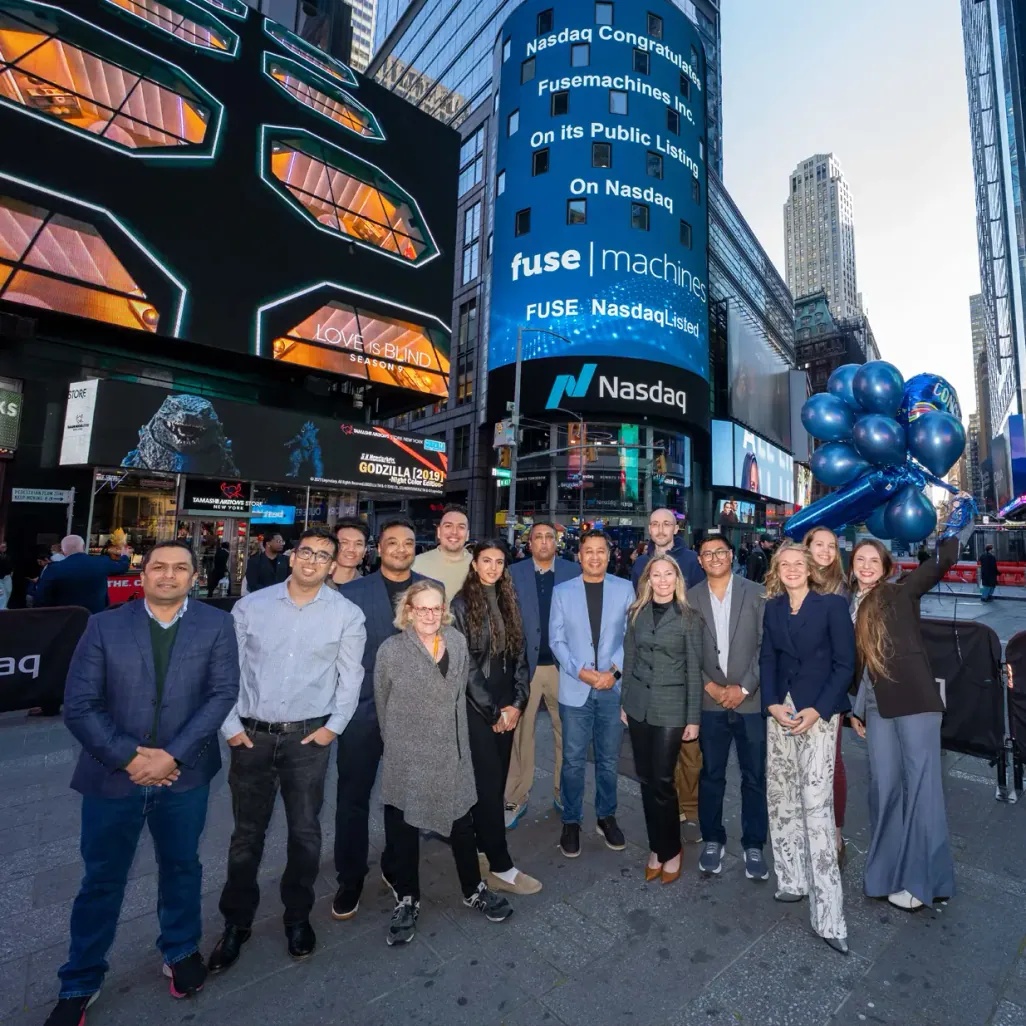
05 / A public company, an unfinished conversion
The Nasdaq debut brought a different test. Fusemachines reported $7.714 million revenue in 2025, down from $8.811 million in 2024. Its first-half 2026 filing says product revenue remained insignificant and discloses substantial doubt about continued operation without additional financing. Repeatable software sales remain an ambition to prove.
There are concrete commercial steps. Qintess committed to at least $6.5 million in purchases over three years, with discounts and an equity component. August’s Meteora financing involved a $2.5 million note face value; the purchase price was $2.05 million. Additional warrant cash depends on exercise. Neither future purchases nor possible proceeds belong in today’s revenue.
For a potential customer, the practical move is a bounded project with records, accountable users and a measurable result. For Fusemachines, the challenge is turning that work into repeatable economics. Its original classroom decision still hangs over the enterprise: developing capability takes time, and somebody has to pay before the benefit arrives.
Keep following the work
Explore Fusemachines, AI Studio, HireFoundry and demos, and the AI Fellowship. Read company news and the insights blog.
Watch: ICT Talk with Sameer Maskey · AIEXPO Nepal · Fusemachines on YouTube.