Garden’s most revealing customer was the one that bought the company. SIM IP used its patent intelligence, then joined forces with it in a transaction announced in February 2026 that valued Garden at $150 million. A search tool had become important enough to bring inside the business making the investments. That is a useful place to begin understanding Garden: with the distance between finding a document and deciding what it is worth.
- Garden builds AI tools for patent search, analysis and portfolio intelligence.
- Founded in 2023, it raised a $6.8 million seed round in 2024.
- After the merger, Garden became the technology engine inside SIM IP.
A patent has a vocabulary problem
A patent is a peculiar kind of technical document. It describes an invention, but its language also defines a boundary. Two descriptions can use different words for related ideas. Searching for familiar terms can therefore produce a reassuring pile of results while leaving the important connection undiscovered. Garden entered this world with a fairly specific proposition: improve the search, and much of the work downstream becomes more useful.
Its early product, Patentbreaker, targeted prior art searches and automated claim charts for inter partes reviews. Think of the chart as a disciplined comparison: a claim on one side, material potentially relevant to it on the other. Garden aimed to give patent practitioners a more organized starting point for the painstaking work of examining those connections.
The underlying approach went beyond matching words. Spark Capital described a search engine that represented claims, disclosures and relationships involving inventors, owners and patent lineage. The appeal was contextual retrieval: locating technically relevant material even when the phrasing differed. For a lawyer or researcher, that changes the first question from “Which keyword should I try?” to “Which evidence deserves a closer look?”
Before the models, the interviews
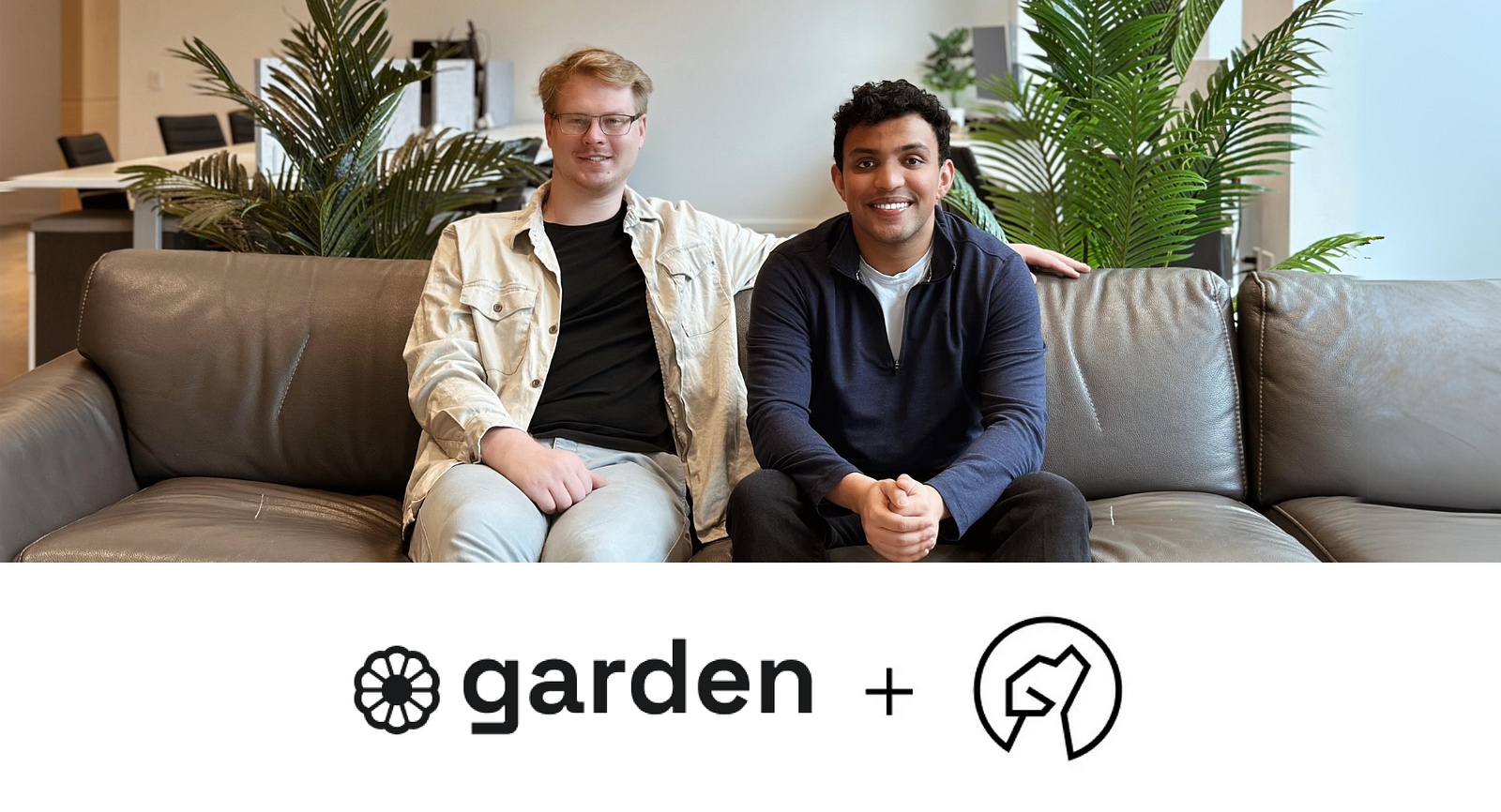
Adi Sidapara and Justin Mack founded Garden in 2023. Sidapara has described its beginnings as a Stanford dorm-room project. His background included natural language processing in computational genomics research; Mack brought a Harvard computer science background. Their subject was specialized, but their preparation included something decidedly ordinary: talking to the people who did the work.
In an early public account, Sidapara said the team had spoken with more than 250 patent professionals. Those conversations pointed him toward poor search and weak evaluation frameworks as recurring problems. The team spent its first months prototyping tools around improving search indexes. This is the part another founder can copy: investigate the repeated task closely enough to identify the dependency that keeps making everything else expensive.
Garden’s own account of its culture emphasized initiative, curiosity and attention to customers. An early engineering recruitment post also described an office-based team working five or six days a week, with short shipping timelines. That is a demanding operating preference, rather than a universal recipe. The more transferable habit is the pairing of technical research with practitioners who can tell whether an output helps.
The search box grows branches
Garden’s public product range expanded into infringement analysis, freedom-to-operate research, portfolio mining, patent chat and chemical-structure search. These serve different decisions. A litigation team wants evidence about particular claims. A research organization wants to understand the surrounding patent landscape. A university wants to identify assets that might interest a licensee. A useful answer depends on which question started the search.
The product names followed the company name into the garden shed. SPADE, announced in 2025, stood for Search Platform for Art Discovery and Extraction. BLOOM addressed organic molecules. Behind the playful naming was a serious expansion of the retrieval problem: chemical structures require a different way of finding relationships than a paragraph of prose. Garden was extending its expertise into the material its customers actually needed to investigate.
Illustrative workflow. Finding a match starts an investigation.
This puts Garden in a busy market. Patlytics offers infringement, invalidity and portfolio workflows; IPRally offers AI patent search and analysis. Semantic retrieval alone is therefore a difficult distinction to defend. Garden’s subsequent move suggests a different competitive argument: connect the analysis to a business that can act on it, then learn from the outcomes of those actions.
The customer becomes the company
The financing history has two numbers that should stay separate. Garden raised $6.8 million in seed financing in August 2024, led by Spark Capital with other investors including Craft Ventures, Mischief and Uncommon Capital. The $150 million announced in 2026 was Garden’s merger valuation. Adding them together would confuse money raised with the value assigned to a company in a transaction.
“SIM IP clearly stood out as the ideal entity to merge Garden with.”Adi Sidapara, February 2026 merger announcement
Before the combination, Garden marketed software to law firms, companies, universities and research organizations. Afterward, the businesses operated under the SIM IP name, with Garden supplying the technology. Sidapara described the combined operation’s customers as patent owners working with SIM IP. The center of gravity had moved toward selecting, financing and monetizing intellectual property.
$6.8MSeed financing · 2024
$150MMerger valuation · 2026
The proposed feedback loop is straightforward. Analysis informs a transaction; the transaction produces information about pricing and patent strength; that information can inform later analysis. This is the merger’s thesis, rather than a demonstrated guarantee of better returns. By July 2026, reporting on Project Agatha, an AI representation of SIM IP chief Erich Spangenberg’s dealmaking knowledge, showed the same interest in putting specialist experience into software.
The last mile still matters
Garden’s story offers a practical test for an AI business: identify who can do something valuable with the answer. Its early interviews found a research bottleneck. Its customer relationship exposed an opportunity to combine research with transactions. That does not establish that the original software business failed; it shows how a particularly consequential customer helped redirect the company.
The approach depends on evidence being accessible and interpretation surviving scrutiny. A promising search result cannot, by itself, establish a patent’s commercial value. The useful lesson is to connect retrieval, expert judgment and actual outcomes tightly enough that each improves the next decision. Garden’s wager is that the reader of the patent and the buyer of the patent have more to teach each other than the software market first assumed.