Eight hundred messages is an odd way to describe an invention. Yet that is the daily load in a semiconductor-company case study published by Clairvolex: more than 800 pieces of docketing correspondence, covering more than 80 jurisdictions. Somewhere inside this traffic are the instructions that keep a patent portfolio moving. The invention may be clever. The inbox has very little interest in cleverness.
- Clairvolex sells patent services and software to corporate IP teams and law firms.
- Its tools tackle docketing, disclosure statements, office action responses and portfolio analysis.
- The recurring design choice: prepare the work automatically, then give a specialist something to review.
Clair Docket Assist, the company’s answer to that traffic, extracts and classifies incoming information, identifies actions and internal rules, and automates entry into a docketing system. The specialist moves toward validation and quality assurance. Clairvolex says the semiconductor deployment reduced ownership costs and errors while speeding up docketing. Read the example as an account of a workflow: a stream of correspondence becomes structured work that somebody can inspect.
That is a useful place to begin understanding Clairvolex. The company works in the space between possessing intellectual property and running a competent operation around it. Its products deal with things a patent professional encounters on an ordinary Tuesday. A rejection. A reference. A deadline. A decision about whether an asset deserves another year of expenditure.
An apprenticeship in other people’s patents
Founded in 2006, Clairvolex is led by Manoj Pillai, who previously founded and led the IP law firm LexOrbis. Its own history describes more than ten years of expert-led services before the company began building its AI and machine-learning software suite with flagship customers. The order matters. A team that has processed the documents has a different starting point from a team that has merely imagined the documents.
The distinctive claim here is practical knowledge of the job. Patent engineers, analysts, paralegals and technology specialists appear together in the company’s account of its workforce. The advertised culture prizes expertise and collaboration. That combination makes sense for software whose usefulness depends on understanding why a professional compares two passages, checks a family member, or treats one piece of correspondence differently from another.
In his announcement of the company’s rebrand, Pillai said the software had been deployed on Clairvolex’s own services production floor. That creates an interesting feedback loop: the people delivering work can expose friction in the tools used to deliver it. The arrangement also explains the business model. A buyer can engage a services team, use software, or combine them according to the work at hand.
“We are very appreciative of their solutions.”Reinoud Mangelmans, Philips
Company-published customer testimonial
Four products, four places to lose time
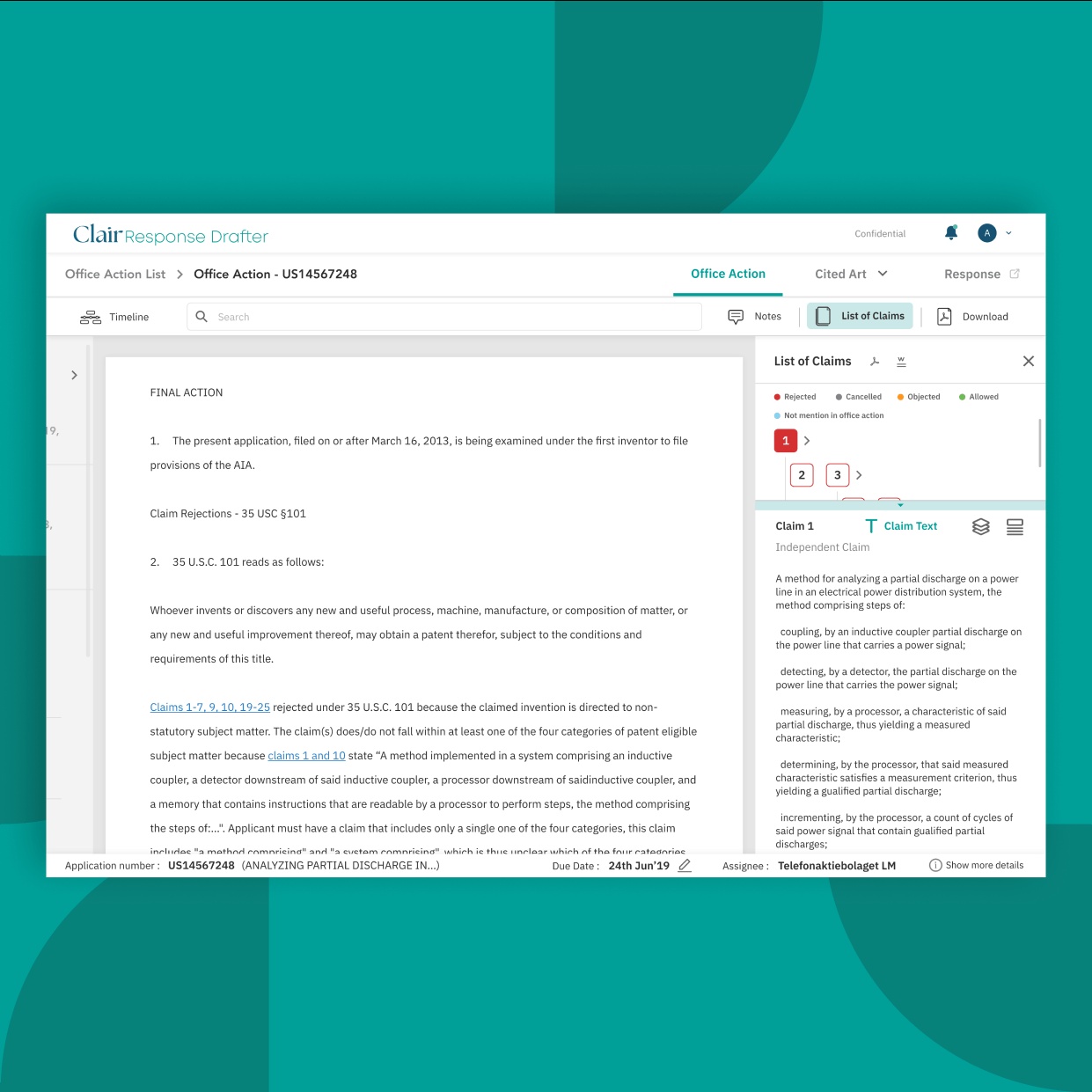
Clair Response Drafter concentrates on US office action responses. Its guided reading puts the examiner’s position beside claims and cited material; contextual search helps locate relevant passages; claim maps expose dependencies and history. Drafting follows research and strategy within the same interface. The appeal is easy to understand: fewer trips between documents before the professional can begin composing an argument.
Clair IDS tackles information disclosure statement preparation. A paralegal uploads a portfolio; the software gathers references, compares material across patent-family members, assembles a citation matrix and populates forms for review and filing. It is a wonderfully unromantic product description. The object is a checked disclosure package, with less gathering and copying between the starting point and the reviewer’s desk.
Docket Assist tackles correspondence and action assignment. Clair Insights addresses another level of the problem: classification, prosecution metrics, claim-scope changes, costs and portfolio decisions. Together these products show how specific the company’s software ambition is. Each begins with a recognizable job, an input and a professional who needs an output they can use.
- 01Incoming mailDocuments and attachments
- 02Extract + classifyIdentify information and actions
- 03Apply rulesClient procedures and data entry
- 04Expert reviewValidation and quality assurance
The services range is broader. Clairvolex prepares patent applications and responses, provides paralegal support, and undertakes searches and licensing analysis. An IP team can seek help at a particular stage rather than buy an entirely new operating model. That flexibility is commercially important in a department that already has counsel, databases, internal procedures and a docketing platform.
A portfolio is also a bill
The company reports more than 100 active corporate and law-firm clients, including 14 of the top 50 worldwide IP filers. Its experience page records 8.90 million docketing actions over a decade. Those are company-reported measures of activity, but they explain the emphasis on repeated tasks. A small improvement has more room to matter when the task keeps returning.
Clair Insights also asks a less comfortable question: which patents should be renewed, and which should be abandoned? Its metrics cover prosecution and maintenance costs as well as portfolio quality. A patent count is easy to display. A useful spending decision requires a closer look at the individual asset and the business it is supposed to support.
Marvell’s published testimonial describes Clairvolex’s annual assessment of patent strengths as helping inform renewal decisions. The search and monetization practice takes another route to value, preparing evidence-of-use analysis, claim charts and licensing packages. These activities give a portfolio owner material for commercial decisions. A chart or ranking is an aid to that decision; someone still has to decide what to do with it.
What the money bought
In 2015, Clairvolex received Series A investment from Indus Age Partners and Anaqua. The accompanying Anaqua partnership proposed jointly offered IP asset management solutions. In June 2019, an additional $3.5 million Series B tranche, led by Walden Riverwood Capital, was earmarked for LEAP-IP’s market penetration and expansion in the US and Europe. The contemporaneous account also described plans to add data-science and engineering capacity.
In September 2020, Inc42 reported INR 16.6875 crore raised through compulsorily convertible debentures from an IndusAge fund and JF Mauritius SPV. These financing events show the resources behind the software effort. They are investment amounts, rather than the price a customer pays for a Clair product.
Clairvolex’s published telecom case covers approximately 4,000 patent applications and more than 6,400 office action responses. Company-reported results from one engagement.
The telecom case is useful because it gives savings a setting: a sustained engagement across multiple jurisdictions. For a prospective buyer, the meaningful comparison would include the workload, the existing process and the quality of the resulting work. The estimate is a reason to investigate the economics of a similar operation, with its own baseline.
The instructions still matter
Clairvolex’s published trademark docketing case contains a detail more revealing than an AI slogan: 158 pages of standard operating procedures, plus more than 60 client-specific instructions. Its approach included training, quality checks, performance monitoring and refresher assessments. The procedures are part of the product’s operating environment. Automation needs to know what competent performance looks like.
That provides a lesson other businesses can copy. Start with repeated work. Describe its rules. Decide which preparation can be automated and where review belongs. Measure the result against the old process. The same reasoning also sets conditions on usefulness: unclear procedures, inaccessible documents or insufficient review weaken the arrangement. A low-volume operation should examine whether integration and oversight costs outweigh the time it might save.
Clairvolex sits among IP software companies and specialist service providers. Anaqua illustrates the market’s overlap particularly well: an alternative in some software buying decisions, and a historical partner and investor. Clairvolex’s pitch rests on the connection between tools and delivery expertise. Buyers should assess that connection against the particular job they need done.
A May 2026 recruitment post carries the thought forward. While promoting automation of manual patent and trademark workflows, Clairvolex sought experienced paralegal, docketing and IDS professionals for its Gurgaon team. The company still has room for people who understand complex families and judgment calls. After all, making the inbox move faster is useful only if the work arriving at the other end is worth trusting.
Take a closer look
Explore Clairvolex, its Response Drafter and IP services. Watch the Response Drafter demo, follow the company on LinkedIn, X or Facebook, and read the 2019 funding coverage or the Clair IDS launch announcement.