A patent reference is an unpromising place to look for a business story. It might be another patent, a paper, a document that somebody has to associate with the right application. It lacks the romance of the laboratory. Yet move it across a growing portfolio and a deceptively small job becomes a coordination problem. Who has seen it? Where has it been cited? Which case needs attention next?
MaxVal Group has made that sort of question its occupation. The company provides software and services for managing intellectual property, from collecting an invention disclosure to maintaining a portfolio. Its appeal lies in an unfashionable proposition: ideas need administration. The person with the breakthrough and the person watching the filing calendar are working on the same asset, even if only one gets a celebratory photograph.
- Symphony runs the portfolio: inventions, patents, trademarks, deadlines and renewals in a Salesforce-based platform.
- Max-IDS handles the references: a specialist tool that can work with an existing IP system.
- People finish the work: MaxVal also supplies docketing, search, paralegal and other IP services.
01 The founder had occupied both sides of the desk
D. Bommi Bommannan founded MaxVal in 2004. His career had already taken him through a useful sequence of perspectives: inventor, patent agent, attorney. He worked in research, at law firms and inside companies. An invention was something he had helped create, something he had helped describe, and something he had helped protect.
That history helps explain the business he built. MaxVal’s leadership biography traces its early patent monetization work to life sciences, followed by portfolio work across other sectors. The organizing idea was the value of a patent over its lifetime. A filing is one event in that life; the record, the decisions and the follow-through keep accumulating.

In 2014, MaxVal acquired Intellectual Assets, Inc., an advisory business working with R&D, business development and licensing groups. The acquisition broadened its expertise beyond patent operations into project evaluation, competitive intelligence and strategic decisions. That matters because keeping an asset in order and deciding what to do with it are closely related jobs.
02 One system, several kinds of work
Symphony is MaxVal’s central IP management platform. A corporate team can collect invention disclosures, manage prosecution and docketing, review its portfolio and handle renewals. Trademark management is part of the offering too. Reporting and configurable workflows give different participants a way to work from shared records.
The choice of Salesforce as its foundation is revealing. MaxVal’s explanation is that it wanted to concentrate on IP management while benefiting from an established platform’s security, workflow, reporting and document capabilities. It is a sensible allocation of attention: build the specialist layer on infrastructure already being developed for a much larger market.
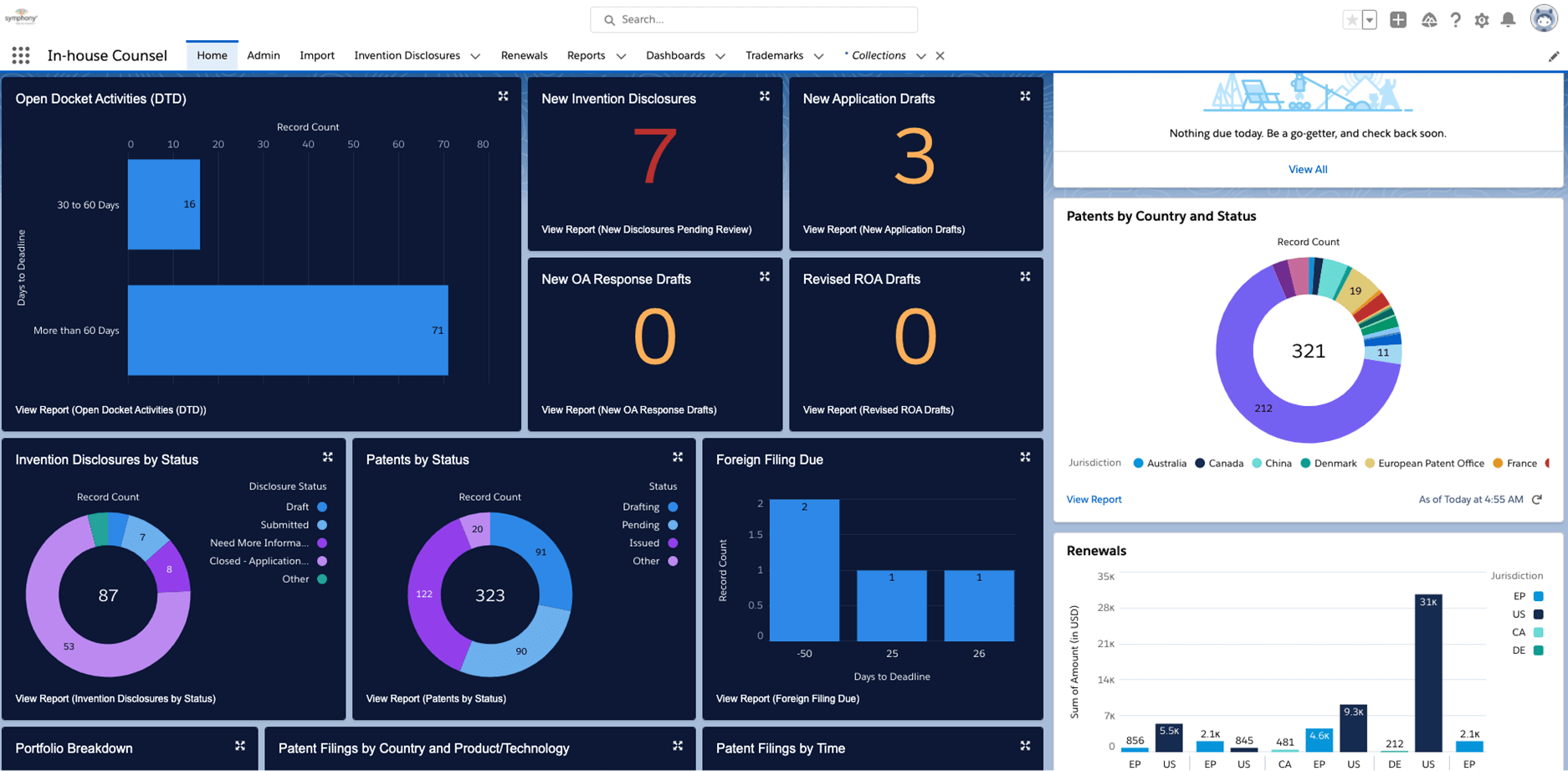
The law firm version has a different complication to solve. A corporate department manages its employer’s portfolio. A law firm must accommodate multiple clients, each with particular permissions, processes and expectations. In January 2022, MaxVal announced a partnership with Baker McKenzie to extend Symphony into that world.
The announced functionality included client-specific controls, configurable workflows, billing and time-management integrations, and dashboards for clients and partners. Baker McKenzie selected the partnership after a market review, according to the announcement. Here, the change in product direction came from a concrete customer setting: the same portfolio machinery had to serve many separate relationships.
- 01CaptureRecord the idea
- 02EvaluateSearch and review
- 03ProsecuteTrack the work
- 04MaintainReview and renew
03 The small tool with a large filing cabinet
Max-IDS takes a narrower bite. It manages prior-art references and generates Information Disclosure Statement packages. Users can download references, associate them with cases and track cross-citations. The product can sit beside a current IP management system, integrate with Symphony, or become a process that MaxVal runs for the customer.
That flexibility is commercially useful. A legal team need not replace its entire system to address one troublesome task. MaxVal says the product has served filers since 2006 and advertises a 40 percent reduction in time spent generating IDS packages. Treat that percentage as a vendor claim to test against your own workload.
MaxVal’s advertised reduction for Max-IDS. A product claim, not a measured result for every customer.
Pure Storage selected Max-IDS in June 2025. Its legal director for IP and product, Elizabeth Morris, described the attraction in operational terms:
“Max-IDS delivers the automation and control we need to reduce risk, ensure accuracy, and drive efficiency.”
Elizabeth Morris / Pure Storage / June 2025
The law firm WAVS IP offers a different kind of evidence. In August 2025, MaxVal announced that the firm had fully integrated Max-IDS into its services workflow after years of use. The announcement reports improvements in efficiency and quality without attaching a numerical result. Continued use tells a useful story, but it is not a stopwatch.
MaxVal also announced Max-IDS updates in March 2025 for cumulative reference tracking and automated fee selection in response to the USPTO’s revised IDS fee structure. The detail is wonderfully prosaic. A reference count can affect the filing bill, so the product has to keep up with the rules around the record.
04 Software has colleagues
MaxVal’s services page makes a candid observation: software cannot perform every function in the IP lifecycle. The company sells human support alongside the platforms, including docketing, renewals, paralegal work, patent searches, illustrations and consulting. Its business model combines B2B software with specialist service engagements.
Some of that expertise comes through integrations. A 2021 RWS partnership brought translation and international filing services into Symphony, allowing practitioners to order and track work within the portfolio system. A 2023 Corsearch collaboration addressed global trademark data. These are attempts to shorten the distance between a record and the work it requires.
Relecura adds another layer. A partnership announced in 2024 led to the May 2025 integration of NoveltyAI and ClassifierAI. The tools support novelty searches and patent classification within Symphony, including summaries, relevance ranking and filtering. For a review committee, the attraction is information arriving closer to the decision it informs.
Our reading of this approach is that MaxVal wants to reduce the friction around professional judgment. A search result still needs interpretation; a classification still needs to suit the portfolio. The company’s own October 2026 article on patent analytics extends that thinking upstream, into what R&D teams choose to investigate and build.
05 Buy the handoff, not the adjective
MaxVal serves corporate counsel, patent operations teams and IP law firms, ranging from startups to large companies. RapidSOS selected Symphony in June 2025 to centralize and automate a growing portfolio. TP-Link’s February 2025 selection announcement emphasized transparency and reporting. Those are recognizable needs when people and records multiply.
The market has serious alternatives. Clarivate’s IPfolio is also built on Salesforce, and Anaqua’s AQX also brings portfolio management, workflows and analytics together. MaxVal’s platform foundation is therefore not an exclusive advantage. Its more useful proposition is the particular combination of Symphony, a specialist reference tool, services and integrations. Buyers should compare how that combination handles their actual work.
The economic question begins with the whole engagement. A useful budget separates software access, implementation, record migration, integrations and ongoing services. Public product pages lead to a demonstration and sales conversation. For a buyer, the practical comparison is the quoted scope against the cost of the current process: staff time, repeated checking and work passed between providers.
Start the evaluation with a reference that appears in several cases. Follow it through the system. Then try a deadline and a renewal. Check who approves the result, who can see it and what happens when incoming information is incomplete. These are our suggested buying tests, drawn from the jobs MaxVal’s products address.
In that exercise, the first failure to look for is a handoff: a record that does not reach the next person with enough context to act. Automation depends on usable data, maintained rules and clear responsibility. A team with very little filing activity may have less to gain from a broad platform; a complicated portfolio with poorly maintained records will need cleanup as well as software.
There is a lesson here for anyone managing consequential work. Pick a recurring task, give it a reliable record, decide who owns the exceptions and keep expert help within reach. MaxVal applies that discipline to intellectual property. The invention may arrive in a flash. Looking after it rewards a steadier temperament.