The origin of Patent Watch is a ratio: more than 50,000 patents, roughly 10 people. Alex Stroe's brother Andreas encountered it while doing research at Philips, where four patent applications brought him into long conversations with the intellectual-property team. The patents were valuable. The people were capable. The calendar was merciless. Even a large company could not keep watch over every claim, every rival product, every possible collision between the two.
For Alex, the gap looked familiar. Before becoming a legal-tech founder, he had worked in startup sales and marketing, traded funded accounts, and moved through buyer, analyst, and business-development roles at defense manufacturer Curtiss-Wright. Those are different worlds with a shared nuisance: too much information, too little time, and consequences attached to the decision. A patent portfolio simply made the imbalance unusually visible.
The brothers started building part-time. Their question was commercial before it was technical. What happens after a company pays to secure an invention? Too often, the answer is that the document is catalogued, maintained, and occasionally revisited. Alex saw a costly asset behaving like an archive. Patent Watch would try to give it an operating rhythm.
Chapter 01The useful outsider
Patent work rewards expertise and patience. Alex arrived with a complementary instinct: make the value proposition legible. His earlier startup roles centered on growth and marketing. His Y Combinator biography adds two cheerful curveballs, day trading funded accounts and spending more than $1 million on advertising. One teaches a person to respect evidence under pressure; the other teaches that attention is expensive and vague messages die young.
Patent Watch's pitch is correspondingly concrete. A company uploads patents. The software interprets claims, researches products, and produces structured claim charts that map the words of a patent against a product's features. It can also search for prior art, examine patent validity, and help find counter-litigation possibilities. Each task once meant a fresh expedition through databases, product pages, papers, and technical documents. Alex wants the expeditions turned into repeatable workflows.
The last step matters. Alex has publicly rejected the idea that AI should simply sweep away the IP department. His preferred frame is leverage: software does more of the searching and structuring, while specialists decide what the evidence means and what should happen next. It is a practical stance for a field where an assertive-looking result can carry legal and financial weight.
“We're not here to replace IP teams. We're here to unlock their leverage.”Alex Stroe
Chapter 02The brother test
There is a charming bluntness to two brothers founding a company around a problem one of them brought home from work. Andreas supplies the inventor's proximity. At Philips, his applications forced him to see how the machinery behaves after invention. Alex supplies the commercial translation, turning a specialist's frustration into a product that a licensing manager, patent attorney, CTO, or head of research can understand.
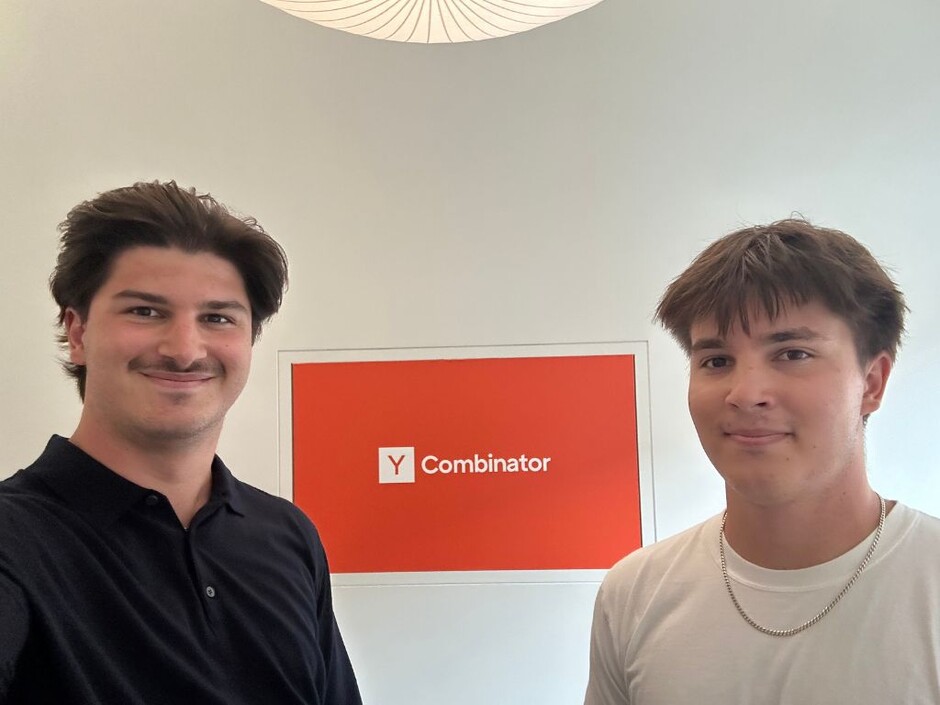
Their YC launch put the family resemblance to work. The photograph of Alex and Andreas beside the orange Y Combinator sign came with a teasing caption asking whether anyone could tell they were brothers. The joke softened a dense subject. Immediately below it sat the company's core in plain language: upload patents, receive possible matches and claim charts, investigate prior art, and prepare faster when litigation arrives.
By then, the part-time project had accumulated adult responsibilities. Patent Watch announced a $400,000 oversubscribed pre-seed round in 2025, backed early by Hustle Fund and Rockstart. It entered YC's Fall 2025 batch, grew to a six-person team, and described customers ranging from private inventors to Fortune and Global 500 companies. Confidential work is hard to turn into founder folklore, so Alex's public story has focused on the shape of the problem rather than client trophies.
Find the expensive asset a company already owns, then locate the work its team is responsible for but rarely has enough hours to perform.
Chapter 03From feature to platform
The product scope widened quickly. Early messages centered on infringement detection. By mid-2025, Alex was describing a centralized IP platform that could stretch from due diligence and drafting to portfolio management and infringement work. The ambition creates a harder product problem, because every new module must preserve the chain between an assertion and its evidence. It also reflects how customers experience patents: infringement rarely sits alone. Validity, prior art, freedom to operate, portfolio pruning, licensing, and litigation lean on one another.
On April 1, 2026, Patent Watch announced a $2.8 million seed round led by FundersClub, with participation from Y Combinator, Transpose Platform, Blast, and other investors. Alex said the financing brought total funding to $3.2 million. Alongside it came Patent Watch 2.0, offering custom workflows, improved modules, and a refreshed interface. The phrasing was characteristically operational. The money was fuel; the release explained where the vehicle was going.
The transition also reveals Alex's central bet. Better search is useful, yet search ends with a list. Patent Watch wants to follow the work farther, into the analysis and documents that support licensing, enforcement, diligence, and portfolio decisions. In startup language, it is the move from finding information to helping a customer complete a job. In newspaper language, the clipping service would like to run the city desk.
Chapter 04Planes, panels, pavement
Alex's public life has expanded with the product. He flew into London for Future IP UK, spoke about AI-assisted infringement detection, and left 12 hours later. His takeaways from the room were sober: build layered IP protection and keep watching competitors. Later, he joined an IP Dealmakers panel in Austin about AI across the patent lifecycle. In May 2026 he returned to London for an industry workshop on practical AI use across patent work.
The travel produces small observations that suit him better than executive maxims. On a London sidewalk, he noticed a patent number beneath his feet. Patents, he wrote, protect much of what people see and touch. The detail is almost comic: the founder arrives to discuss invisible corporate assets and discovers one stamped into the pavement. Oscar Wilde might have preferred a plaque. Alex got prior art underfoot.
There have been more conspicuous markers. In early 2026, Patent Watch's logo appeared in Times Square. Alex wrote that it put the distance from the company's part-time beginnings into perspective. Yet the same update emphasized building, hiring, and shipping. A billboard can celebrate motion; it cannot do the work. Patent portfolios are indifferent to neon.
A patent is a promise written in legal and technical language. Alex Stroe's company is building the to-do list that follows.The YesPress view
Chapter 05The asset after the applause
The clever part of Patent Watch's story arrives after the usual innovation narrative ends. Companies celebrate inventions, file applications, win grants, and frame certificates. Maintenance continues for years. Meanwhile, products change, rivals ship, markets split into subcategories, and claim language waits for someone to compare it with reality. The administrative triumph of owning a patent can conceal the operating burden of understanding what it is worth today.
Alex wants that burden made visible and manageable. His aspiration is straightforward: help patent portfolios become easier to protect and monetize. The grander version is a full-stack platform where teams can construct their own workflows across infringement, validation, prior art, and analytics. Either version depends on trust. The platform has to show its work, keep evidence attached, and fit the habits of specialists who know when a neat answer is hiding a messy question.
His career looks unusually well suited to selling that proposition. Marketing taught him how to explain. Defense work exposed him to industries where documentation and procurement matter. Trading made feedback immediate. Startup operating made iteration normal. Andreas supplied the close encounter with invention and institutional constraint. Together, the brothers found a business in the distance between owning an asset and having the time to use it.
There are louder AI pitches. This one begins with a dusty portfolio, a small team, and a queue that no amount of personal diligence can empty. Alex Stroe is betting that the next useful era of patent software will be measured less by how many documents it can find than by how much responsible work it can help finish. Fifty thousand patents may still be a formidable stack. At least the stack now has a watch.