Before Fausta Ballesteros had a C-suite title, she had a habit. Growing up in a small town in Argentina, she introduced people who ought to know one another. She shared their stories, spotted common interests and made the connection. It is a modest origin for a global marketing career, which may be precisely why it explains so much. Across oil, consumer brands, software engineering and artificial intelligence, Ballesteros has kept returning to the same work: help people see the point, then help them see each other.
Today she is Chief Marketing Officer at Wizeline, the technology-services company, leading its global brand and go-to-market work. The vocabulary around her has changed. It now includes AI-native enterprises, automated workflows and generative search. Her own vocabulary remains strikingly social: culture, teams, trust, visibility, experimentation. Machines may generate the copy. Organizations still have to decide what they believe, how they learn and whether anyone feels safe enough to admit that yesterday's answer has expired.
This is the useful tension in Ballesteros's story. She markets technology without confusing technology for the whole product. The campaign can be polished, the model can be clever and the presentation can be packed with arrows. If a team cannot turn any of it into a habit, the future remains a slide.
The connector learns to sell
Communications came first. Ballesteros studied the subject at Universidad Austral in Buenos Aires, then went into public affairs and issues management for Shell Latin America. The work required stakeholder judgment, but a move into sales and retail-franchise relationships supplied a different education. Argentine gas stations, she has observed, are not merely pumps beneath fluorescent canopies. They are gathering places. Understanding why customers chose one, lingered at one or trusted one made marketing tangible.
She followed that curiosity into a master's degree in Marketing at Universidad de San Andrés. Consulting work brought assignments involving Unilever and American Express, brand public relations, launches, events and celebrities. Then she started a communications company focused on women, years before the subject became a dependable panel topic. The firm developed soccer and hockey tournaments for college-age and post-college women, giving participants a credible activity and sponsors a reason to join it.
Then came the break in the neat chronology. In 2007, pregnant with her first child, Ballesteros moved with her husband to the United States. She left a growing Argentine career for a market she did not yet know, in a language that was not native to her. She explored New York, began a blog and freelanced as a journalist on trends, business and entrepreneurship. Reinvention sounds elegant after the fact. At the time, it mostly consists of doing the next available useful thing.
Globant became the second act. Ballesteros started as a consultant on U.S. public relations and marketing communications, then rose to lead the function in the United States. Her remit expanded across events, analysts, thought leadership, brand development and Europe. So did her family: she became the mother of four boys while her responsibilities grew. She also helped see Globant through its 2014 public offering, a moment she has called one of her career highlights.
“You always can make your mark, empower someone, open a door, coach or mentor and bring another perspective.”Fausta Ballesteros
A corporate event acquires a pulse
A mentor, Andrés Angelani, eventually persuaded her to move to Softvision. There she found a company with technical credibility and little American brand muscle. The job was part excavation, part translation: discover what the business already did well, reposition it as a global player and make its culture visible enough to travel.
Programmers' Week became the clearest artifact of that approach. What began as a one-day event in Romania grew into a week-long celebration of a distributed developer community. When work abruptly went remote in 2020, the event moved online. More than 100 speakers delivered 85 tech talks across India, Romania, Canada, the United States and Argentina. The numbers are respectable. The transformation is better: employees who normally appeared as capacity on an organization chart became teachers, hosts and protagonists.
Recognition followed. The virtual edition received a Facebook Workplace customer-success award. The 2021 program later earned a Bronze Stevie. A separate Women in Engineering project asked women engineers to photograph their daily lives during remote work. The black-and-white exhibit placed third among 385 nominations at Romania's Webstock Awards. Ballesteros described belonging as the point: people working hard in isolation could recognize one another's full lives, not merely their output.
Her management philosophy was visible at home too. During lockdown, she organized menus, school, chores and activities on lists and a kitchen blackboard. Everyone had a role. Everyone had some skin in the game. Her youngest interrupted the high theory with an urgent request for candy. The anecdote is funny because it punctures the executive fantasy of control. Good systems do not eliminate chaos. They make room for people to help when chaos arrives.
“My family is a team, and my team is a family.”Fausta Ballesteros
The classroom follows her to work
Education sits quietly behind much of Ballesteros's public work. She completed a women's leadership executive program at Yale School of Management in 2021 and has continued to advocate for STEAM education and women entrepreneurs. In an essay about hybrid schooling, she argued that students should help create both the curriculum and the experience, with learning rooted in real projects, experimentation and personal agency. The same verbs appear in her management advice. People learn by taking charge, trying something and sharing what happened.
Her approach to visibility follows the same logic. Personal branding, in her telling, is not the daily manufacture of a more impressive self. It begins with self-awareness, then makes genuine strengths easier for the right opportunities to find. The distinction explains why she returns so often to coaching, introductions and opening doors. Visibility is useful when it produces alignment, not simply attention. A person should become more legible without becoming a slogan.
AI arrives, certainty leaves
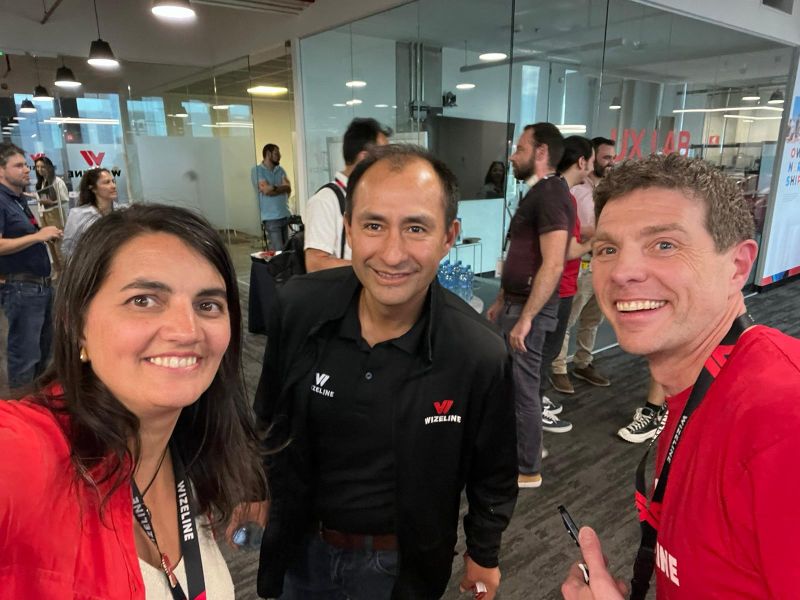
Wizeline appointed Ballesteros CMO in 2024. The role reunited her with Angelani and placed her alongside founder Bismarck Lepe. In a candid she called “worlds colliding,” the three stand shoulder to shoulder at a Wizeline gathering. It is a compact picture of how careers actually advance: capability matters, but so do mentors, shared history and the memory of being useful under pressure.
At Wizeline, the subject is increasingly AI. Ballesteros's most distinctive contribution is to resist treating AI fluency as a static possession. She has said she would question a candidate who claimed to know everything about it. The tools move too quickly. What she wants instead is a temperament: comfort with change, willingness to experiment, readiness to fail fast, practical curiosity and the ability to learn peer to peer.
That argument turns hiring from a hunt for finished experts into the design of a learning system. A knowledgeable loner may impress for an hour. A curious teammate can raise the pace of everyone nearby. Ballesteros describes champions and small teams spreading skill through practice. In 2026, commenting on Wizeline's expanded AI training with DataCamp, she put the distinction neatly: move from knowing about AI to using it role by role, workflow by workflow.
The brand after the search box
By 2026, Ballesteros was also speaking about a second-order effect of AI: buyers increasingly meet a company first through an answer assembled by a machine. At Pepper's Index '26 in New York, she joined a discussion of brand defense, B2B strategy and the marketing funnel after generative search. Her observation was acute. AI-driven discovery can produce faster leads, yet those buyers may enter sales conversations less certain about what they need. The funnel did not vanish. It became harder to draw.
Her closing prescription avoided prophecy. Waiting, she said, is neither an option nor a neutral act. Move budget toward execution. Pick a marketing workflow. Compress it from days to hours. Transform. Perform. Then move to the next one. For an industry fond of declaring new eras, this is pleasingly unceremonious advice.
It also completes the circle. The child who introduced people in Argentina became an executive concerned with how people and companies will be introduced by machines. The medium is new; the responsibility is familiar. Make the story accurate enough to travel. Build a culture capable of learning when it lands. Leave the door open for the next person.
“Waiting isn't an option and it's not neutral. Shift your budget to execution.”Fausta Ballesteros at Index '26
Ballesteros has a favorite cluster of imperatives: be useful, leave a light on, light up. She explains it through ordinary acts, such as making an introduction, coaching someone, opening a door or rescuing a meeting with a joke. There is no grand theory of leadership hiding behind the language. There is repetition. Culture, in her telling, is made from small contributions performed often enough that other people begin to copy them.
That may be the cleanest way to understand her work. She does not merely package transformation for the market. She tries to make organizations hospitable to it. In the age of artificial intelligence, the rare skill may be neither prediction nor certainty. It may be the old human art of helping a room become a team.
Follow the work
- Fausta Ballesteros on LinkedIn
- Wizeline leadership profile
- The Mentors Office conversation on teams, personal branding and AI
- Global Marketing Leaders conversation
- Her 2020 long-form interview on culture and connection
Profile updated September 2026.