The revealing line in Christina O’Reilly’s new-job announcement sits beneath the title. She wrote a job description for herself: help a technology company get clear on what it stands for, where it wins, and how marketing drives real business outcomes. That sentence is compact enough to fit inside a social post. It also contains the operating logic of a career that has moved through enterprise software, online safety, data analytics, cloud services and now the unruly stream of social media.
O’Reilly joined Hootsuite as Chief Marketing Officer in April 2026. The timing gives the assignment extra weight. Hootsuite’s founder Ryan Holmes had just returned as chief executive. Artificial intelligence was remaking how marketing teams create, listen and decide. Hootsuite itself was preparing to recast its product portfolio as a social operating system, with a conversational AI layer built on live social data. A familiar platform was entering a period of reinvention.
Her role sits inside that change: lead global marketing, sharpen the go-to-market story and connect positioning to enterprise growth. The interesting part is the distance between the inputs and the outcome. Social produces an endless supply of signals. A company still has to interpret which ones matter, choose a response and organize people to act before the moment closes. O’Reilly’s working material is clarity under time pressure.
The detective in the marketing department
Her route into the profession started somewhere less obvious: criminology. O’Reilly earned a Bachelor of Social Sciences at the University of Ottawa, studying from 1991 to 1995, then completed a Marketing Management program at George Brown College. She has explained the bridge plainly. Human behavior and motivation fascinated her. Marketing offered a place to put that curiosity to work.
That background invites an easy metaphor, but the practical lesson is better. Complex purchases rarely turn on a feature list alone. A marketer has to reconstruct the scene around a decision. Who feels the problem? What risk do they carry? Which proof will travel from an internal champion to finance, security and the executive team? A useful message accounts for the behavior of a group, not only the preference of an individual.
O’Reilly learned that work across functions. Early in her career she collaborated with sales, managed events and drove demand generation. She went on to hold roles at PeopleSoft, Microsoft and SAP, companies that sell systems whose value must be translated across technical and commercial audiences. The products changed. The assignment stayed recognizable: make a complicated thing legible without flattening what makes it valuable.
Enterprise marketing also teaches a particular patience. The person who first notices a product may never sign the contract. A message has to survive a chain of retellings, moving from a practitioner to a manager, a technical reviewer, a procurement team and an executive sponsor. Each person needs a different reason to believe, while the company must still sound like one company. O’Reilly’s career has repeatedly placed her inside that translation problem.
“Understanding human behaviors and motivations fascinated me.”Christina O’Reilly
Her public advice to younger leaders carries the same attention to people. Be authentic. Find a mentor and become one. Support the community. Volunteer. Stay curious. Pair data with empathy and transparency. These are modest verbs, closer to habits than slogans. Together they describe leadership as a loop of listening, learning and returning value.
From online safety to the data estate
At Two Hat Security, an AI content-moderation company later acquired by Microsoft, O’Reilly led marketing and policy work around online safety. In 2020, she described a communications program that linked the company’s message to policy initiatives and amplified it globally. The campaign earned a Hermes Creative Award. It was a particular kind of marketing problem: the product operated deep inside online communities, while the public conversation involved trust, responsibility and the limits of automated moderation.
The work required technical fluency and institutional judgment. A content-safety tool cannot be presented as a shiny layer of automation. Its story has to travel through policy, platform governance, customer risk and public expectations. O’Reilly’s role placed her where those concerns met.
She then became CMO of Gensquared, a Canadian data and analytics consultancy. The company was later acquired by EY. While there, she hosted Data-Driven Leaders, interviewing executives about the difficult work behind a data-driven culture. The premise was revealing: data becomes useful through the people who collect it, challenge it and decide what to do next.
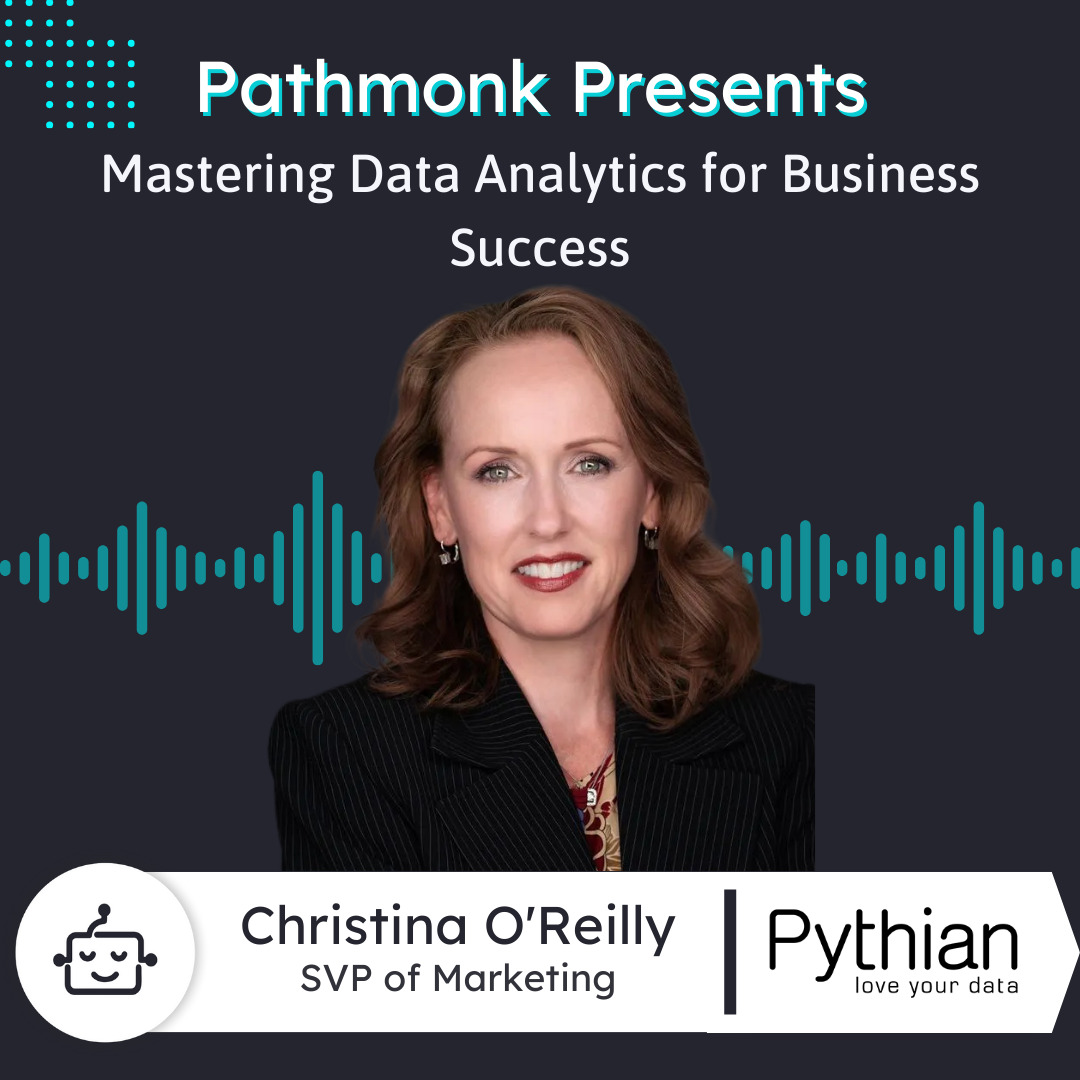
Her own podcast conversations returned to value, governance and action. In one episode she highlighted an executive’s comparison between data and money: both deserve diligence and care because both carry inherent value. As a guest on Pathmonk, she made the advice operational. Start with the cleanest data set possible. Understand how to apply it. Keep training as technology changes. Then trust your gut.
Hosting changed her position in the conversation. A marketer is usually expected to arrive with the answer; an interviewer earns progress by asking the next useful question and leaving enough room for surprise. The format suited the curiosity she traces back to behavioral science. It also made visible a recurring theme in her work: knowledge becomes strategic only after people can explain it, challenge it and carry it into a decision.
That last phrase matters because evidence does not remove responsibility. A dashboard can surface a pattern; it cannot accept the consequences of a decision. O’Reilly’s formulation gives intuition a disciplined place. Good judgment grows from exposure, curiosity and clean inputs. It is neither a mystical substitute for evidence nor an automatic output of software.
A career built around translation
In January 2023, O’Reilly joined Pythian as Senior Vice President of Marketing. She led global work around data, analytics, AI and cloud services. Pythian’s challenge resembled the ones before it at a different scale. Customers had fragmented systems, legacy infrastructure, governance questions and no single clean path into artificial intelligence. Marketing had to show how a portfolio of services could meet a company at its current stage and move it toward a usable outcome.
O’Reilly spoke about tailoring solutions to each client’s data objectives. She also stressed the prerequisite that tends to disappear during an AI rush: define the goal and put the house in order. The phrase carries from a data estate into a marketing organization. Buying another tool will not repair a workflow whose owners, approvals and standards remain unclear.
Former colleagues have described her as a long-range strategic thinker who also moves quickly, with empathy for the people doing the work. One recommendation points to the early pandemic, when she helped keep a marketing team focused through uncertainty. Another comes from outside a conventional marketing department. After moving from Toronto to Kelowna, O’Reilly worked on Imagine Kelowna, the city’s long-term community vision, then adapted to transportation technology and urban-design projects. The common praise was versatility: she could organize people with different expertise around a shared outcome.
That civic chapter adds texture to the executive résumé. Public engagement is full of competing perspectives, incomplete information and consequences that resist a neat campaign metric. The work asks for research, stakeholder management and patience. Those muscles are equally useful when a marketer has to reconcile a product roadmap, a sales target, a customer problem and a brand promise.
The distance problem
At Hootsuite, the raw material moves faster. A complaint, meme, cultural turn or product conversation can gather meaning across networks before a weekly report reaches the meeting where someone can approve a response. The strategic question is less about collecting more information and more about shortening the responsible distance from observation to action.
That is also the premise of O’Reilly’s current public work. In a Hootsuite webinar, she and colleague Ben Cathers examine why adding more AI tools does not automatically transform marketing. Disconnected dashboards, approvals and manual handoffs still slow the organization. A model may accelerate a task while the surrounding system preserves the bottleneck.
Her scheduled Brandweek conversation puts the problem in sharper terms: turn social signal into strategy. Brands pulling ahead detect what shapes perception, interpret it and act while the opening exists. AI belongs in that chain, especially when it can work with live social information. Human judgment remains the connective tissue.
“I’ve spent 20+ years helping technology companies get clear on how they go to market - what they stand for, where they win, and how marketing drives real business outcomes.”Christina O’Reilly
Her Hootsuite chapter is still new. That makes outcomes premature and the operating question more interesting. Can a large marketing organization become faster without becoming careless? Can social intelligence inform decisions beyond the social team? Can AI close the gap between a signal and an approved action while preserving context, standards and accountability?
O’Reilly’s career does not supply a magic answer. It supplies a repeatable sequence: study the behavior, clean the inputs, clarify the position, organize the people and connect the work to a business result. The sequence has survived several waves of enterprise technology because each wave creates fresh complexity for someone to translate.
The marketer in the criminology classroom was learning to ask why people act. The executive at Hootsuite is asking a related question at network speed: when the signal arrives, what will the organization do with it? Between those two points sits a career spent making the answer clearer.