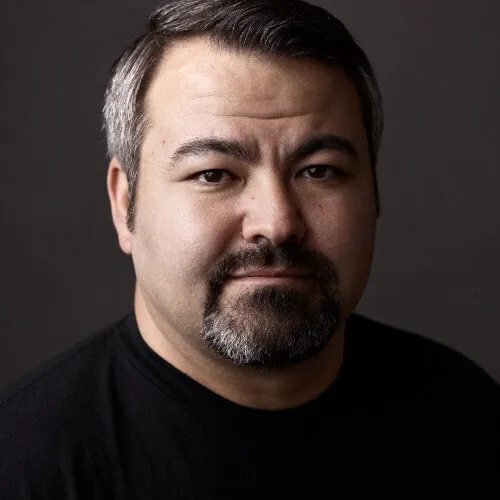
The man with the 15-year head start
Most teenagers are figuring out their first job. Doktor Gurson was filing paperwork with ICANN. The company he built at fifteen - a domain registrar - eventually became the 32nd ICANN-accredited registrar in the world. His last name was not yet a punchline in radiology circles. That part came later.
Gurson is the kind of founder who cycles through industries not because he lacks focus, but because he moves faster than any single market can absorb him. Web hosting. Cryptocurrency infrastructure. Hardware at Y Combinator. Workforce software. And now, the one that stuck - generative AI for radiology. Rad AI, which he co-founded in 2018 with Jeff Chang, a radiologist who began medical school at 16 and is reportedly the youngest person to do so in U.S. history, has grown from a pitch deck into the infrastructure behind roughly half of America's diagnostic imaging workflow.
By 2025, Rad AI had raised $199 million in total funding, hit a $525 million valuation, and was processing reports for nearly 50 million patients per year. Khosla Ventures, Transformation Capital, and Google's AI fund all wrote checks. Deloitte ranked it the 19th fastest-growing company in North America. CNBC put it on the Disruptor 50. The accolades kept arriving with the regularity of a well-tuned radiology workflow - which, of course, is exactly what Rad AI builds.
"We see that combining AI with radiologists yields the best outcomes."- Doktor Gurson, Co-founder & CEO, Rad AI
The founding logic is tighter than most healthcare AI pitches. Radiologists in America are drowning. The volume of imaging studies has grown faster than the supply of radiologists trained to read them. Report generation - composing the written impression at the end of every scan review - consumes a disproportionate chunk of a radiologist's day. Rad AI's flagship product, Rad AI Impressions, automates that step using generative AI trained on real clinical language. Independent data from physician users puts burnout reduction above 80%.
What separates Gurson from the standard-issue AI evangelist is his stubborn insistence that augmentation, not replacement, is the value proposition. In a field where the instinct to position AI as a replacement for human judgment is both tempting and career-ending (hospitals don't replace doctors with software, they buy tools that make doctors faster), Gurson's framing has been commercially precise. Rad AI doesn't threaten radiologist jobs. It absorbs the friction that makes the job unsustainable.
Gurson and co-founder Jeff Chang first worked together at Y Combinator in 2014 - building Doblet, a portable phone charging hardware startup. They got acquired, went separate ways, and reconvened four years later to tackle radiology. Two precocious builders who first met making phone chargers now process medical images for 1 in 6 Americans. Silicon Valley has stranger origin stories, but not many.
Rad AI Continuity, the second major product, tracks incidental findings - the incidental discoveries (a nodule, a suspicious shadow) that radiologists flag but which can fall through the cracks in overwhelmed health systems. Rad AI Continuity ensures those flags become follow-ups. In a system where incidental findings account for a significant percentage of early cancer detections, the downstream value is hard to overstate.
The company's third product line, launched in December 2024, is next-generation speech recognition designed specifically for radiology dictation - a bet that even the interface through which radiologists speak their findings into reports is broken enough to fix.
On the radar
The awards landed in rapid succession through 2024 and 2025 - not the soft recognition that startups pin to their websites to reassure nervous investors, but the hard-edged rankings built on revenue growth and market share. Deloitte's Fast 500 is audited. The CB Insights Digital Health 50 runs on proprietary data. The CNBC Disruptor 50 specifically tracks companies "pioneering" generative AI in healthcare - not companies talking about it.
The bank collapsed on a Friday
In March 2023, Silicon Valley Bank - the financial institution holding operating funds for thousands of startups - collapsed over a single weekend. For founders who had not diversified their banking, it was existential. Gurson was among them. In subsequent interviews, he described the experience with an unusual lack of spin.
"In the moment it definitely was making me physically ill - not knowing whether or not the company you've spent five years building was going to go away overnight as a result of something as unpredictable as a collapse of a bank was really hard."- Doktor Gurson, on the SVB collapse
The company survived. The banking system's intervention - depositors were made whole by regulators - resolved the immediate crisis. But Gurson's candor about the psychological weight of that weekend distinguishes him from founders who perform resilience in retrospect. He sat in the discomfort while it was happening. That kind of present-tense honesty is rarer than funding announcements, and more useful.