Scene
It is 2:14 a.m. somewhere in the Midwest. A radiologist is on her seventh CT of the night, dictating findings into a microphone that has heard a thousand abdomens. When she stops talking, a draft of the impression - the part of the report a referring doctor actually reads - is already on the screen. She edits two lines and signs. The next study loads. This is the room Rad AI built its company inside.
Who they are now
A quiet operating layer for American radiology
Rad AI is a 230-person, San Francisco-headquartered software company whose products run inside more than 200 hospitals, health systems and radiology groups. The customer list, by the company's count, performs close to half of all U.S. medical imaging. Nine of the ten largest U.S. radiology groups are on it. The tenth, presumably, has a meeting on the calendar.
What's striking is how unflashy the pitch is. Rad AI does not claim to read scans. It does not claim to replace anyone. It writes the report - or, more precisely, drafts the parts of the report that radiologists hate to write.
// Pull quote, lightly polished. Original spoken into a Dictaphone at hour eleven of a night shift.
The problem they saw
Radiologists are drowning, and nobody wants to be one
The American radiologist reads more studies per year than they did a decade ago. The volume curve goes one way; the workforce curve does not. Burnout in radiology is consistently among the highest in medicine. Hospitals respond by hiring locums and outsourcing reads overnight. Patients respond by waiting longer. The whole system has been quietly trading sleep for throughput.
Into this picture stepped a wave of AI companies promising computer vision that would catch the cancer the radiologist missed. Most of them got fewer customers than expected, and learned a brutal lesson - radiologists are not, on balance, looking for a second opinion. They are looking for ten minutes back.
The tension
Every founder who walked into radiology in the last decade tried to read the picture. Rad AI typed the words underneath it. That is the entire bet, restated in one sentence.
// Filed under: lessons it took the rest of the industry six years and roughly two billion dollars to learn.
The founders' bet
A 16-year-old med student grows up
Dr. Jeff Chang started medical school at NYU at sixteen. He finished a fellowship in musculoskeletal MRI and then worked overnight ER radiology shifts for ten years - the kind of decade that teaches you, viscerally, which keystrokes you have repeated 400,000 times. He went back for graduate work in machine learning. The intent was practical. He wanted to remove the keystrokes.
His co-founder, Doktor Gurson, had previously built consumer ventures - Doblet, a phone-charging hardware company, and Lifetime Host - and studied at Berkeley Haas. Yes, his first name is Doktor. No, he is not a doctor. He runs the company.
The two of them started Rad AI in 2018 with what now reads as a counter-trend hypothesis - the most valuable place to apply AI in radiology was not the image at all. It was the report.
// One co-founder reads the scans. The other built a phone charger. Somehow this works.
The product
Three tools, one continuous workflow
Rad AI's catalogue is small on purpose. There are three things, and they hand work to each other.
Rad AI Impressions watches a radiologist dictate findings, and generates the impression section - the summary clinicians actually act on - in the radiologist's own style. In roughly five percent of reports, it catches a clinically significant discrepancy between findings and impression. Five percent sounds small until you remember it is five percent of every report at scale.
Rad AI Omni Reporting is the reporting platform itself, a generative-AI-native replacement for the legacy software radiologists have been complaining about for fifteen years. A feature called Omni Unchanged lets a radiologist dictate complex follow-up exams up to fifty percent faster, using up to ninety percent fewer words. The product is, in this sense, an exercise in linguistic compression.
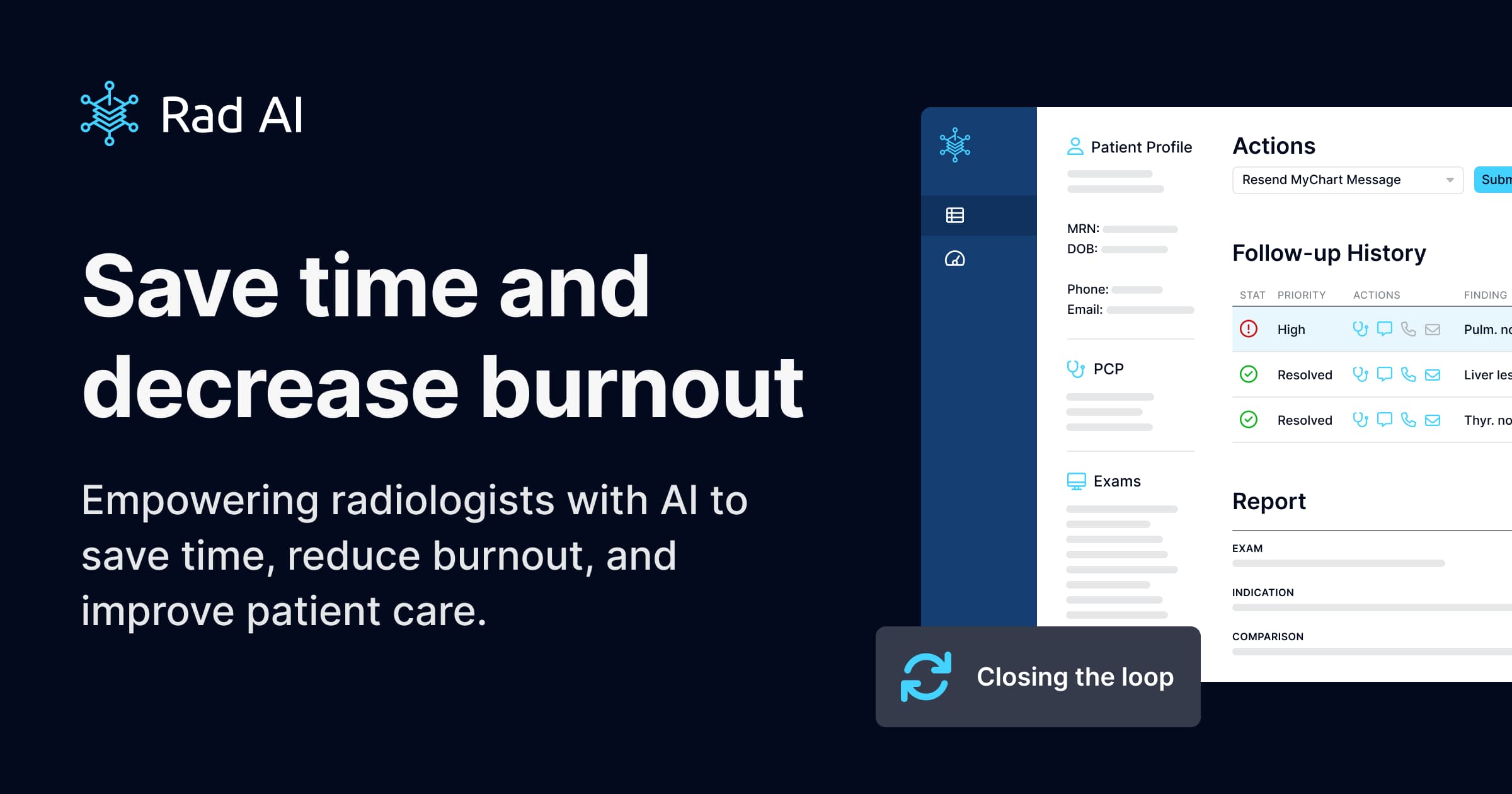
Rad AI Continuity closes the loop after the report is signed. When a radiologist flags an incidental finding that needs a follow-up scan in six months, Continuity makes sure the follow-up actually happens. Deployed alongside Impressions, it lifts the number of clinically appropriate follow-ups by up to forty percent. Patients who would have slipped through the gap don't.
What a Rad AI day looks like
// Numbers as reported by Rad AI and its peer-reviewed and customer disclosures. Bars animate when this card scrolls into view. They are honest bars.
// The 5% bar looks small. It is not small. It is roughly the population of Texas, in scans, per year.
Scrapbook
A short company timeline
// Taped to the office wall, more or less in this order.
The proof
Customers, dollars, peer review
You can argue with marketing copy. It is harder to argue with adoption curves. Rad AI's customer list crosses every category that matters in U.S. radiology - academic medical centers, national radiology groups, regional health systems. Strategic Radiology, a network of more than thirty independent practices, has rolled out Rad AI Impressions across roughly two-thirds of its members, with another third on the full reporting platform. Siemens Healthineers, which sells the imaging hardware in the first place, is a reseller.
And then there is the peer-reviewed study, the first of its kind, that compared radiologist preference for a domain-specific model (Rad AI's) versus general large language models. The radiologists preferred the domain model. This is the sort of result that, if it had gone the other way, would have been awkward to publish.
// Investors have to read decks. Radiologists vote with a right-click.
The mission
Keep the radiologists we still have
Rad AI's stated mission is to maximize human potential in healthcare with AI. The plain-English version is sharper. The U.S. is not going to mint a new generation of radiologists fast enough. The ones we have are leaving. The software needs to do enough of the rote work that the job becomes one a human still wants to do.
This is, notably, not the mission a venture deck would have written in 2018. In 2018 the talk was about AI replacing radiologists altogether. Geoffrey Hinton famously said as much. Seven years later, the radiologists are still there, the volumes are higher, and the gen-AI company doing the most clinical work is the one that asked them what they wanted instead.
Why this matters tomorrow
If Rad AI works on radiology, the same pattern - draft the language, close the loop, hand the human only the decisions - will be tried on pathology, cardiology, and every other specialty drowning in documentation. The interesting question is not whether Rad AI succeeds. It is who copies the playbook first.
// File this section under: things that will be obvious in 2030.
Scene, revisited
Back to 2:14 a.m.
The seventh CT is signed. The radiologist gets up to make tea. Before Rad AI, she would still be typing - which is to say, she would still be at her desk, and she would not be making tea. The work is the same. The volume is higher. The shift ends on time. That is the entire product. It is also the entire pitch. Whether Rad AI ends up being the operating system for American healthcare or merely the most quietly important software company in radiology, the underlying idea has already been proven. The most valuable thing AI can do, right now, is hand a clinician back her evening.