Live
Uber autonomous trips up 10x year-over-year, expanding to 15 cities in 2026 90% of Uber engineers now use AI tools in daily workflows Uber 2025 gross bookings hit $193.4 billion - a company record Dara Khosrowshahi: "You go 15 to 20 years, majority of rides could be robot-operated" Uber operating in 70+ countries under Khosrowshahi's eight-year tenure CEO compensation: $39.4M in 2024 as Uber sustains profitability Uber autonomous trips up 10x year-over-year, expanding to 15 cities in 2026 90% of Uber engineers now use AI tools in daily workflows Uber 2025 gross bookings hit $193.4 billion - a company record Dara Khosrowshahi: "You go 15 to 20 years, majority of rides could be robot-operated" Uber operating in 70+ countries under Khosrowshahi's eight-year tenure CEO compensation: $39.4M in 2024 as Uber sustains profitability
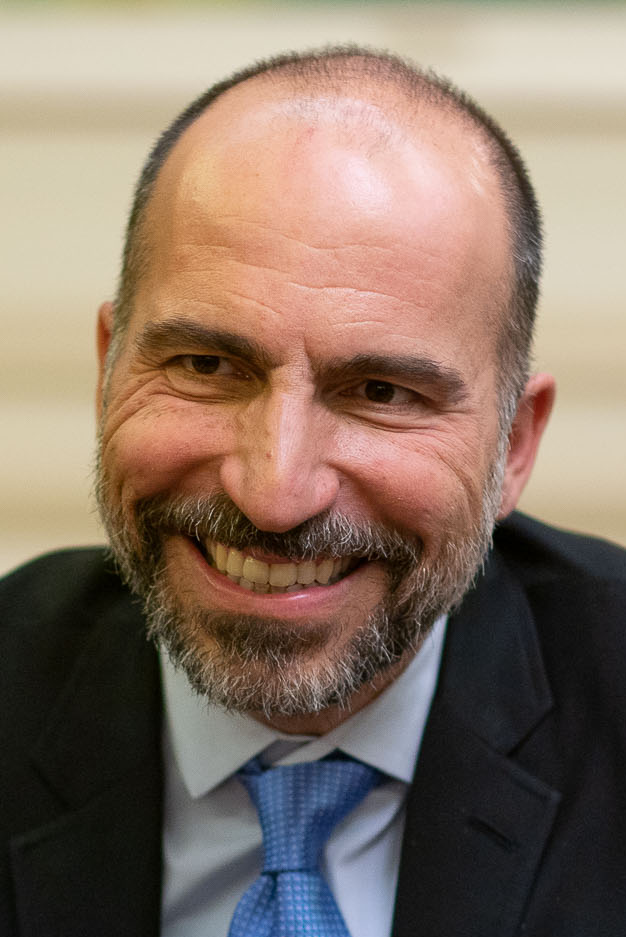
Dara Khosrowshahi, CEO of Uber

DARA KHOSROWSHAHI / UBER CEO / SAN FRANCISCO

Executive Profile - CEO & Tech Leader

Dara
Khosrow-
shahi

Chief Executive Officer, Uber Technologies

"Speed gives you the luxury to be able to fail."

$193B
2025 Gross Bookings
70+
Countries
8yrs
Leading Uber
32K
Employees
2019
Uber IPO Year
$82B
IPO Valuation
12yrs
At Expedia
~$277M
Net Worth Est.
90%
Engineers Using AI
01

Nine Years Old. One Suitcase. No Return Ticket.

In 1978, a nine-year-old boy left Tehran with his mother and two siblings, headed first to southern France, then to a house in Tarrytown, New York, belonging to relatives. His family owned Alborz Investment Company - pharmaceuticals, chemicals, food, distribution - one of Iran's larger conglomerates. The Islamic Revolution nationalized it while they waited. There was no going back.

His father stayed behind in Iran for six years, looking after Dara's grandfather, while his mother - who had never held a job - went to work full-time. The family spent years in immigration limbo, moving through lawyers' offices and consular queues. The day they got their green cards, Dara Khosrowshahi saw something shift in his father's face: relief, finally, of knowing they were welcome and would stay welcome.

That specific memory - not the general feeling, but the lawyers' offices, the interviews, the green card in hand - shows up in his speeches decades later. It's the kind of detail that doesn't fade. And it's the lens through which he runs one of the most complex logistical operations on the planet: with the knowledge that belonging is earned, not assumed.

"I remember my father taking us to meetings with lawyers, interviews with immigration officers, doing everything he could to get us that treasured green card - and the happiness, the sense of relief, when he finally did. We knew that we were welcome now, and we would be welcome tomorrow."
- Dara Khosrowshahi

He went to Brown University and studied electrical engineering - not finance, not business - graduating in 1991. The choice mattered. While his peers were coding during the boom years, Khosrowshahi was taking apart how systems work at the component level. That instinct - understand the wiring before you touch the interface - runs through every company he's led.

His first job was at Allen & Company, the boutique investment bank where media moguls like Barry Diller came to do deals. Khosrowshahi spent seven years there as an analyst. One day he explained something financial and complicated to Diller in terms that landed. Diller noticed.

That meeting began a professional relationship that lasted nearly two decades. When Diller's USA Networks acquired Expedia from Microsoft in 2001, Khosrowshahi followed. By 2002 he was CFO of IAC. By 2005, at 36, he was CEO of Expedia.

"Desperation sometimes drives innovation."

- Dara Khosrowshahi
02

Twelve Years, Sixty Countries, Three Acquisitions

Khosrowshahi ran Expedia for twelve years - an eternity in tech leadership - and turned it from a single travel booking site into a global empire that covered hotels, flights, vacation rentals, and more. He acquired Travelocity, Orbitz, and HomeAway. He expanded to sixty-plus countries. He quadrupled gross booking volume and more than doubled pre-tax earnings.

The playbook he developed there was simple to describe and hard to execute: put the traveler at the center of every decision. Let their clicks decide what gets built. That voter-as-customer philosophy sounds obvious until you watch how many companies optimize for advertiser revenue or platform lock-in instead.

By 2017, Expedia was one of the world's most dominant travel platforms. Khosrowshahi had a comfortable office in Seattle, a twelve-year track record, and unvested stock worth $184 million. He was, by any measure, set.

"When you let travelers vote with their clicks, and you put that at the center of your decision-making, you build the product they want, and ultimately, their business will follow."

- Dara Khosrowshahi on the Expedia philosophy
Allen & Co
7 years (analyst)
1991-98
IAC / USA
CFO then CEO of Travel
1998-05
Expedia
12 years as CEO
2005-17
Uber
8+ years as CEO (ongoing)
2017-now
Breaking
03

He Walked Into a Company on Fire

In the summer of 2017, Uber was, depending on who you asked, either a cautionary tale or a dumpster fire. Travis Kalanick had resigned under board pressure following a cascade of scandals: allegations of a toxic work culture, a viral blog post from a former engineer, a leaked video of Kalanick berating a driver, and a lawsuit from Waymo over stolen trade secrets. The company was burning cash and credibility simultaneously.

The board began a search. Jeff Immelt of GE was the frontrunner. Meg Whitman of Hewlett Packard Enterprise was close behind. Dara Khosrowshahi was the dark horse - the guy who ran a travel company and wasn't particularly famous outside Seattle tech circles.

During his board presentation, Khosrowshahi put up a slide that read: "There cannot be two CEOs." Kalanick was watching. The deadlock on the board lasted through multiple votes. When Benchmark - the VC firm that had pushed Kalanick out - was accused of essentially holding its lawsuit against Kalanick over the board's head to secure Meg Whitman's appointment, one Whitman supporter switched his vote. Khosrowshahi became Uber's CEO on September 1, 2017.

He forfeited $184 million in unvested Expedia stock to do it. Spotify co-founder Daniel Ek had spent considerable time persuading him the move was worth it. In one of the stranger recruitment stories of Silicon Valley's recent history, it took a Swedish music streaming billionaire to convince an Iranian-American travel CEO to take charge of a broken American ride-hailing company.

Khosrowshahi replaced Kalanick's 14 sprawling cultural values - which included phrases like "always be hustlin'" and "super pumped" - with eight new ones. The anchor: "We do the right thing. Period." Not a slogan. A reboot.

Culture Overhaul, 2017

His first months were spent in listening mode. He traveled, met drivers, talked to regulators in cities where Uber had burned bridges, and quietly began replacing the culture of performance-at-any-cost with something more sustainable. The changes weren't dramatic - Khosrowshahi is not a dramatic person - but they were structural. He gave teams accountability. He set a clear path to profitability. He stopped the internal chaos that had made Uber a recurring headline for the wrong reasons.

Two years later, in May 2019, Uber went public at an $82 billion valuation, raising $8.1 billion in net proceeds. The IPO wasn't the triumphant day the company had hoped for - shares dropped on the first day of trading - but it happened. The company was still standing. For a company that had come that close to total credibility collapse, standing was enough.

The Quotes That Define His Leadership

"We do the right thing. Period."

Uber's core value, introduced 2017

"Put the right people in the right places, and then you trust them to do the right stuff."

On leadership style

"Speed gives you the luxury to be able to fail."

On operating pace

"You can imagine the majority of our trips being fulfilled by robots. Probably not 10 years from now, but 15 to 20 years from now, you're going to start getting there."

On autonomous vehicles, 2026

"Ten years is not a lot of time for society to adjust to that kind of an impact."

On AI replacing human work

"A CEO of a multinational global company can't say what to do; you've got to plant the flag."

On leading global companies
The Platform
04

$193 Billion, 70 Countries, and a Bet on Robots

By 2025, Uber's gross bookings reached $193.4 billion. The company operates in more than 70 countries. It is profitable - genuinely profitable, not adjusted-EBITDA profitable - for the first time in its history. Uber Eats, once an experiment, is a significant revenue driver. Uber Freight handles logistics. Uber Health serves hospital transportation. The single ride-hailing app has become a multi-service urban mobility platform.

Khosrowshahi's thesis for why Uber wins as autonomy scales is specific: the company that controls the rider relationship, not the vehicle, will capture the value. Pure robotaxi companies own the cars. Uber owns the demand - the 17 million daily trips, the pattern recognition across cities, the merchant and consumer relationships built through Eats. When a self-driving car partners with Uber, Uber's platform advantage multiplies rather than disappears.

Autonomous trips are already live in eight global cities as of early 2026, with plans to reach fifteen by year's end. Trip requests increased tenfold year-over-year. Avride handles deliveries in Austin and Dallas. Cartken runs autonomous Uber Eats delivery in Osaka. These aren't pilots anymore.

The AI Moment

Ninety percent of Uber's software engineers now use AI tools in their daily workflows. The company even built an internal AI chatbot modeled after Khosrowshahi - called "Dara AI" - so employees can rehearse presentations before taking them to the real thing. In most companies, that would be a punchline. At Uber, it's operational infrastructure.

On AI's broader economic impact, Khosrowshahi is clear-eyed without being alarmist. He believes AI will replace the work that 70-80% of humans do, and that ten years is not long enough for society to prepare for that. His response is to move fast on the technology while advocating for the policy thinking that should surround it. He doesn't pretend the disruption is painless - his family's history with sudden, violent economic displacement probably makes that particular delusion harder to maintain.

Dara Khosrowshahi in Conversation

Uber CEO on the Future of Transportation

Dara Khosrowshahi on autonomous vehicles, AI, and Uber's next decade

Leading Through Crisis

How Khosrowshahi rebuilt Uber's culture after 2017

05

Gamer, Sci-Fi Geek, Metal Fan

His Twitter bio has not changed in years: "Uber CEO; travel and sci-fi geek; gamer who doesn't have enough time to play much." That's the self-presentation he's chosen to maintain - the executive who still thinks of himself primarily as someone who'd rather be playing World of Warcraft or reading a Heinlein novel than sitting in a board meeting.

He married Sydney Shapiro in December 2012. He wore a Slayer T-shirt to the wedding. Sydney is a former teacher and actress who describes herself as a sci-fi geek alongside her husband. They have twin sons, Hayes and Hugo, born in 2013, both diagnosed with autism spectrum disorder. Khosrowshahi has spoken publicly about autism awareness and appeared as a guest speaker for the Autism Partnership Foundation. He also has a daughter, Chloe, and son Alex from his first marriage to Kathleen Grant.

He cycles regularly, travels obsessively (the Expedia CEO thing was never just a job), and consumes science fiction the way some executives consume business books. His reading list informs his worldview about autonomous systems, AI-mediated futures, and the long arc of technological change - which shows up, if you listen carefully, in how he talks about where Uber is going.

He is not a loud person. He does not thump tables or issue grandiose mission statements. He says "put the right people in the right places" and then actually does it. When asked what he'd tell his younger self, he talks about slowing down to trust people earlier. That's the leadership philosophy of someone who learned the hard way that control is an illusion, not an asset.

"Taking big risks combined with having a team you believe in - and that believes just as much in you as a leader - make for long-term wins, even in a game of inches."
- Dara Khosrowshahi

Eleven Things Worth Knowing

🎮

Avid World of Warcraft player. His Twitter bio leads with "gamer" before "CEO".

🤘

Wore a Slayer heavy metal T-shirt to his 2012 wedding. Not a suit. Slayer.

🚀

Degree: Electrical Engineering from Brown, class of '91. Not business school.

💸

Forfeited $184 million in unvested Expedia stock to take the Uber CEO job.

🤖

Uber built an AI chatbot named "Dara AI" in his likeness for internal leadership presentations.

📚

Self-described sci-fi geek. The long view he applies to autonomous vehicles probably has roots here.

🌍

His family fled Iran in 1978. He was nine. They ended up in Tarrytown, New York via southern France.

💡

Barry Diller hired him after he explained a complex financial model clearly in a single meeting.

🚲

Cycles regularly. Fits neatly that the CEO of a mobility company uses one of the oldest ones.

🧩

Father of four. Twin sons Hayes and Hugo are both on the autism spectrum. He advocates publicly for autism awareness.

🗳

The board vote making him Uber's CEO deadlocked multiple times before a last-minute switch broke it in his favor.

The Long Arc

1969
Born in Tehran, Iran. Family owns Alborz Investment Company, one of Iran's larger conglomerates.
1978
Family flees Iran ahead of the Islamic Revolution. Nine years old. Father stays behind for six more years.
1991
Graduates Brown University with a degree in Electrical Engineering. Joins Allen & Company as an analyst.
1998
Joins Barry Diller's USA Networks after impressing Diller with a financial explanation that stuck.
2002
Becomes Executive VP and CFO of IAC, Diller's internet holding company.
2005
Named CEO of Expedia at age 36. Begins a twelve-year tenure that will define his reputation.
2005-2017
Expands Expedia to 60+ countries. Acquires Travelocity, Orbitz, HomeAway. Quadruples gross bookings.
Sept 2017
Becomes Uber CEO after contentious board selection. Forfeits $184M in Expedia stock. Slides say: "There cannot be two CEOs."
2019
Leads Uber's IPO. $82 billion valuation. $8.1 billion raised. Shares dip first day. Company survives.
2023
Uber posts its first full year of GAAP profitability under Khosrowshahi's leadership.
2025
Uber gross bookings hit $193.4 billion. Autonomous trips active in 8 cities. 90% of engineers use AI daily.
2026
Plans to expand autonomous operations to 15 cities. Predicts robot-majority rides within 15-20 years.

Links & Further Reading

Share This Profile

From Tehran refugee to Uber CEO. Share the full story.