A loyalty program asks for a peculiar kind of devotion. Carry another card. Remember another password. Find the coupon before the cashier loses patience. Then, if all goes well, receive a small discount for having performed these little acts of administrative affection. Marketing departments call this engagement. A shopper might call it homework.
- Cheetah Digital connects customer data to personalized campaigns.
- Its history joins email, interactive experiences and loyalty.
- Salling Group reported 10x more daily active loyalty members.
- The former Marigold business now belongs to Zeta Global.
The loyalty card already in your wallet
Salling Group, the Danish retailer, took a different route. Its redesign linked a customer’s payment card to membership. Registration required an app, an email address and the payment card. Purchases could then inform individual offers. Earlier versions had lacked personalized membership offers; printed leaflets had supplied the old coupon routine.
Cheetah Digital’s published account reported a tenfold increase in daily active loyalty members, with the first-year membership target reached in four weeks. The lesson is unusually portable: remove a step customers dislike before adding a feature marketers admire. Adoption is evidence of use, however; those figures alone do not establish incremental profit.
For Cheetah Digital, this is a revealing example of the business it wants to be in. The interesting object is a payment card, something people already know how to use. The sophisticated work happens behind it. Marketing technology succeeds when customers can forget that it is there.
A question is only useful if the next offer changes
Cheetah Digital by Marigold is the familiar name for an enterprise customer engagement business now owned by Zeta. It helps brands turn customer information into campaigns across channels. Its historical suite brought together messaging, a data foundation, interactive experiences and loyalty. That combination gives the company a particular argument: learning about someone and communicating with them belong in the same working system.
Consider the phrase “zero-party data.” It sounds as though someone in marketing has discovered a party and removed all the guests. The idea is more sociable. A customer deliberately tells a brand something: a preference, an intention, a desired experience. First-party data might record a purchase. A volunteered answer can help explain what the buyer hopes to do next.
Then watch what happens, and update what you know.
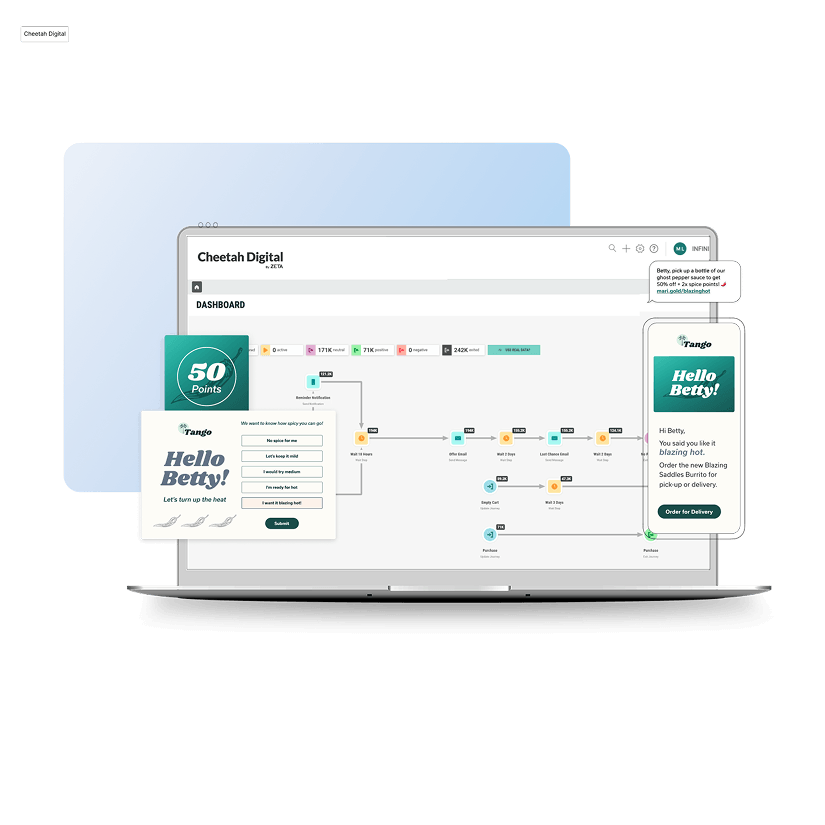
Marigold Grow, the portfolio tool descended from Cheetah Experiences, collects such answers through polls, surveys, giveaways and games. Messaging activates the information; loyalty provides rewards and offers that can make participation worthwhile. The exchange needs a purpose. A form with twenty questions and a vaguely promised “better experience” is a particularly efficient way to collect abandoned forms.
An airline example in Marigold’s playbook makes the distinction concrete. American Airlines gathered declared travel preferences, including business or leisure and cabin choices, then used them to shape individual email paths. The important sequence is the one a reader can copy: ask a question whose answer changes a decision you can actually make. A brand that asks about travel habits and continues sending identical offers has merely improved its filing cabinet.
The inbox business that kept changing owners
The lineage begins with CheetahMail, founded in 1998. Irene Pedraza and David Villeger were its co-founders. By the time Experian acquired it in 2004, the company was profitable and served brands including Neiman Marcus, Starbucks, Discovery Channel and Bloomingdale’s. Email was becoming a commercial channel with its own technology, analysis and service requirements.
There is a temptation to tell software history as a parade of inventions. Cheetah’s history is also a sequence of changes in what buyers wanted. Sending an email was one problem. Coordinating a customer relationship across a growing collection of channels was another. Every new channel made the old customer record a little more valuable and a little more complicated.
Experian sold a 75% interest in its email and cross-channel marketing business to Vector Capital in 2017, retaining the remainder. The whole business carried an enterprise value of approximately $400 million. Experian’s stated reason was a strategic review that found fewer synergies with its other operations. Cheetah Digital emerged as the independent identity.
The next acquisitions filled recognizable gaps. Stellar Loyalty arrived in 2018 with cloud-based customer engagement and loyalty technology. Wayin followed in 2019, adding interactive experiences and preference collection. In product terms, Cheetah was assembling the ability to send a message, invite an answer and reward a relationship.

The merger with CM Group was announced as complete in February 2022. CM Group adopted the Marigold name in January 2023. Those changes placed Cheetah beside other marketing brands and spread its relationship-marketing vocabulary across a larger portfolio. Product names changed along the way, which helps explain why buyers encounter Cheetah, Engage+, Grow and Loyalty in overlapping histories.
The people cost almost as much as the platform
A 2024 Forrester study commissioned by Marigold modeled a composite customer over three years. Its risk-adjusted present-value costs were roughly $1.4 million for licensing and services, $1.27 million for implementation and ongoing management, and $33,000 for training. The modeled ROI was 283%. These are scenario results, rather than a price quote or a promise.
Interviewees described laborious bulk campaigns, limited segmentation and weak provider support before switching. The business model pairs volume-dependent email and SMS licensing with professional services. My reading of the cost split: procurement should budget for the operating team as carefully as the software. Someone has to connect the data, construct campaigns and keep the machinery working.
Where the plumbing earns its keep
The natural customer is an enterprise B2C marketer with a substantial customer base and a complicated campaign operation. Retail, travel, hospitality, financial services and media all fit that description. The 2022 merger announcement named Hilton, Levi’s and Williams-Sonoma among Cheetah’s customers. Those are historical customer references, useful for understanding its market rather than a live attendance register.
The current product emphasizes segmentation, reusable content, custom connectors and APIs, plus large-volume personalized delivery. Deliverability support includes monitoring sender reputation and warming sending IPs. These are practical concerns: an elegant campaign loses its appeal when the database is wrong or the message fails to reach the inbox.
“Working together as a partnership is what helps us get the most out of it.”Gayle Gunning, CRM Director, Smartbox Group
Cheetah’s historical service offering includes strategy, technical work, campaign design and execution, a dedicated account team and round-the-clock support. That places its expertise partly in the software and partly in the people who help clients operate it. Movable Ink’s Da Vinci integration with Engage+ also shows how outside content-selection technology can sit alongside the messaging system.
Buyers considering Salesforce Marketing Cloud, Adobe, Braze or Iterable are shopping in adjacent territory. The useful comparison is specific: which customer records can the system activate, how difficult are the integrations, and who owns the work after launch? Cheetah’s assembled history makes it especially interesting where messaging, customer preferences and loyalty must inform one another. Those capabilities still need to be evaluated against the particular contract and deployment.
For a small team sending a simple weekly newsletter, this level of machinery may be difficult to justify. The same applies to a brand that cannot update customer records reliably, provide worthwhile rewards or staff the campaign operation. An automated journey can faithfully repeat a bad decision. Faster execution only makes the mistake more punctual.
A new owner, and the same old test
Zeta completed the acquisition of Marigold’s enterprise software business on November 24, 2025. The consideration was up to $325 million, subject to adjustments, for a portfolio that included Cheetah Digital, Loyalty, Selligent, Sailthru, Liveclicker and Grow. It was a portfolio price; assigning the entire amount to Cheetah would be a splendid piece of arithmetic and a poor piece of reporting.
January 2026 release notes began a phased Zeta rebrand. They also improved a feature called Hidden Summary for AI, intended to help email clients summarize a message accurately. The detail is almost comically contemporary: after decades of helping brands write to people, the product now helps them explain their emails to the machines reading ahead of those people.
The reader’s useful takeaway survives the changing names. Start with one moment in which a customer has to do too much work. Remove the unnecessary step. Ask one question that will alter the next offer. Check whether more people return and whether the economics improve. Cheetah Digital sells considerable machinery for that sequence. The sequence itself is small enough to write on the back of a shopping receipt.