A small advertiser can be an expensive customer. The budget is modest; the work refuses to shrink accordingly. Somebody still has to find the audience, buy the space, deliver the campaign and explain the result. In advertising technology, a small cheque can arrive carrying a surprisingly large suitcase.
Aman Sareen helped build ZypMedia around that inconvenience. Local businesses wanted access to digital audiences. The systems serving those audiences were not necessarily designed to make a small, geographically constrained campaign worth the trouble. His opportunity lay in taking the trouble seriously.
That starting point helps explain a career that can otherwise look like a succession of company names: ZypMedia, ZypTV, Sinclair, LG Ad Solutions, Aarki and now RZR. Across those chapters, Sareen has worked on the machinery between an advertiser’s intention and an audience’s attention. The screens keep changing. The advertiser still expects the money to do something.
The customer with the smaller cheque
Sareen’s education joined computer engineering at Illinois Institute of Technology with a master’s in electrical engineering at Purdue. His earlier advertising roles included Inadco, YuMe and Apsalar. The eventual founder came to the problem with experience inside the systems, rather than merely an enthusiasm for the business they might produce.
In 2013, he co-founded the business that became ZypMedia with Ramandeep Ahuja and Mark Goldman. Ahuja was a former college roommate; Goldman brought media experience. It was a partnership with both technical and commercial ingredients, a useful combination when the customer’s problem extends beyond getting the software to run.
By 2018, Sareen was explaining the local advertiser’s predicament in straightforward terms. Small budgets could leave businesses below the threshold at which large advertising companies would engage. ZypMedia worked with media partners to make programmatic campaigns accessible to those businesses, including advertising on streaming television.
His formulation was unusually specific: “We prioritize impression delivery over budget.” In other words, a small campaign should receive attention even when a much larger one shared the platform. The engineering challenge followed the commercial promise. Automation had to make many small jobs manageable.
“We prioritize impression delivery over budget.”
Aman Sareen, discussing ZypMedia in 2018
Borrowing the address book
ZypMedia’s route to those customers was equally practical. Local television and radio businesses already knew local advertisers. They had salespeople, established relationships and reasons to keep a campaign working after the contract was signed. ZypMedia could supply the digital capabilities behind that relationship.
The arrangement made distribution part of the product. A media company could add digital advertising to its existing offering; its customer could buy through a familiar contact. ZypMedia’s contribution included training, support and operations as well as software. The company was selling an ability to deliver, with all the unglamorous work that phrase conceals.
In June 2015, the business announced its change of name from ExtendTV to ZypMedia, a $4.4 million Series B and a long-term agreement with Sinclair. The agreement opened a path through more than 2,500 Sinclair salespeople across 79 markets. A trial in three markets had become a much wider commercial relationship.
The platform’s design borrowed principles from high-frequency trading. Speed mattered because a local campaign had fewer suitable opportunities to buy. The company also paired algorithms with analysts who understood local markets. Human involvement was present early in Sareen’s story, well before supervised AI became part of his later vocabulary.
An operating model, not a measurement of campaign results.
By October 2018, a further $5.6 million financing round brought Archer Venture Capital into the business alongside existing investors. The proposition remained grounded in an underserved customer. Larger audiences and more sophisticated buying did not require abandoning the local relationship that made the sale possible.
There is a particular discipline in serving this kind of customer. Each extra manual step has to be justified against a limited budget. Reporting must be understandable to someone whose principal occupation is running a business. Support cannot assume a dedicated advertising department at the other end of the conversation.
That gives the founding idea its interest. The work is technical, but the measure of usefulness is ordinary: can a customer buy an appropriate campaign without acquiring a second profession? ZypMedia’s combination of software, service and established sales relationships addressed the whole transaction. The algorithm had company.
The television changes its address
Streaming television gave that model another opening. A local advertiser could understand the appeal of appearing on a television screen even as the buying process became more complicated. The familiar object in the living room now connected to an unfamiliar collection of publishers, applications and purchasing systems.
In July 2020, ZypMedia became ZypTV and widened its invitation to agencies and brands. Its offering included audience targeting, frequency management and reporting across streaming inventory. Managed services were available; a self-service buying option was being tested. The ambition was to make local buying work across more of television’s new arrangements.
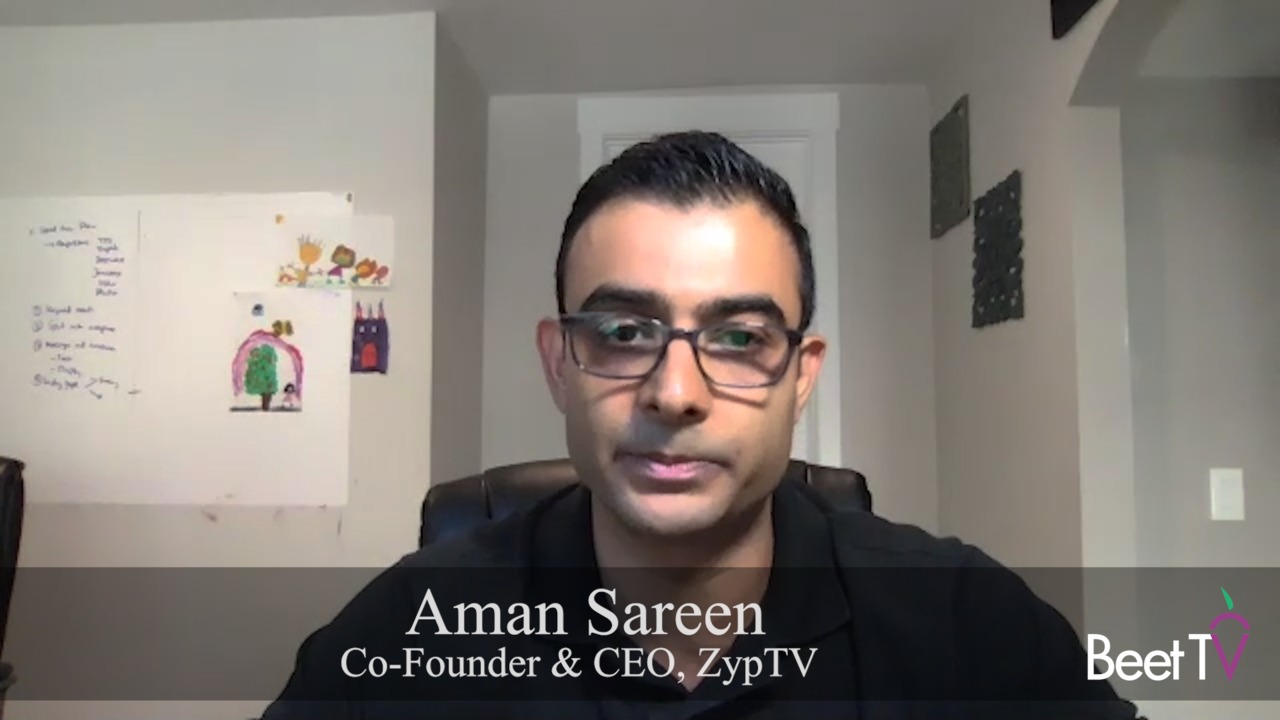
In a video conversation that August, Sareen described self-service connected TV buying as demanding too much time and constant human intervention from smaller agencies and brands. His priorities included fraud prevention and real-time inventory forecasting. These were operating obstacles, the kind that can make an apparently convenient tool rather inconvenient to use.
Sinclair acquired ZypTV in 2021. Sareen later served as general manager at LG Ad Solutions, placing him closer to the device maker’s view of television advertising. His official biography credits that chapter with building programmatic monetization infrastructure and helping establish LG Ads Plus. He was now working with the screen’s owner as well as its advertising buyers.
The sequence gave him experience on several sides of the transaction: the local business, the media partner, the buying platform and the television manufacturer. It is a useful preparation for an industry in which every participant sees a different fragment of the audience.
The uncomfortable business of starting again
In January 2023, Sareen became CEO of Aarki. This time he inherited an existing company. In his later account, the product was aging, internal processes were layered and sales needed reworking. Founding had required assembling a business; this assignment required changing one that already had habits.
He described stopping sales while the organization concentrated on rebuilding the platform. The team and sales organization also changed substantially. His emphasis on transparency, visible performance measures and accountability makes clear that the project extended beyond engineering. An improved system would need people willing and able to operate differently.
It is the awkward part of the turnaround story. Software has versions; organizations have memories. People know where work gets stuck and which conversations happen behind closed doors. A new product cannot, by itself, settle those arrangements. Sareen’s telling acknowledges that the cultural work was harder than the technical work.
The rebuilt platform, Encore, placed retention and privacy within the product’s design. Sareen also treated profitability as a test of the business rather than a distant reward. The local-advertising years had already made unit economics difficult to ignore. At Aarki, the same discipline applied to an inherited organization.
- 2013Co-founds the business that becomes ZypMedia.
- 2020ZypTV expands the invitation to agencies and brands.
- 2023Takes over Aarki and begins a rebuild.
- 2026Leads the platform under its new name, RZR.
Fewer signals, more judgment
The technical problem had changed. Mobile advertisers were working with fewer dependable tracking signals and delayed feedback. In his discussions of Encore, Sareen argued for building around those constraints and accommodating different privacy frameworks. A platform designed for yesterday’s information supply would struggle with today’s decisions.
His account of Aarki’s machine learning describes contextual information informing predictions about audiences and bids. Creative work sits alongside that process: an audience model still needs an advertisement that gives someone a reason to respond. Analysts, data scientists and creative staff contribute different forms of judgment.
This explains his fondness for describing human expertise and AI together. The machine can process enormous volumes; people still decide what matters, evaluate results and adjust the approach. His point is operational. A model’s output has to survive contact with a campaign budget.
He also wants acquisition and re-engagement to inform each other. Finding someone who installs an app and encouraging a former user to return are connected commercial problems. What happens after the first action can change the value of paying for it in the first place.
In January 2025, Aarki announced Aarki Labs in Bangalore, with leadership across marketing, India operations and product. The expansion gave the technical agenda an organizational address. Sareen’s ambition depended on recruiting people who could turn predictions into products and campaigns that customers would continue to buy.
Six million decisions, ten chickens
In March 2026, Aarki became RZR. The company described a connected platform spanning mobile acquisition, retargeting, connected television and influencer campaigns, processing more than six million queries a second. Those are company-reported infrastructure figures, describing workload rather than customer results. The rebrand placed several strands of Sareen’s career under one roof.
RZR announced a new Bangalore office in April, extending its India and Southeast Asia presence. In September, Sareen received an honorable mention for Leadership in Advertising at the AdExchanger Awards. These are the current milestones of a career that began with much smaller transactions.
The person behind them is less solemn than the infrastructure might suggest. In 2025, Sareen described a household with two daughters, two dogs, two rabbits and ten chickens. He named Apple’s original Rip. Mix. Burn campaign as a favorite and complained about professional social media’s appetite for empty self-promotion. Evidently, operating an advertising business does not oblige one to enjoy every advertisement for oneself.
His public career offers a more useful description than a slogan: find a commercially awkward problem, work out who already knows the customer, and build the machinery to serve them. It began with local budgets. It now crosses screens. Somewhere beyond the bidding systems, the chickens continue their own entirely independent operations.