Jason Fairchild has spent a career helping advertisers ask an awkward question: what did the money actually do? It is a reasonable inquiry, though advertising has occasionally treated it as an interruption to a perfectly good lunch. At GoTo, he worked on paid search. At OpenX, he helped build a market for digital ads. At tvScientific, he brought the argument to television, where a beautiful picture has long been easier to admire than to account for.
His latest chapter brings those experiences together. Pinterest completed its acquisition of tvScientific in February 2026. Fairchild remains co-founder and CEO of the business, now called tvScientific by Pinterest, and also serves as Pinterest’s GM of Programmatic & Affiliate. Search, television and shopping intent have become adjoining rooms in his working life. He has spent years learning where the doors should go.
The light before the screen
There was an earlier kind of picture. Before internet advertising, Fairchild moved to Los Angeles to work in holography at LA Holographics. The business failed. A succession of sales and marketing jobs followed, before an idea for online treasure hunts brought him into contact with EarthLink founder Sky Dayton. The proposed investment became a job instead. It was an indirect route into the internet, with rather more invention than career planning.
EarthLink gave him experience in business development during the commercial internet’s early expansion. GoTo gave that experience a particular direction. Living in Pasadena, Fairchild followed Bill Gross’s Idealab closely and wanted to work within its orbit. Gross became a mentor. Fairchild joined GoTo among its early employees, entering a business that asked advertisers to learn a different vocabulary: keywords, bids and measurable responses.
The work required persuading people as well as arranging distribution. GoTo became Overture, then part of Yahoo in 2003. Fairchild’s responsibilities included paid-search partnerships and global business development. His career would repeatedly return to that combination: build the mechanism, find the partners, explain why the customer should change a familiar habit. A new advertising market needs all three. The software rarely shakes hands on its own.
“I'm a start-up guy.”Jason Fairchild, reflecting on his early career
An exchange needs company
After work at Claria, Fairchild co-founded the enterprise OpenX business with Tim Cadogan in 2008. Both had experience at Yahoo. OpenX put them inside another change in the way advertising was traded, this time through programmatic systems that could connect publishers’ available space with advertisers’ demand. Fairchild served as chief revenue officer. Building relationships was central to building the market.
The original assumption about adoption proved troublesome. OpenX’s existing open-source ad-server community did not automatically become willing participants in the commercial proposition the founders envisaged. An installed base looked promising on paper; willingness to buy was a separate matter. The exchange required patient assembly, recruiting supply and finding demand during the financial crisis. It was a lesson in the distance between possessing an audience and having a business.
Fox Audience Network became an important early relationship. OpenX’s work with Fox and MediaMath helped demonstrate the possibilities of real-time bidding. Later, Fairchild’s work at OpenX included global partnerships and the development of header bidding, which allowed publishers to invite competing bids for advertising inventory. His professional territory was expanding, but the practical question remained familiar: could a market make better use of what it already had?
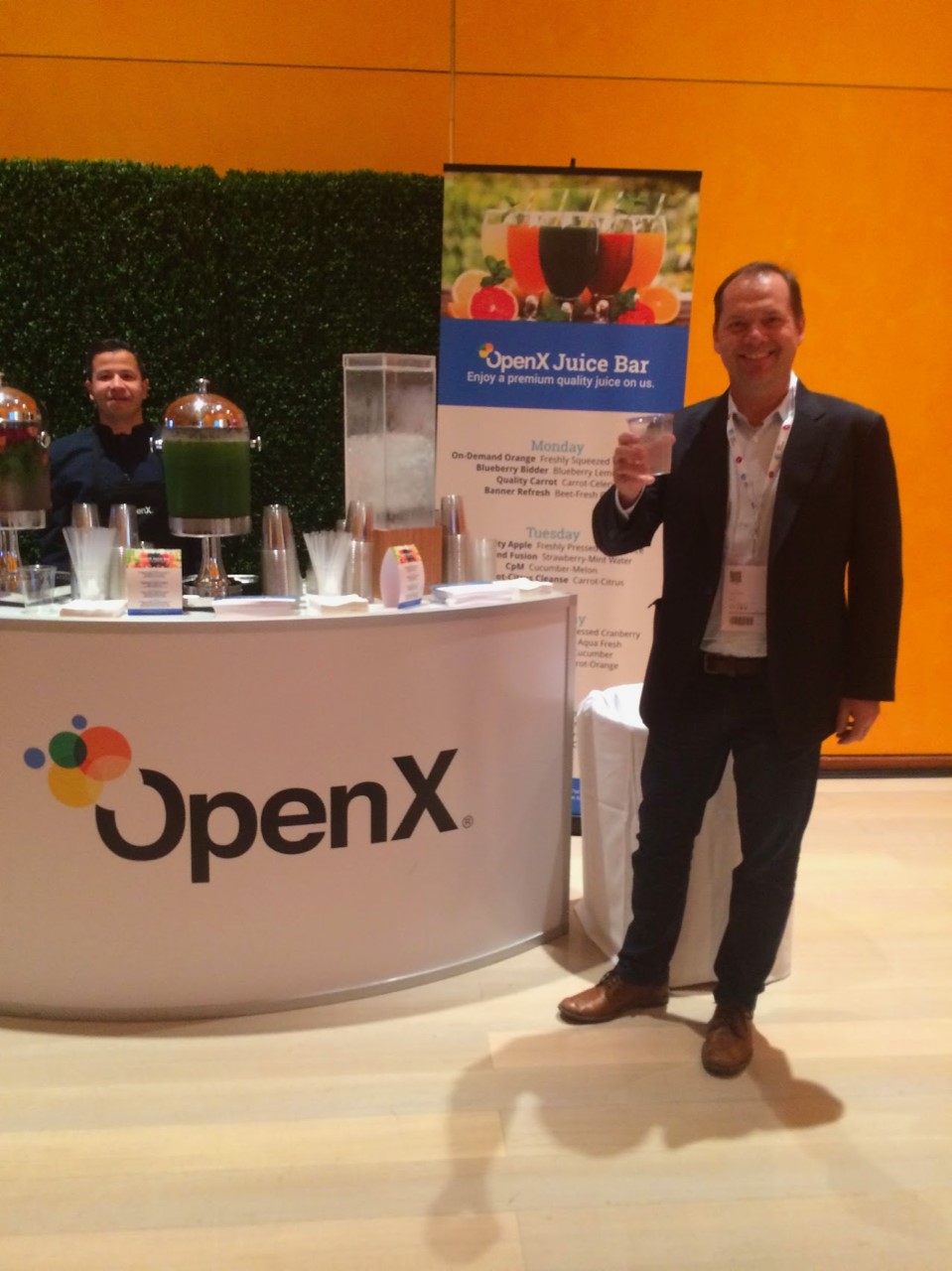
A photograph from the OpenX years catches him beside a branded juice bar, glass raised, wearing the conference badge that serves as the advertising industry’s temporary passport. It is a cheerier picture than the usual architecture diagram. Yet both belong to the job. Exchanges need engineering; they also need people who will meet, talk, take a chance and come back.
A phone call, then a decision
Television became Fairchild’s next subject while he was winding down his OpenX chapter. Audiences were moving to streaming, and internet-connected televisions offered a technical possibility that traditional television buying had struggled to provide: a feedback loop between seeing an advertisement and taking an action. The migration of viewers and the possibility of measurement were arriving together. To someone trained by paid search, the resemblance was difficult to ignore.
Fairchild has described putting the idea to Bill Gross in a phone call: apply the accessibility and measurability of paid search to connected TV. The relationship had come full circle. Gross, David Koye and Kent Wakeford joined him as tvScientific’s co-founders. The company was founded in 2020 and formally launched publicly in March 2021, bringing another Idealab connection into Fairchild’s career.
His account of the decision includes a useful interruption. He had been discussing the proposal with customers, investors and advisers, testing demand, feasibility and timing. Wakeford eventually told him, in effect, that research had done what research could do. A decision was due. Fairchild’s recollection gives the founding story a recognisable human scale. Conviction can be developed carefully; certainty is less accommodating about appointments.
The sale has several witnesses
tvScientific’s proposition brings media buying, optimization, measurement and attribution into the same platform. The intended customer includes the performance marketer accustomed to evaluating search or social advertising against a business result. Fairchild wants that customer to be able to buy television with comparable discipline. A campaign might be evaluated against purchases, website visits or app activity, depending on what the advertiser needs to achieve.
The difficulty is partly one of credit. A viewer can see a television advertisement and later search for the product on a phone. A measurement system organised around the final click will naturally notice the search. Television’s earlier contribution can be harder to see. Fairchild has made this allocation of credit a recurring subject, including in his essay titled The Great Attribution Heist: TV Creates Incremental Demand. Search Takes the Credit.
In conversation with Todd Crawford on The Partnership Economy, he connected tvScientific directly to his GoTo experience and argued for linking advertising to sales. His point of departure was the way streaming changed delivery: once television arrived through the internet, feedback became technically possible. The challenge was to assemble the buying and measurement systems that would make the connection useful to an advertiser.
- SeeA television advertisement introduces a product.
- SearchThe viewer looks for it on another device.
- BuyA purchase follows. Which interactions helped?
A conceptual customer journey, not campaign data.
The company attracted capital and media partners around that proposition. A $20 million Series A in 2022 included NBCUniversal, and the companies planned Peacock Ad Manager as a self-service buying portal. A $25.5 million Series B followed in February 2025, led by NewRoad Capital Partners. Fairchild said the money would support data science and engineering. The pitch required substantial work beneath its comparatively simple promise.
Please spare him the five-page memo
Fairchild’s public writing offers a more personal view of the executive behind the platform. He has little patience for explanations that make their reader perform the author’s unfinished thinking. In a May 2026 essay about simplicity, he complained about long executive briefings that transfer the work of synthesis to the person receiving them. Anyone who has opened an attachment with a sinking feeling will recognise the grievance.
He argues that technical complexity can become a refuge, even a commercial advantage, for businesses that benefit when customers struggle to understand them. His preferred test is direct: “What are we actually trying to accomplish here?” Applied to an advertising platform, the question sends attention back toward sales, downloads and revenue. Applied to a meeting, it might mercifully shorten the meeting.
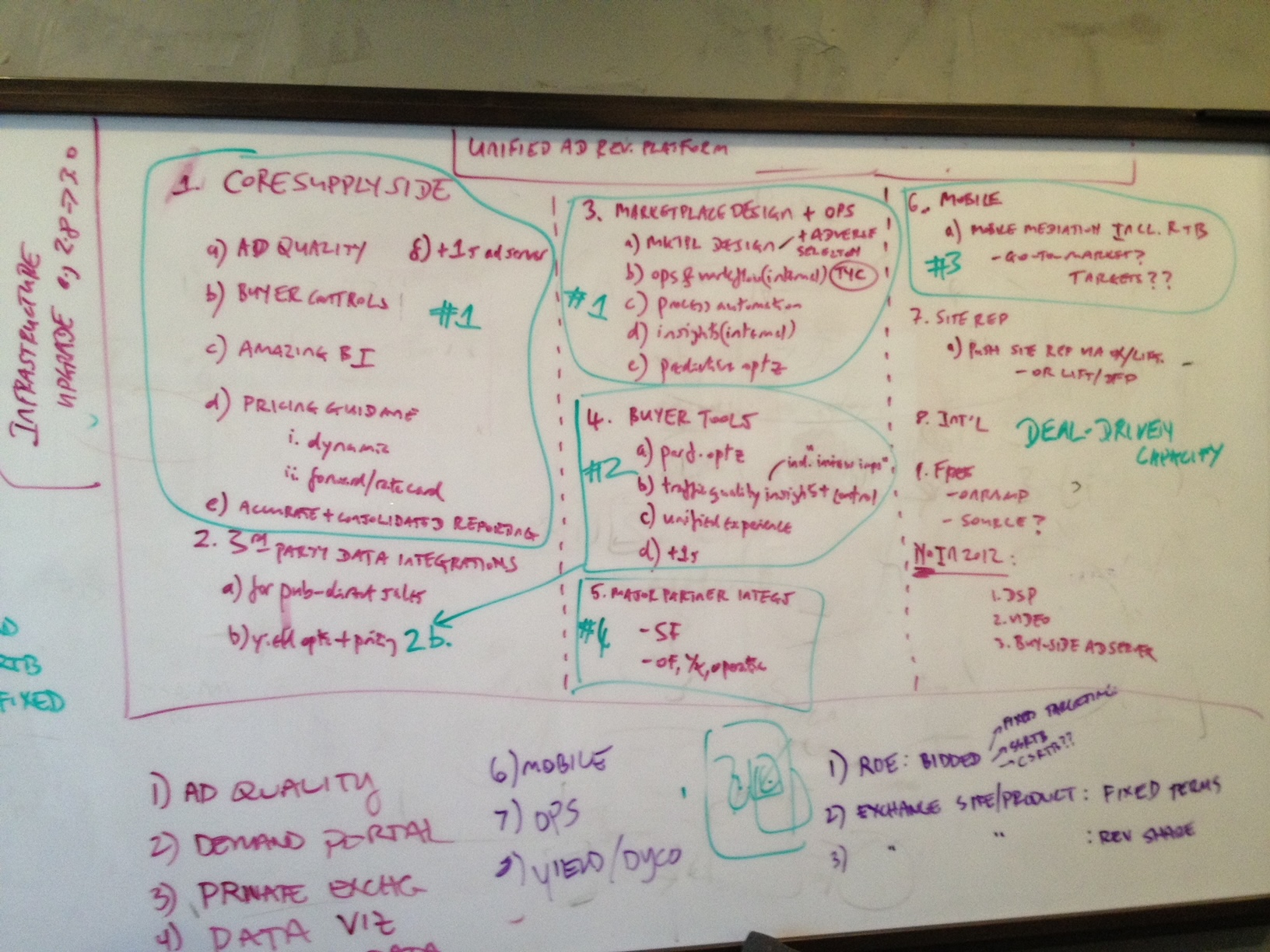
His writing about founders also gives experience a place that startup mythology sometimes reserves for youth. He recommends humility, simplicity and adaptability: learn from failure, make ideas understandable, keep adjusting as the business changes. These are expressed principles, rather than a licence to invent his private temperament. They do, however, fit the career’s repeated need to listen to a market and revise an assumption.
That emphasis reaches hiring, too. When introducing a senior revenue appointment in 2024, Fairchild listed commercial experience and the ability to scale an organisation, then added the importance of being someone the team could collaborate with easily. His language about keeping egos out of the room was unusually plain for an executive announcement. Competence, in his formulation, still had to be pleasant enough to work beside.
Pinterest enters the picture
Pinterest announced its agreement to acquire tvScientific in December 2025. The acquisition closed in February 2026, and in April Pinterest audiences became available for connected-TV campaigns through the platform. That sequence matters: the combination has moved from a proposed transaction into a product available to advertisers. Fairchild’s current responsibilities span the tvScientific business and Pinterest’s programmatic and affiliate channels.
The strategic attraction is visible in the two businesses. Pinterest observes what people are considering and planning through visual discovery; tvScientific provides a way to activate and measure advertising on television. Combining those capabilities offers another route between an emerging interest and a later purchase. Fairchild’s October 2026 newsletter schedule included an essay about visual search, returning him once again to the commercial possibilities of searching.
There is an agreeable continuity in the journey from GoTo to this point. Fairchild has repeatedly worked where a medium acquires a new buying system and customers must decide whether to trust it. The television may be larger than the early computer screen. The advertiser’s question still fits on a small piece of paper: what happened after someone saw the ad? Fairchild has made a long career of insisting that the answer is worth the trouble.