The revealing moment in a television campaign may be the day somebody switches it off. Earnin, the financial-services app, stopped its connected-TV advertising for a couple of days and watched performance fall. Its chief marketing officer, Brittanie Williams, says that experience prompted the company to devote 18% of its media spending to CTV with tvScientific. An interruption became a reason to invest. For an advertising business built around measurement, that is a useful beginning.
- The job: buy streaming-TV ads and connect exposure to purchases, installs, and other outcomes.
- The bet: qualified advertisers can agree a cost per outcome and pay for results.
- The new ingredient: Pinterest’s shopping-intent signals, following its February 2026 acquisition.
tvScientific occupies the space between a television commercial and the spreadsheet that must justify it. Brands want the living-room screen. Performance marketers want to know what happened afterward. The company sells the machinery intended to connect those desires: buying, targeting, optimization, and measurement in one platform.
01 A search veteran looks at the television
Jason Fairchild had seen an advertising market become accessible before. He joined GoTo.com in 1998, when paid search was finding its shape, and later co-founded OpenX. His founding account of tvScientific describes a familiar obstacle: television was difficult to buy and difficult to measure. A small business could buy search traffic; television demanded a different apparatus.
Fairchild assembled a team with David Koye and brought the idea to Idealab founder Bill Gross. Founded in 2020, tvScientific lists Fairchild, Koye, Gross, and Kent Wakeford as its co-founders. That lineage explains its instincts. The screen was changing, but the commercial ambition was familiar: give more advertisers a manageable way to buy an audience and assess the return.

02 Put a price on the action
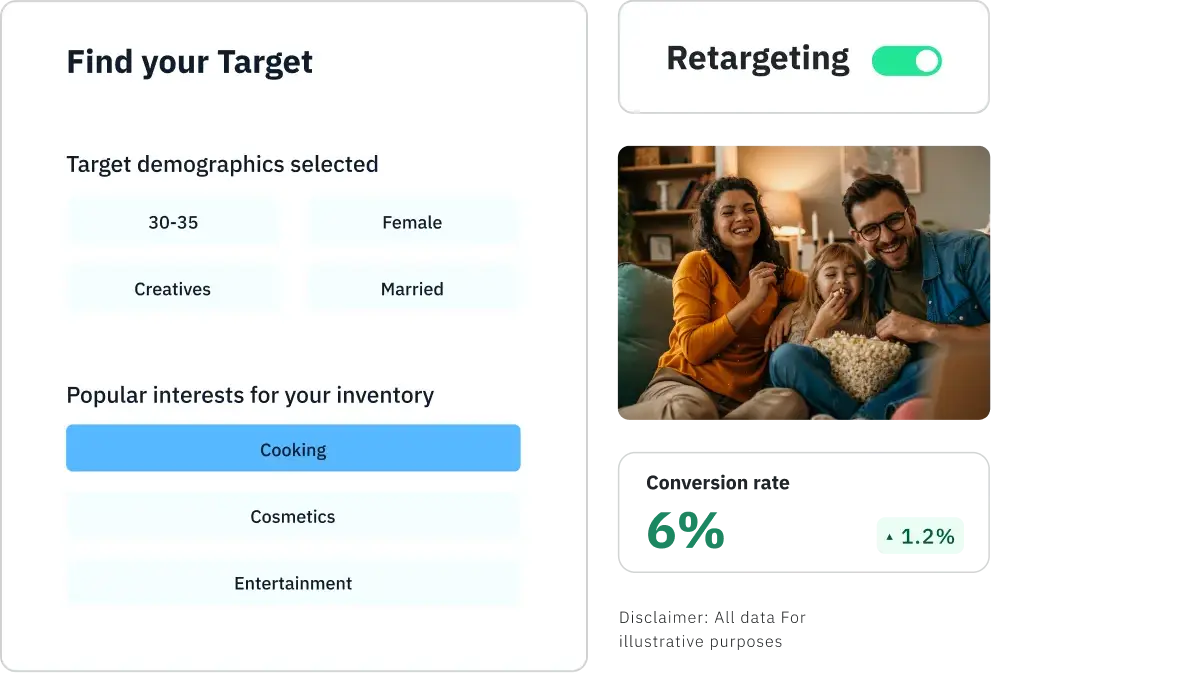
The product is an advertising platform, with self-service and managed support. Advertisers choose audiences, supply video, define a conversion, and use reporting to examine results. tvScientific’s expertise lies in connecting household-level ad exposure to subsequent actions and feeding that information back into campaign decisions. Retailers, subscription brands, financial apps, and mobile-game publishers all have reasons to care.
Its Guaranteed Outcomes program, launched in June 2025, makes the proposition unusually concrete. Qualified advertisers specify an acceptable cost per outcome; tvScientific commits to delivering against it. That changes the purchasing conversation from how many impressions a budget buys to how many agreed actions it produces. The wider platform also supports CPM buying, priced per thousand impressions. Eligibility and agreed outcome definitions matter.
- 01DefineA sale, install, or visit
- 02ReachChoose audiences and inventory
- 03MeasureConnect exposure and response
- 04AdjustOptimize toward the goal
It is competing in a busy neighborhood. MNTN also sells performance-oriented CTV advertising. Tatari combines buying and measurement across streaming, linear television, and online video. Measurable TV is therefore a category, rather than an exclusive invention. tvScientific’s particular combination is outcome-based buying, household attribution, and, now, direct access to Pinterest audiences.
03 The bread did not need a studio
Wildgrain offers a less abstract test. The subscription food business had a small growth team, an acquisition-cost discipline, and reservations about television. Would testing cost too much? Would the ads require actors and a studio? Its answer was to repurpose social creative with tvScientific’s help, rather than commission a production from scratch.
The company’s published case study puts Performance TV at 5-7% of Wildgrain’s total advertising spending during peak periods. That is a useful scale reference, not a dollar price. It also reports 150% year-over-year subscriber growth, a customer result that should not be mistaken for a controlled estimate of TV’s contribution.
“Everything was repurposed from Meta.”
Rose Hopkins, Growth Marketing Lead, Wildgrain
The more transferable habit is Hopkins’s attention to overall customer acquisition cost alongside channel reports. If several platforms touch the same buyer, each dashboard can look persuasive. A growing business still has one total bill and one population of acquired customers. Their relationship deserves a weekly look.
04 Credit is easier than causation
Household matching addresses an awkward feature of TV: viewers do not have to click the commercial. tvScientific connects exposure and conversion signals within a defined attribution window. But a purchase after an advertisement is not automatically a purchase caused by it. The buyer might have purchased anyway.
The company’s October 2026 product guide describes Halo v2, an always-on incrementality feature comparing exposed and unexposed groups. It also describes a TV Influence Report for journeys that end with another platform receiving last-click credit. These are different questions: where TV appeared in a journey, and what TV changed.
In July 2026, tvScientific launched a certified measurement program with INCRMNTAL, Measured, Singular, and WorkMagic. Bringing other measurement providers into the process is a practical acknowledgment that the media seller’s account should be open to examination. Its public commitments to transparency and performance become more useful when customers can check them.
05 Pinterest brings the shopping list
Before the acquisition, investors had financed the experiment: a $20 million Series A in 2022 and a $25.5 million Series B in 2025 were among its rounds. Pinterest announced its agreement in December 2025 and completed the purchase on February 17, 2026. Its first-quarter filing put total purchase consideration at $465.1 million, primarily cash.
Pinterest’s disclosed purchase consideration.
Closed February 17, 2026.
The strategic ingredient is intent. Someone collecting kitchen ideas on Pinterest may be preparing to buy something before typing a product query. The companies brought Pinterest audiences to CTV in spring 2026. In June, Creative Advisor added predictive recommendations about video elements such as messaging, audio, and brand visibility. The business now tries to improve both who sees an ad and what they see.
06 Copy the experiment
For a marketer, the sensible starting point is a defined outcome, an affordable test, reusable creative, and a measurement window suited to the buying cycle. Agree how credit is assigned before celebrating the dashboard. Compare platform reporting with independent measurement and total acquisition economics.
That approach depends on observable conversions and enough evidence to evaluate them. A long sales cycle, sparse conversion volume, or an ambiguous outcome makes the exercise harder. A contractual acquisition price also says little about repeat purchases or customer profitability. Those remain the advertiser’s questions. Earnin’s interruption is instructive because it asked what the business would look like without the ads. That is a question worth keeping, whatever screen carries them.