A gift can be exquisitely chosen and still be wrong. In July 2024, Sendoso marketing executive Kacie Jenkins described sending a chief marketing officer gear for an upcoming desert trip. She had remembered the trip. She had understood the interest. Unfortunately, the recipient had already bought similar gear. The thought was welcome; the object was redundant.
- Alyce recommends gifts around personal interests, then lets recipients accept, exchange, or donate.
- Its buyers are revenue teams seeking conversations and stronger customer relationships.
- Software, invitations, and gifts have separate costs.
- Sendoso acquired Alyce in 2024 and adopted its recipient-choice approach.
That little collision explains much of Alyce by Sendoso. A recommendation can get you close. Choice finishes the job. Alyce made the receiver’s decision part of the product, allowing a suggested gift to become something else, or a charitable donation. The sender supplies the gesture and the budget. The recipient gets a say in what arrives.
The chocolate nobody asked for
Greg Segall had encountered a less subtle version of the problem. A fitness-minded entrepreneur who watched what he ate, he kept receiving holiday chocolate from business contacts. These were people who knew him. Yet their seasonal generosity seemed to forget the person it was addressed to. Alyce, founded in December 2015, developed around that mismatch between a sender’s good intentions and a recipient’s actual preferences.
In a 2021 interview, Segall described three concerns: the relationship, unwanted material, and charitable giving. “Money is going to waste and there is so much stuff ending up in landfill,” he said. Choosing before shipment offered a way to avoid producing yet another object someone would have to dispose of.
A recommendation can get you close. Choice finishes the job.
The person after five o’clock
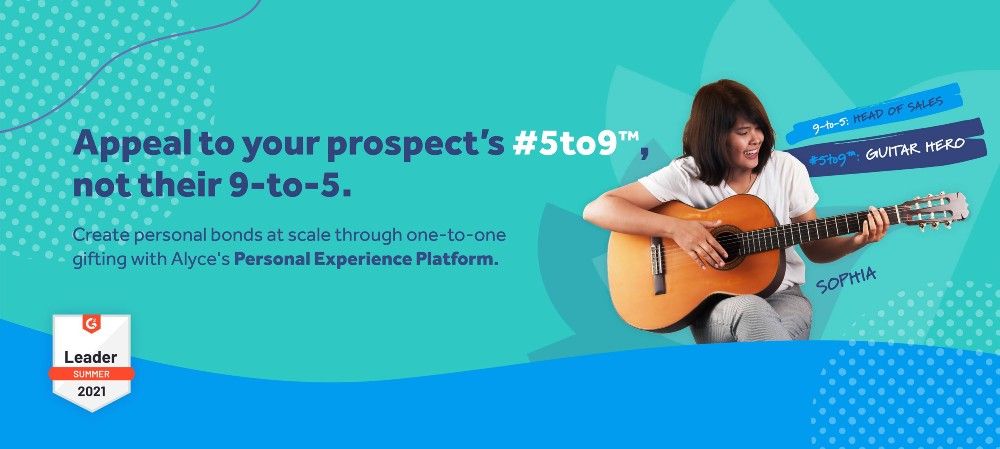
Alyce called its interest-based approach the “5to9”: the hobbies and enthusiasms that exist beyond a buyer’s job title. Publicly available information could inform a recommendation. The point was to give a salesperson something more relevant to work with than a mug bearing the salesperson’s own company logo. The recipient could correct the suggestion without rejecting the gesture.
In practice, teams create a campaign, define its budget and audience, and offer a gift through a physical or digital invitation. Redemption turns the offer into a selected item. Integrations put gifting alongside established sales and marketing work, rather than leaving it in an isolated spreadsheet. Salesforce and Salesloft were among Alyce’s integration partners. Swag Select applied recipient choice to branded merchandise; the 2021 Smart Gifting release added themed marketplaces and group campaigns.
Its natural customers are businesses with valuable relationships to cultivate: sales teams opening accounts, marketers following up after events, and customer success teams thanking existing customers. Historically named users included Lenovo and Marketo. Employee gifting provides another use case. Alyce sits between marketing automation and a gift marketplace, combining campaign administration with the pleasurable business of choosing something.
The code was longer than the patience
An early founder interview contains a telling admission. The first redemption experience used handwritten cards and a long code. Segall said Alyce shortened the code to eight digits, improving conversion, and added follow-up emails with a direct gift link. The friction appeared after the thoughtful gesture, at the moment someone had to perform a small administrative chore to enjoy it.
The same interview describes a change in the company’s commercial thinking. Customers were using gifting to obtain prospect meetings. Alyce paid attention to that behavior and put more emphasis on prospecting and software subscriptions. The workflow had value beyond the merchandise transaction. For a founder, this is a useful distinction: customers may reveal the business by repeatedly doing something that your original product description treated as just one possible use.
A gift budget is only part of the bill
Alyce’s provider-supplied pricing materials on G2 separate three charges: an annual platform fee, gift invitations, and gifts themselves. The underlying materials date to October 2024, so buyers should get current terms. Sendoso’s current plan comparison also directs buyers toward pricing conversations. Budgeting therefore requires more than multiplying recipients by a gift price. Software access, campaign volume, fulfillment where applicable, and the team’s time all belong in the calculation.
The competition includes Reachdesk, PFL, Loop & Tie, and CorporateGift. Recipient choice alone cannot settle a purchase decision; alternatives also offer variations on redemption and exchange. Alyce’s recognizable emphasis is the combination of personal-interest recommendations and a receiver-controlled experience. Buyers still need to compare catalogue suitability, integration depth, regional availability, and total campaign cost. An ingenious invitation is of limited use if the items available do not suit the people receiving it.
The rival becomes the owner
Alyce raised an $11.5 million Series A in 2019, then a $30 million Series B in April 2021. In February 2024, Sendoso announced an asset purchase agreement bringing the companies together. The acquisition price was undisclosed. The initial promise was continuity for both platforms, with Alyce’s personalization joining Sendoso’s global fulfillment capabilities. The companies had approached the same commercial problem from overlapping directions; now their work would travel under common ownership.
Price undisclosed
By July, Sendoso had launched Recipient Gift Exchange and explicitly linked the release to Alyce’s recipient experiences. Jenkins’s desert-trip example made the argument unusually well: even remembering someone’s interests cannot tell you everything they already own. Alyce’s approach survived in a feature that allowed the buyer to make the final adjustment. The strategic value was visible in the product, rather than merely asserted in the announcement.

Copy the courtesy, then measure the result
A practical starting point is a small, defined audience and a reason for contacting each person. Offer a relevant choice, simplify redemption, and connect follow-up to a real conversation. Measure invitations, redemptions, qualified meetings, and revenue separately. An accepted present proves demand for the present. Its commercial value depends on what follows.
The approach depends on willingness, permission, and fit. A recipient who cannot accept gifts cannot be persuaded by a better catalogue. Someone indifferent to the offer may ignore the invitation. A poorly selected account remains poorly selected after receiving something pleasant. Alyce’s useful contribution is to make a gesture easier to accept on the receiver’s terms. Any seller can copy that courtesy. The software helps repeat it; the relationship still needs someone paying attention.