Allie Kelly’s marketing career began with a building. Not a brand architecture diagram or a pipeline model, but the literal sort: construction, architectural engineering and project administration. It was useful work, and it taught her how plans become schedules, how schedules become deliverables, and how small misses grow expensive. It also clarified what she wanted to do next. Kelly moved west and joined the marketing team at Stein Eriksen Lodge in Park City, Utah, trading project administration for the daily theater of hospitality.
That switch is the first useful clue in her story. Hospitality makes abstraction difficult. A campaign eventually becomes an arrival, a reservation, a meal, a conversation at the desk. The customer is not a persona drifting around a slide. The customer has taken off a coat and is standing in front of you. Years later, after Kelly had moved through global services, software startups, recruiting technology and buyer intelligence, her language would become more technical. The concern beneath it stayed plain: pay attention to what people are doing, then meet them with something relevant.
“My philosophy is data drives creativity.”Allie Kelly
The sentence appears in her professional biography, and it lands because it refuses a tired choice. Marketing departments are often asked to pledge allegiance to the quantitative or the imaginative. Kelly’s verb makes the relationship more interesting. Data drives. Creativity still has to steer, notice the weather and decide whether the trip is worth taking.
The long route to full-stack marketing
After the lodge, Kelly joined Lionbridge Technologies, where her roles expanded from global marketing manager to director of global marketing and solution innovation. Lionbridge sold language and technology services across borders, which put scale and international complexity into the work. She then moved through SnapApp, an interactive-content company, and Attivio, an enterprise search and information-access business. Each stop added another layer: content, demand generation, enterprise selling, product language and the awkward choreography between marketing and sales.
- Project administration at Shawmut Design and Construction
- Marketing and public relations at Stein Eriksen Lodge
- Global marketing leadership at Lionbridge Technologies
- Director at SnapApp, then VP of marketing and demand generation at Attivio
- CMO roles at JazzHR and Employ
- Marketing leadership across Intentsify and its evolving 5x5 relationship
In 2016, she took the chief marketing job at JazzHR. The recruiting-software company had come through a difficult rebrand, and Kelly entered as the only woman on its executive team. The assignment was not simply to make more noise. It was to rebuild coherence: a product customers could understand, a story sales could use and a culture employees could carry.
Kelly has described building new processes inside organizations as one of her strongest professional drivers. That preference helps explain the arc. Her jobs were not confined to communications. At JazzHR and later Employ, she worked across brand, product, sales and customer experience. When JazzHR, Jobvite and NXTThing RPO came together under Employ, her remit became a shared marketing organization serving several products and customer segments. The business was asking marketing to behave like connective tissue.
The recognition followed. The Software Report included her among its Top 50 Women Leaders in SaaS in 2019. APPEALIE named her a SaaS Marketing Leader for 2021. The Recruitment Process Outsourcing Association gave her its 2023 Influential Woman in Talent Acquisition Award. The list is tidy. The more revealing material is how Kelly talks about teams. In a public reflection on a former mentee’s success, she wrote that watching someone she had guided early in a career flourish was among the most fulfilling parts of professional life. Measurement matters to her, but so does making growth visible in people.
“The pressure that I feel is the pressure that I put on myself.”Allie Kelly, in a 2021 podcast conversation
The raw material and the recipe
At Intentsify, Kelly arrived at a business built around the very thing her philosophy demanded: evidence about buyer behavior. Intent data tries to detect when an organization is researching a problem or product. It can include search activity, site visits, content engagement and other signals. The temptation is to treat the dataset like a vending machine. Insert budget, select pipeline, wait for the satisfying clunk.
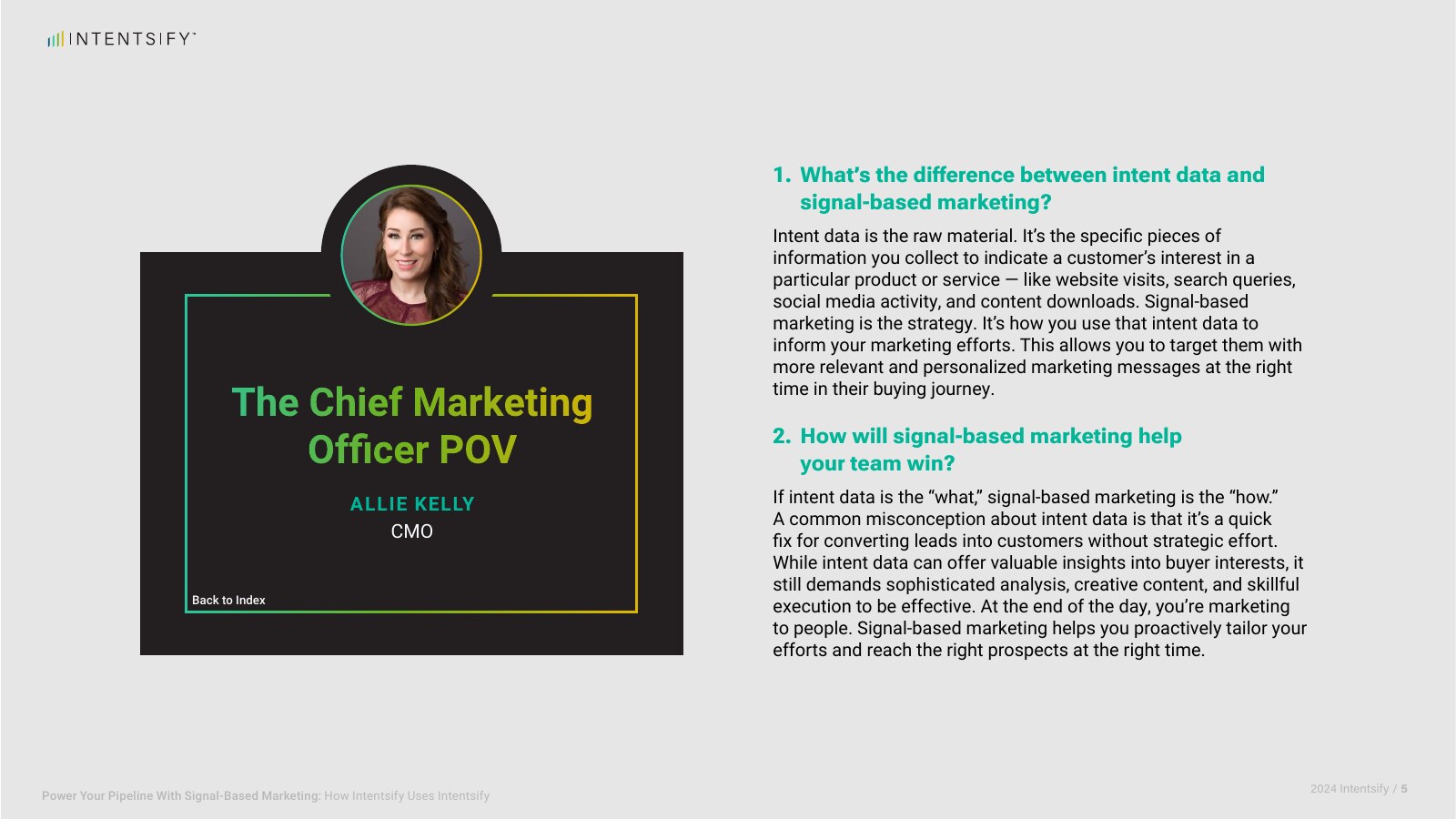
Kelly’s explanation is less convenient and more credible. “Intent data is the raw material,” she has written. Signal-based marketing is the strategy for using it. Raw material still needs analysis, creative content and skilled execution. A signal can suggest that an account is interested. It cannot decide what a useful message sounds like, whether the timing is respectful or how marketing and sales should coordinate the next move.
From noise to a useful next move
This distinction became the spine of Kelly’s writing and speaking. At Gartner’s 2024 Marketing Symposium, she joined Ping Identity’s Morgan Cole for a conversation about operationalizing intent to drive revenue. In Demand Gen Report, she argued that the meaningful leap comes when teams move from collecting information to changing their actions. In Intentsify’s own playbook, she returned to the human limit of the machinery: “At the end of the day, you’re marketing to people.”
A committee has entered the chat
The people, inconveniently, arrive in groups. A large B2B purchase rarely belongs to one person moving alone through a funnel. Finance cares about risk. A technical buyer worries about integration. The daily user wants the thing to work. An executive sponsor needs the change to be defensible. Their research overlaps without becoming identical.
Kelly’s recent work has pushed marketers away from worshipping the isolated marketing-qualified lead and toward understanding the buying group. The difference is practical. A lone content download can be incidental. Several related people at one company researching adjacent problems begin to describe a decision taking shape. The marketer’s job becomes less like counting raised hands and more like mapping a conversation before joining it.
She is candid about the maturity of that approach. During a 2025 program on rebuilding the B2B funnel, Kelly said no one was getting the new model right immediately. Propensity models, buying-group definitions and cross-functional measures need pilots, feedback and adjustment. Her advice carries the temperament of an operator: begin with a tractable problem, learn in public with the people who will use the system, and resist mistaking an elegant model for a finished one.
“I can guarantee that no one’s getting this right out of the box.”Allie Kelly, on building new B2B marketing models
There is a pleasant lack of sorcery in the argument. Better intelligence can help a team waste less attention, but it does not write the campaign, earn trust or settle a disagreement about positioning. AI can identify patterns at a scale no human team can manage. Humans still decide which patterns deserve a response. The more precise the technology becomes, the harder it is to excuse an irrelevant message.
What the operator keeps
Kelly’s career spans categories that appear unrelated at first glance: a mountain lodge, localization services, interactive content, enterprise search, recruiting platforms and intent data. The thread is not a single market. It is the work of turning scattered information into a coordinated experience.
From hospitality, she kept proximity to the customer. From construction, a respect for sequence and dependencies. From global technology, she learned the difficulty of carrying one promise across many contexts. From recruiting software, she saw how culture, product and brand collide in every candidate and customer interaction. At Intentsify, those lessons sit inside a business that tries to detect interest before a buyer announces it.
Her public persona supplies a few counterweights to the dashboards. Kelly is an avid skier, a knowledge enthusiast and an aspiring surfer. Skiing rewards reading a landscape at speed. Surfing, one suspects, is less impressed by quarterly planning. Both require attention to signals that cannot be ordered to arrive.
That may be the most portable idea in Kelly’s work. Marketing does not suffer from a shortage of information. It suffers when information becomes an alibi for sending more, automating more and listening less. A useful signal should reduce waste. A useful creative idea should respect the person receiving it. A useful process should help a team notice the difference.
“Data drives creativity” sounds like a slogan until you follow it through the jobs, the rebrands, the shared-service teams and the buying-group models. Then it starts to look like a discipline. Evidence gives imagination a place to stand. Imagination gives evidence a reason to matter. The operator’s task is to keep the two in the same room.