A business buyer leaves crumbs everywhere. A white paper opened before breakfast. A comparison page revisited after lunch. A webinar registration, an ad impression, a quiet run of searches by several people at the same company. To a casual observer, it is office weather. To Marc Laplante, it has been a career.
Laplante is the co-founder, chief executive, and chairman of Intentsify, the Westwood, Massachusetts company built to turn those scattered traces into useful B2B decisions. His résumé reads like a compact history of the category. First came technology publishing, where an audience declared its interests by what it chose to read. Then came predictive analytics, which tried to gather those choices across a wider field. Now comes buyer intelligence shaped by language models, identity graphs, and the stubborn fact that companies do not buy software. Groups of people do.
The interesting part is not that Laplante keeps finding new language for this problem. The interesting part is that he has stayed with it while the language changed around him. “Content engagement” became “intent.” Accounts became buying groups. Keywords became concepts. Artificial intelligence arrived, wearing a bright tie and asking for the corner office. Through it all, Laplante kept asking a practical question: can this signal help somebody decide what to do next?
The publisher learns to read the readers
Laplante spent 13 years at TechTarget, joining during its startup years and helping it grow into a publicly traded technology media company. He worked on the commercial side, including as a publisher. In that world, editorial content served two audiences at once. Technology professionals came looking for answers. Vendors came looking for the professionals who might soon need their products.
A 2009 launch offers a neat snapshot. As publisher of SearchCloudComputing.com, Laplante described a site meant to answer both tactical questions from developers and strategic questions from chief information officers. The cloud was still a fresh organizing idea. The readers did not arrive as a single tidy persona, and the buying decision did not belong to a single title. Different people needed different information, even when they were approaching the same purchase.
That sentence has aged nicely. Hype is loud; research behavior is usually quiet. Publishing taught Laplante where the useful evidence hides. It also exposed the limitations of a publisher's window. A reader's activity on one network can be revealing, but no complex purchase happens on one website. By 2012, he had left TechTarget and co-founded Prelytix with Mike Kelly and Scott Kelly. Their new company widened the view.
The first company sharpens the question
Prelytix was an early entrant in predictive analytics for B2B marketing. Its premise was to let organizations see intent signals across thousands of publishers rather than through a single pane. The company was acquired by First Derivatives and Market Resource Partners in 2015. Laplante had moved from observing a media audience to building software that interpreted a market.
A sale can look like the end of a founder story, especially when compressed into a biography. Here it functioned more like a field note. The data could reveal activity, but customers still had to assemble sources, calibrate the meaning, connect it to their own products, and activate the result. A signal without a next move is merely an interesting fact, and marketing departments already own magnificent collections of those.
In 2018, Laplante co-founded Intentsify with Mike Kelly, Ed Laplante, and Eric Belcher. The company was built around aggregation and action: combine multiple kinds of buyer-intent data, compare research against a target account's own history, then help sales and marketing teams decide where to focus. This was less romantic than promising clairvoyance. It was also more useful.
How a faint signal becomes a next move
across sources
topic and timing
account and action
The early numbers suggested that the market understood the pitch. Intentsify was profitable in its first full year. Laplante has written that revenue quadrupled in 2020 and tripled again in 2021. By the end of that year, the company had more than 150 customers and accepted a strategic investment from BV Investment Partners. The capital was intended to accelerate growth and product development. It also meant a founder-owned business had acquired a new kind of audience: institutional stakeholders with their own appetite for signals.
Growth, followed by a rebuild
Fast growth did not persuade Laplante that the product category was finished. It persuaded him that its foundation needed work. In a 2026 reflection, he said Intentsify rebuilt its technology in 2023 around large language models and natural-language processing. The aim was to move beyond keyword matching toward models that could infer what a buyer might be trying to accomplish.
The distinction matters. A keyword is an object; an intention is a relationship among objects, people, timing, and context. Someone researching “data integration” might be replacing a product, repairing an implementation, preparing a budget, or writing an article. More data can narrow those possibilities, but volume alone does not settle them. The model has to be calibrated to the customer's solution and to changes in the account's own research pattern.
Then the unit of analysis became smaller. In 2024, Intentsify launched Buying Group Intent, designed to show research patterns at the persona level. Laplante made the sales logic plain in a public post: sales professionals call individuals, not companies. An account can be surging while the person on the phone remains politely bewildered. Knowing which functions and seniority levels are active can make an opening conversation more relevant and less like a stranger reciting the weather.
That return deserves attention. Laplante had moved into the chairman role. In July 2024, Intentsify announced that he would again become chief executive while Charlie Allieri became president. Coming back to a founder's chair is a peculiar assignment. The office may be familiar, but the company is not. There are more employees, more customers, a private-equity partner, a larger product surface, and fewer charming excuses available for improvisation.
The company gets acquisitive
Laplante's renewed tenure has combined product work with acquisitions. Intentsify bought 5×5 Data Co-Op in 2024, adding a member-driven identity-data business. In January 2026 it acquired Salutary Data, which maintains curated contact and company information. The two moves extended the same thesis: intent becomes more actionable when it connects to accurate identity.
There is a practical loop here. Research activity suggests interest. Identity data connects that activity to an account and possible members of a buying group. Activation carries the insight into advertising, lead generation, or sales prioritization. The outcome then produces new information. The elegance is in making the loop consistent. The danger is in mistaking confidence for truth, especially as AI agents begin acting on data without pausing to admire their own uncertainty.
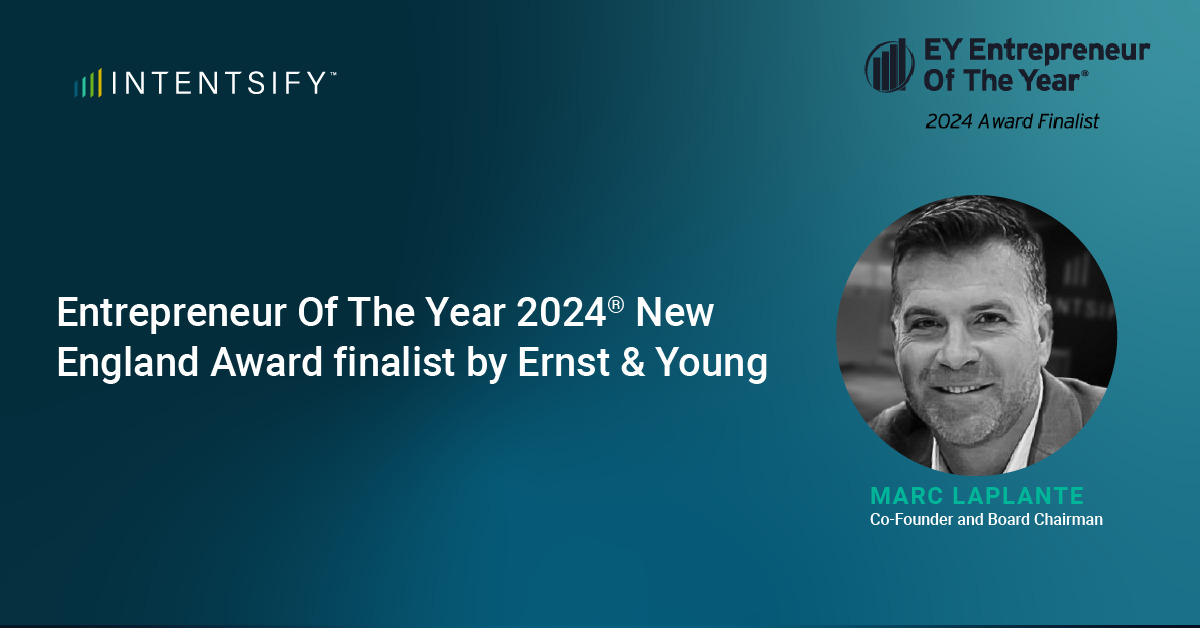
Intentsify's company milestones have supplied plenty of outward validation. It entered the Inc. 5000 at No. 278 in 2023 and appeared again in 2024, 2025, and 2026. Laplante was named one of 27 regional finalists in EY's 2024 New England entrepreneur program. Product awards and two U.S. patents followed. Yet his public comments repeatedly distribute credit across employees, customers, co-founders, and partners. The personality visible through those remarks is less solo inventor than commercial conductor: keep the sections together, keep the tempo legible, and make sure the audience hears the useful part.
A career built on better clues
The transferable lesson in Laplante's story is pleasingly unglamorous. Learn a market from close range. Notice the recurring friction. Build a product. Let the product reveal the next layer of friction. Then resist the temptation to declare the original question solved.
At TechTarget, the clue was content. At Prelytix, it was activity across publishers. At Intentsify, it became multi-source intent tied to action. Now the company talks about concepts, personas, identity, and AI-ready data. Each step makes the map more detailed. None turns the territory into something tidy.
That may be why Laplante has remained with the problem for so long. B2B purchases involve people behaving like people: curious, cautious, distractible, political, occasionally decisive. Software can notice patterns in their research. It can estimate timing and surface likely participants. It cannot remove the human comedy from a buying committee, and it should not pretend to.
The useful ambition is smaller and harder: give the next conversation a better chance of being relevant. Laplante has pursued that ambition from a publisher's desk, through one acquisition, into a second founder journey, and back to the CEO chair. The buyer keeps moving. So does the map.