Every B2B marketer has met the lead that looked alive in a spreadsheet and expired on contact. Someone at a large company read three articles about cloud security. A score jumped. An alert fired. Sales called an innocent director who had been researching a conference panel, not a purchase. The software worked exactly as designed; the conclusion did not.
Intentsify exists in that awkward gap between activity and meaning. Founded near Boston in 2018 by Marc Laplante, Mike Kelly, Ed Laplante and Eric Belcher, the company collects research signals from multiple sources, compares them with an account's usual behavior, calibrates the pattern to a customer's actual product, and helps a revenue team do something with the result. That last clause is the business. Data that arrives after the campaign brief, outside the CRM and without an obvious next move is expensive trivia.
Translate research into a useful Tuesday morning
The customer is usually an enterprise demand-generation, account-based marketing, digital or sales team. It already has a target-account list, a CRM and several channels hungry for budget. The problem is allocation: which accounts deserve an ad today, which buying committee needs another piece of content, and which salesperson should receive an alert with enough context to sound informed?
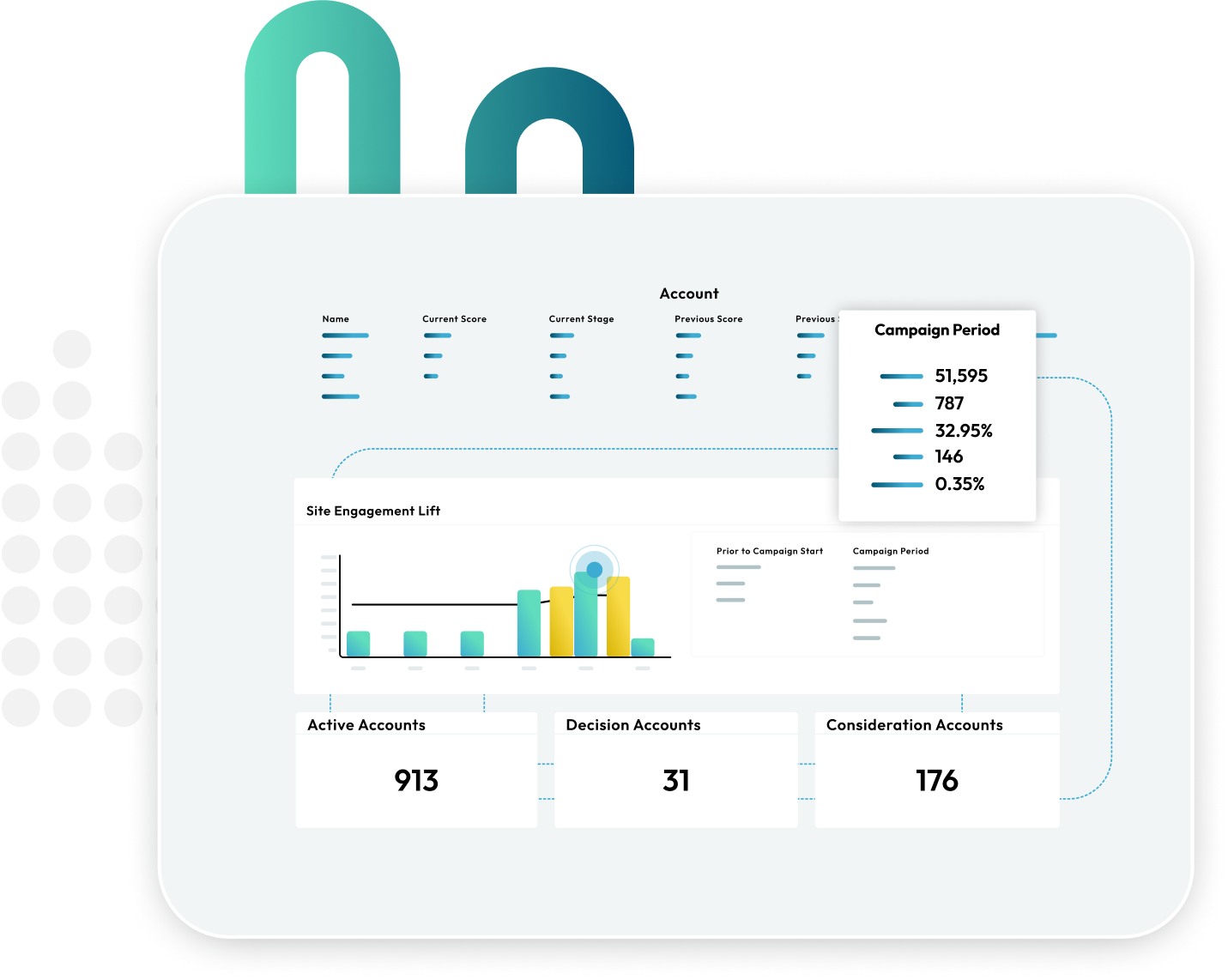
Intentsify's Buyer Intelligence product ingests topic, keyword, website, company, contact, technographic and business-event data. Its models score current activity against a historical baseline, distinguish early research from later-stage behavior, and show movement over time. Customers can bring a list or build one from firmographic criteria. They can receive the intelligence inside systems they already use rather than forcing every employee into a fresh control room.
From faint signal to funded action
Growth exposed the first weak link
The original proposition was aggregation. One intent feed could be noisy; several independent feeds could verify one another and reveal a stronger pattern. It worked. Intentsify says it became profitable in its first full year, quadrupled revenue in 2020 and tripled it in 2021. By the end of that year it had more than 150 customers and an undisclosed strategic investment from BV Investment Partners.
But growth also clarified what the early machinery could not do. Topic and keyword systems are good at recognizing that an account cares about “data security.” They are weaker at inferring whether the research matches one vendor's posture-management product, another vendor's compliance tool, or a graduate student's thesis. In 2023, Intentsify rebuilt its approach around large language models and natural-language processing. Instead of asking customers to pick from a generic shelf of topics, the software could read product pages, PDFs, messages and use cases, then construct and weight a custom model.
The change was not “add AI.” It was changing the unit of understanding from a keyword to the job a buyer was trying to accomplish.YesPress analysis
The next constraint was identity. Enterprise software is not purchased by a logo floating above an office park. Security, finance, IT, procurement and an executive sponsor may all research different questions. Intentsify's partnership with 5x5 Data Co-Op supplied a continuously refreshed identity graph, built from a network in which members contribute validation events as well as consume data. The company says that relationship compressed several years of planned development into months. It acquired 5x5 in 2024 and released Buying Group Intent, designed to map research patterns to likely personas inside a decision-making group.
That history answers what changed the founders' minds. Success did. More customers made the limitations of IP-level and keyword-level inference too obvious to ignore. The product moved from “which company surged?” toward “which cluster of roles is exploring which solution, at what stage?” In 2026, the acquisition of Salutary Data added curated company intelligence and a reported 156 million verified B2B contact profiles. The stack was becoming a data supply chain: behavior, identity, context and activation.
03 / The productsSoftware in the middle, services at both ends
Intentsify sits in an unusual market position. It is part data provider, part SaaS company, part media operator and part managed-service shop. An annual intelligence subscription provides account, buying-group and contact insights. Audience products package those signals for demand-side platforms and ad networks. Managed lead generation distributes a customer's content to relevant decision-makers and verifies the contacts who respond.
The advertising business spans display, native, online video, streaming audio, connected television and digital out-of-home. Campaigns can change by research stage and feed engagement back into the model. Email products handle buying-group nurture, brand campaigns and follow-up. In August 2026, Intentsify added QuantumDemand, a managed solution that joins identity, solution-level intent and engagement into buying-group context, with a proprietary Quantum Index measuring purchase readiness. This makes Intentsify closer to an operating layer than a database: a customer can buy the signal, the action, or both.
The company's “anti-platform” language is more pragmatic than rebellious. B2B teams have spent years assembling Salesforce, marketing automation, data warehouses, ad tools and orchestration software. Replacing that stack is a career-risking request. Intentsify instead promises custom delivery into the systems already on the floor. Its August 2026 Clay integration pushes account and buying-group signals into a workspace used to build outbound flows and AI agents. The strategic idea is simple: shorten the distance between knowing and doing.
04 / The receiptsPipeline numbers beat a beautiful heat map
The strongest public evidence comes from customer case studies, with the usual caveat that vendors publish their happiest outcomes. PagerDuty used multiple signal types, ranked accounts, distributed branded content to relevant people and verified the resulting contacts. It reported a 10-to-one pipeline-to-spend ratio and average deal sizes twice those from other vendors.
Reported pipeline-to-spend ratio after intent-ranked content syndication.
Reported increase in deal size alongside twice as many BDR-prospected opportunities.
Year-over-year increase in marketing-qualified leads without adding budget.
Intentsify's 2026 rank in its fourth consecutive appearance on the list.
Sysdig wanted marketing and sales to agree on accounts while moving toward an “account-based everything” model. Its published results included twice as many BDR-prospected opportunities, 92 percent intent-signal coverage among open opportunities and an 81.8 percent prediction rate for closed-won deals. Splunk, launching an observability product without a larger budget, reported an eightfold year-over-year rise in MQLs and a threefold improvement in return on marketing-contributed pipeline.
Those outcomes describe what Intentsify actually does better than a features page. It does not manufacture demand. It tries to find existing research sooner, reduce wasted distribution, supply a relevant person and message, then keep marketing and sales looking at the same account story.
05 / Price and frictionThe bill is private. The conditions are not.
Intentsify does not publish list prices. Contracts combine different amounts of intelligence, contact data, media and service. Vendr's third-party procurement dataset places the median annual spend around $43,636, with a wide observed range from roughly $22,000 to $130,000. Treat that as a directional benchmark, not a quote. Media budgets and ambitious managed programs can change the economics quickly.
Where this breaks
Intent intelligence will not rescue a fuzzy ideal-customer profile, generic creative, poor sales follow-up or a product too inexpensive to support enterprise data costs. A score is evidence for a decision, not permission to spam.
The first operational failure is often adoption. A G2 review pattern praises lead quality and support while noting an initial learning curve. That makes sense. Multi-source scoring adds nuance, and nuance adds questions. If sellers cannot see why an account is ranked, or marketers cannot connect a signal to a play, the expensive intelligence becomes another tab. Intentsify addresses this with managed service and source transparency, but the customer still needs process discipline.
It also works best under specific conditions: a clear target market, meaningful contract values, a buying cycle long enough to produce research, several people involved in the decision, and enough historical opportunity data to test whether high scores resemble real buyers. It is a poor fit for low-ticket consumer sales, brand-new categories with little observable research, or teams expecting a weekly list to substitute for positioning and copy.
06 / The stealA playbook you can copy before buying anything
- Start with one revenue question. Pick account prioritization, renewal risk, cross-sell or campaign targeting. “Use intent” is not a use case.
- Model the product, not the category. Feed the evaluation with landing pages, competitor names, use cases and late-stage questions. “Cybersecurity” is a neighborhood, not an address.
- Demand independent confirmation. Treat one signal as a clue. Look for coordinated activity across sources, people and time.
- Back-test before launch. Score old opportunities without revealing the outcomes. If wins and losses look identical, the model has failed cheaply.
- Write the next action beside the score. Route early research to education, later research to sales, and ambiguous activity to observation. Do not send every surge to the same sequence.
- Measure money, not motion. Compare opportunity creation, sales-cycle length, deal size and pipeline-to-spend. Clicks can be supporting evidence; they are not the verdict.
A crowded field, differentiated by plumbing
Intentsify competes with broad ABM platforms such as 6sense and Demandbase, data vendors such as Bombora and ZoomInfo, publisher-derived products from TechTarget, G2 and TrustRadius, and demand-generation providers. Buyers can assemble similar ingredients themselves. The real comparison is not whose dashboard has the brightest surge icon; it is data freshness, source diversity, model specificity, identity resolution, workflow fit and activation support.
Its recent moves reinforce that position. Two U.S. patents granted in 2025 cover dynamic intent scores and precise target-account-list generation. The 5x5 and Salutary acquisitions deepen the identity layer. New audience products distribute the intelligence beyond Intentsify's own programs. The Clay partnership places it inside agent-driven workflows. In each case, the company is building plumbing beneath the score and more exits from it.
That is the sober appeal of Intentsify. It is not promising to read a buyer's mind. It is trying to recognize a research pattern, attach the right commercial context, and get the observation to a person or machine while it still matters. In B2B marketing, that modest difference can separate a useful introduction from one more automated interruption.