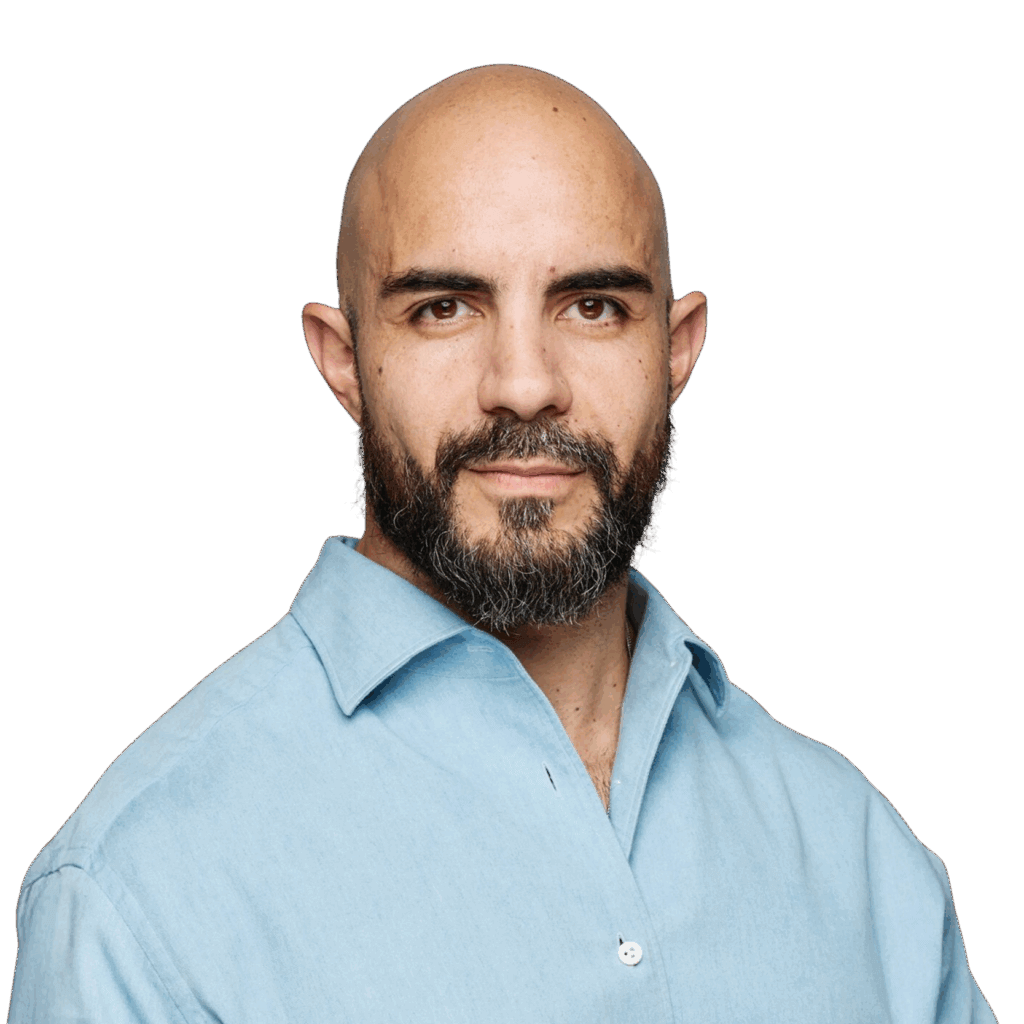
The Man Who Read the Whitepaper First
In 2010, a Stanford computer science student was running security research in the university lab when he found a nine-page document by an anonymous author. Satoshi's whitepaper. Most people who read it that year didn't do anything about it. Ali Yahya built his entire career around what it described.
That's not origin story embellishment. It's the actual shape of his career. Yahya spent years at Google - first at Google Brain, where he was a core developer on TensorFlow, the ML library that would go on to define an era of machine learning. Then at Google X, working on Everyday Robots, the project trying to build affordable home robots. By any metric, a compelling run. And he walked away from it in 2017 to join a small crypto team at Andreessen Horowitz.
Not just joined - he was the first full-time crypto investor they hired. He didn't walk into a practice. He started one. That took a particular kind of conviction: the belief, held since 2010, that decentralized networks weren't a curiosity but an infrastructure shift. The kind that only looks obvious in hindsight.
Since then he has backed the blockchains that now move billions. Solana - a landmark bet before it became a cultural phenomenon. LayerZero, the omnichain protocol that lets blockchains talk to each other - a16z purchased another $55 million in ZRO tokens in April 2025, locking up for three years. EigenLayer, the restaking protocol his firm backed for $70 million in early 2025. Jito, the Solana staking and MEV infrastructure play his team backed for $50 million in late 2025. The pattern: deep infrastructure, cryptographic primitives, coordination layers that most investors can't evaluate and most founders can't fully explain.
He can evaluate them. And he can explain them. His concept of the "Network Flywheel" - the framework he developed for understanding how blockchain tokens capture and defend value - is the kind of framework that takes years to earn. It's not borrowed from traditional finance. It emerged from thinking hard about a new kind of network economy that didn't have a prior reference point.
His 2026 thesis centers on privacy as a structural moat. "Privacy creates chain lock-in," he wrote. "Users on private networks are less willing to migrate if doing so risks exposing transaction histories or behavioral patterns." While most of the industry is debating throughput and fees, he's betting that privacy will determine who wins the layer-1 wars - a winner-take-most dynamic without sacrificing decentralization. It's a thesis that requires you to understand cryptography, game theory, and user psychology simultaneously. Yahya holds all three.
He's also one of the earliest major voices on where crypto and AI intersect. Not in the speculative "AI tokens" sense. In the structural sense: crypto as a coordination layer for unused GPU supply, as a verification layer for synthetic media, as zkML infrastructure that lets machine learning models prove their outputs without revealing their weights. The design space, as he puts it, "we've barely begun to explore."
In 2026, a16z crypto closed its fifth fund at $2.2 billion. Yahya is one of four General Partners leading it, alongside Chris Dixon, newly promoted CTO Eddy Lazzarin, and Guy Wuollet. Through multiple bear markets and the exodus of "fair weather VCs," the team held position. "Many fair weather VCs have pivoted," he observed in 2023, with characteristic restraint. He didn't.