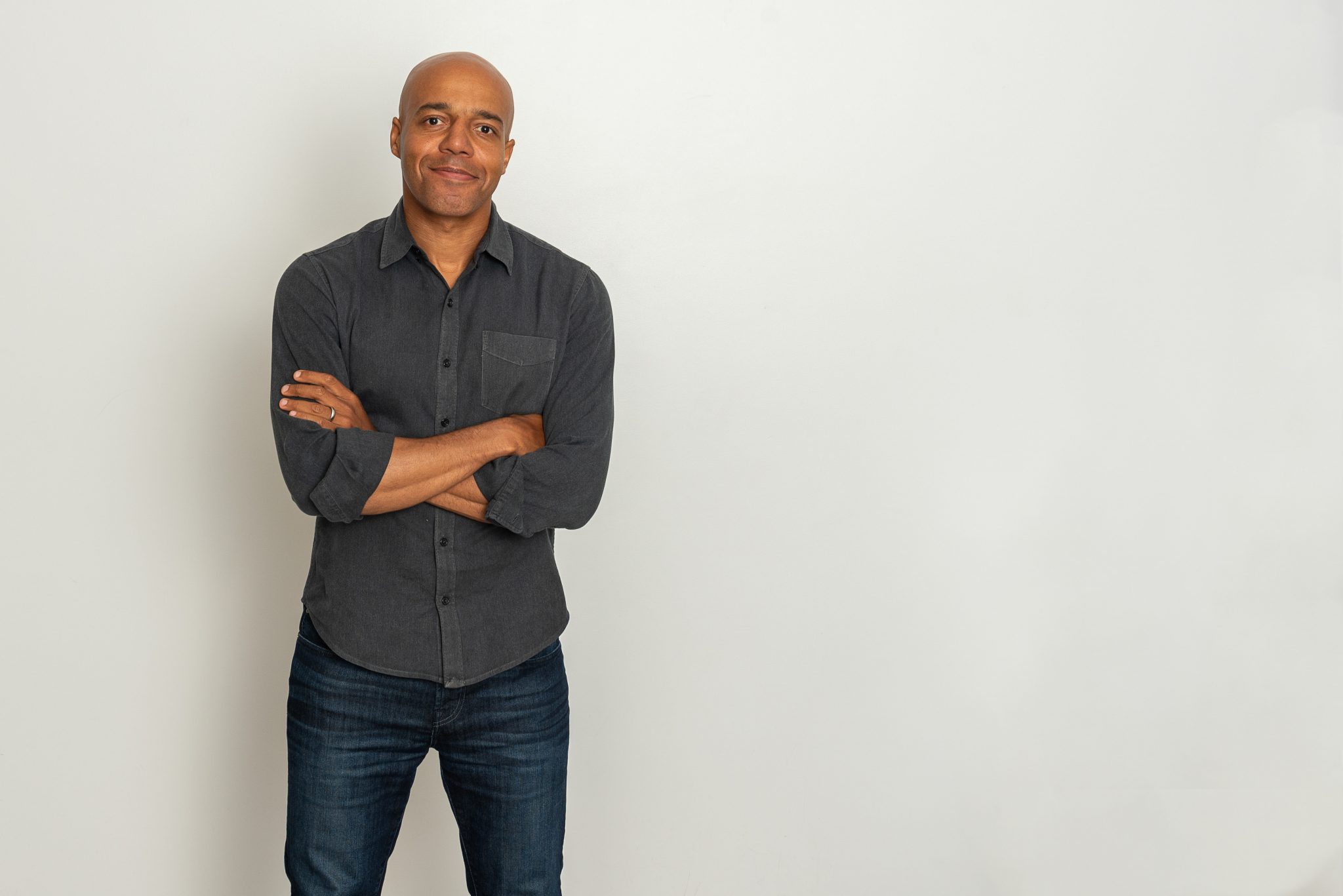
In the mid-2000s, when Mark Zuckerberg was still sending Facebook invites to American college students, a 23-year-old in Madrid was building a social network that would beat him in Spain. Adeyemi Ajao — Ade to everyone who knows him — coded through nights at a business school in the city, building Tuenti before "social network" was even a category worth chasing. By 2010, Tuenti had millions of Spanish users. Telefónica paid roughly $100 million to own it. Ade was 26.
That exit isn't the most interesting thing about him. The interesting thing is what he saw before anyone else did, and what he decided to do next.
Born in Lagos to a Nigerian father and Spanish mother, Ajao spent early childhood ricocheting between West Africa, Italy, and eventually a small coastal city in southern Spain. He arrived in Marbella around age eight or nine — one of the only Black children in his school, in a country that hadn't had much practice with that. His father's advice, blunt and direct: "Everything is going to be more difficult for you because you look different. You're going to have to try twice as hard." His mother's advice: "Embrace your differences and go with the flow." He took both.
He taught himself to code in high school. No classes. No bootcamp. Just a boy who liked chess, liked computers, and had time to figure things out. That self-taught foundation would end up more useful than the joint law degree and economics master's he earned at Comillas Pontifical University's ICADE faculty in Madrid — useful, at least, in the ways that matter for building technology companies from scratch.
"Being an outsider means freedom."
- Adeyemi AjaoAfter Tuenti was acquired, Ajao did something most people in his position skip: he went back to school. Stanford GSB, class of 2010. Then McKinsey. Not the obvious next move for someone who'd just sold a tech company for nine figures, but Ajao was running a pattern — absorb the thing you don't know yet, then go build with it. McKinsey gave him a systematic map of how large organizations actually function, the kind of knowledge a founder can't get by accident. He filed it away.
In 2014, he co-founded Identified — an AI-powered platform that matched companies with talent using machine learning on professional data. The company raised $22.5 million and was acquired by Workday the same year. Ajao joined Workday as VP of Technology Product Strategy and, from inside one of enterprise software's biggest players, helped launch Workday Ventures, their first corporate VC fund. He was doing market reconnaissance for his next chapter without calling it that.
"We back founders who work on problems considered unsexy for traditional VCs — logistics, trucks, food procurement, waste management."
Adeyemi Ajao, Base10 PartnersBase10 Partners arrived in 2017. Ajao co-founded it with TJ Nahigian and set up shop at 101 Mission Street in San Francisco. The thesis was deliberate and somewhat confrontational: while the rest of Silicon Valley was stacking chips on consumer apps, social platforms, and enterprise SaaS, Base10 would invest in automation for what Ajao calls the Real Economy — the sectors that actually employ most people. Logistics. Food. Retail. Healthcare. Construction. The industries a Palo Alto lunch conversation almost never mentions.
The bet was simple: these sectors would automate, the companies doing it would be enormous, and almost nobody in traditional venture was paying attention. Ajao was paying attention. He'd watched as a kid in Marbella while the world decided what to care about and what to ignore — and learned that the ignored parts had different rules.
The portfolio that followed isn't modest. Instacart. Nubank, now worth over $30 billion. Figma. Rappi. Notion. Brex. Stripe. Roughly 60 percent of Base10's portfolio companies are led by women or minority founders — not as a marketing point, but because Ajao's map of overlooked markets naturally intersects with overlooked founders. He was trained for this. His entire life has been a graduate seminar in what gets missed when the room only looks one way.
In 2023, Forbes put Ajao on the Midas List at number 96. He was the first Black investor ever named to the list — in 20 years of the ranking's existence. When Kara Swisher called it "the Oscars for venture capitalists," she wasn't wrong about the weight of the moment. Ajao made the list again in 2024.
"I definitely still feel like an outsider today in almost every circle."
- Adeyemi AjaoThe Advancement Initiative is the part of Base10 that the press sometimes buries in a paragraph but probably deserves its own story. When Base10 raised its third fund — the one that pushed total AUM past $1 billion — Ajao and Nahigian pledged to donate 50% of the carry to create scholarships for underrepresented students in technology at underfunded universities. Not 10%. Not a donor-advised fund that might distribute something someday. Half. It's an odd move in an industry where most philanthropy happens quietly, after the returns arrive. At Base10, the pledge is structural. It's not separate from the fund. It is the fund.
Ajao reads science fiction. He and his brother share the habit. It's the kind of detail that, once you know it, makes everything else make sense. Science fiction is the literature of systems that don't exist yet — of imagining what the world could look like if different forces were in play. It's exactly the cognitive muscle you need to look at a trucking logistics startup in 2018 and see a $3 billion returns story.
He moved to Silicon Valley, by his own account, to "play in the Champions League." He brought an accent, a self-taught coder's toolkit, and a biography that didn't fit the venture capital standard template. He backed companies in sectors the template says aren't interesting. His fund is now the largest Black-led venture capital firm in the world. The first to break a billion. The first on the Midas List. None of it, watching from Marbella in 1990, would have been predictable. All of it, watching from San Francisco now, looks like a straight line.