The Engineer Teaching Microbes to Build Nature at Scale
He spent years teaching bacteria to build molecules that used to take entire fields of plants. Then he bet a company on getting those microbes out of the lab and into million-liter tanks.
There is a stubborn gap in biotechnology that founders talk about the way sailors talk about weather. A discovery works beautifully on a lab bench. Then someone tries to make it at industrial scale and the whole thing falls apart. Ajikumar Parayil built a company designed, from the first day, to walk across that gap. The pitch behind Manus Bio is almost boring in its ambition: make the molecules nature already makes, but do it in a tank, reliably, and cheaply enough that it matters.
Parayil - known to nearly everyone as Aji - is a chemical engineer by training and a scale-up obsessive by temperament. He earned his Ph.D. from Mahatma Gandhi University in Kerala, India, then moved through postdoctoral research at the Singapore-MIT Alliance and, eventually, the Massachusetts Institute of Technology. That last stop is where the story turns.
01 / The ExperimentSimplifying the biology for engineering
In the mid-2000s at MIT, Parayil worked with the chemical engineering professor Gregory Stephanopoulos on one of the hardest problems in metabolic engineering. Cells make thousands of useful compounds, but the pathways that build them are tangled. Nudge one step and three others break. The pair went after isoprenoids, a family of more than 60,000 molecules that shows up in medicines, flavors, and fragrances.
Their answer was a method they called multivariate modular metabolic engineering. Instead of treating a 17-step pathway as one impossibly delicate machine, they broke it into modules that could be tuned like dials. In 2010 they published the result in Science: an engineered bacterium producing a precursor to a cancer drug, with output raised roughly a thousandfold over what came before.
It is a deceptively humble sentence. Most metabolic engineers were trying to out-think the cell. Parayil's instinct was to make the cell easier to boss around - to turn a biological mess into something an engineer could actually design.
02 / The LeapFrom a paper to a payroll
A thousandfold result gets you tenure conversations and citations. What it does not automatically get you is a company. Parayil decided he wanted the harder thing. In 2011 he founded Manus Bio to commercialize the MIT technology, with Stephanopoulos among the founding team.
He did not pretend the business side would take care of itself. He went through MIT's Innovation Teams program and the Martin Trust Center for Entrepreneurship, and took venture courses to learn the language of customers, margins, and markets. The name he chose, Manus, is Latin for hand - nature's molecules, remade by human design.
03 / The Valley of DeathThe part everybody skips
Ask Parayil what makes Manus different and he will steer you, quickly, toward the least glamorous subject in the field: scale. The company talks openly about the "Valley of Death," the stretch between a promising lab process and a working factory where most biotech ideas quietly die. Yields that look great in a flask can collapse in a thousand-liter tank. The economics stop working. The molecule never ships.
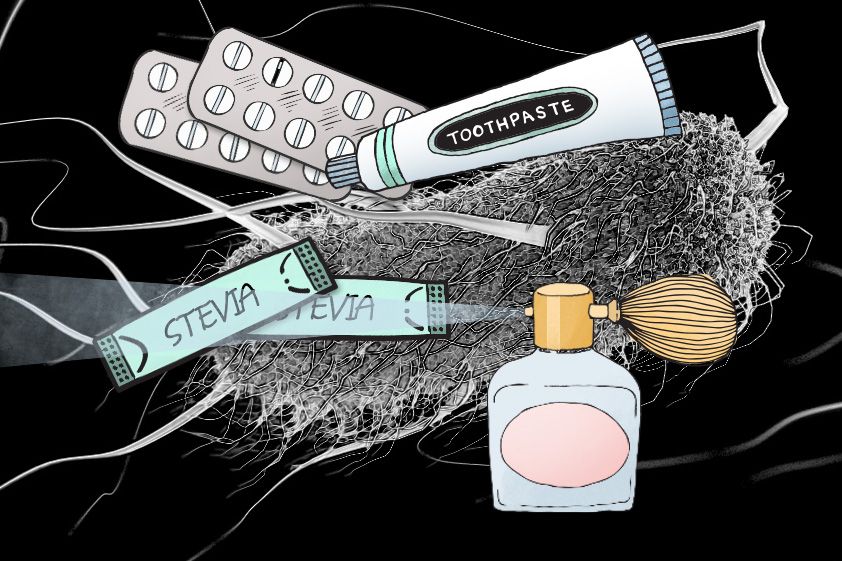
Manus built its whole identity around crossing that valley rather than admiring it. The company moved from lab to a pilot plant around 2018, then kept climbing. One of its marquee products is Reb M, a zero-calorie sweetener derived from stevia that Manus produces through fermentation at more than 95% purity - well beyond what pulling it out of plants typically delivers.
Reb M is the kind of thing that ends up in a can of soda without anyone thinking about the microbes that made it. That anonymity is the point. Parayil is not trying to build a brand you notice on a shelf. He is trying to change how the ingredient underneath the brand gets manufactured.
04 / GeorgiaWhy a Boston lab moved to a tank farm
The headquarters and R&D live in Boston. The muscle lives in Augusta, Georgia, where Manus has been scaling a BioFacility toward roughly 1.3 million liters of fermentation capacity - by the company's account, one of the largest precision fermentation footprints in the country. It is a very deliberate bet: that the future of manufacturing does not have to sit next to a coastline of venture capital. It can hum along in rural America.
Parayil frames biomanufacturing less as a science project and more as national infrastructure - a strategic imperative, in his words, rather than a future promise. When he talks about industrial biotechnology replacing petrochemical production, he means it economically, environmentally, and geographically.
05 / The RecordA quiet pile of recognition
The awards have followed the work rather than the noise. In 2020, Parayil won the American Institute of Chemical Engineers' Raphael Katzen Award, which honors contributions to chemical engineering with real industrial impact. He was later inducted into the American Institute for Medical and Biological Engineering's College of Fellows, cited for developing and commercializing a platform for microbial engineering of complex natural products.
His name sits on more than 180 U.S. and international patents, granted and pending, and more than 60 publications spanning biotechnology and chemical biology. He has also co-founded a second venture, Mirakel Technologies. But the through-line is consistent: take something nature does slowly and scattered across farmland, and make it happen on purpose, in a tank, at a price people can pay.
06 / The Long GameMaking the future boring
There is a version of the synthetic biology story that is all breathless promise - cures, revolutions, a decade always just around the corner. Parayil's version is more patient and, in a way, more radical. He believes the 21st century will be defined by biology replacing the petrochemical playbook, and he acts like the way to prove it is to ship. Not a demo. Real product, out of real tanks, at real cost.
If Manus keeps working, the payoff is a strange kind of invisibility. The sweetener in a drink, the scent in a soap, the flavor in a snack - all quietly made by engineered cells instead of extracted from far-flung crops, and nobody thinks twice. For a scientist who spent his career trying to make biology behave like engineering, that might be the highest compliment: the technology gets so reliable it stops being a story and becomes plumbing.
For now, it is still a story - one that runs from a lab bench in Cambridge to a million liters of tanks in Georgia, held together by a single idea Parayil has been repeating for two decades. Simplify the biology. Then build it at scale.