Aaron Bell’s girlfriend was starting a food business. Bell had been working on artificial intelligence for NASA projects. Helping a small brand advertise online ought to have been a manageable assignment for someone accustomed to rather elaborate software. The advertising industry had other ideas.
The business was Matisse & Jack’s. The difficulty of promoting it helped inspire AdRoll: an engineer encountered a market in which access depended heavily on budgets, intermediaries and patience. His girlfriend later became his wife. The advertising problem became a company.
There is something pleasingly domestic about that origin. A career involving space missions takes a turn because somebody needs to sell food. It gives Bell’s work a scale that a list of job titles misses. The immediate customer has a name, a product and a finite amount of money. An elegant system is useful only if that person can get through its front door.
Years later, Bell would work on AI that helps make weather forecasts and satellite information usable. Advertising and rainfall have very different consequences. But put the work side by side and a recurring interest comes into view: sophisticated machinery, made available to people who would struggle to assemble it themselves.
- 2005EarthTutorHelp students work with satellite imagery.
- 2007 onwardAdRollHelp smaller brands run display campaigns.
- 2019 onwardGoogle ResearchWork on climate, weather and geospatial AI.
A career timeline, rather than a comparison of the projects’ impact.
Before the banners, a view from orbit
Bell began programming young and worked at Microsoft while still in high school outside Seattle. He then studied computer science at Stanford, attending from 1996 to 2000. Software was a working craft for him before it became a route to running a business.
At Stottler Henke, the artificial intelligence company in San Mateo, his projects included systems to help NASA schedule missions. Scheduling is an unglamorous word for a consequential problem: fitting many dependencies into an order that actually works. A plan on a screen eventually has to survive contact with the world.
Another project from those years offers a revealing preview of his later interests. EarthTutor, described in a 2005 paper co-authored by Bell, put an intelligent tutoring system inside satellite-image processing software. It was intended to help students learn remote sensing by doing it, with guidance that responded when they had difficulty.
The associated authoring work also addressed teachers. Subject experts needed to create lessons without becoming software specialists. EarthTutor’s layered design let more experienced authors handle complicated tasks and make their work available to less technical users. The educational ambition depended on a practical detail: how much expertise someone needed before the tool became helpful.
Satellite imagery already contained a great deal of information. EarthTutor worked on the distance between having that information and being able to use it. That distance would turn up again in a much less scholarly setting: the online advertising dashboard.
The banner ad gets a smaller customer
AdRoll took shape in the late 2000s, with Bell and a founding group that included Jared Kopf, Peter Krivkovich, Adam Berke and Valentino Volonghi. Its early business was an advertising network. The mission was to make display advertising workable for brands beyond the familiar names buying prominent placements.
In the older arrangement, a brand might approach a large website, discuss a rate card and negotiate a campaign. That process suited organizations with money and staff to spare. A smaller business needed something it could operate without acquiring an advertising department along the way.
The financial crisis sharpened the question. With customers watching their spending, AdRoll concentrated on product and on what advertisers would still pay for. The answer was a measurable return. As advertising exchanges and real-time buying developed, the company moved toward retargeting: helping brands reach people who had already shown interest by visiting their sites.
For the customer, the attraction was practical. A business already had information about what visitors looked at. AdRoll could help turn that information into an advertising campaign. The engineering challenge involved auctions, integrations and data. The customer’s question was considerably shorter: will this bring people back?
Bell also had to explain the awkward parts. In a 2010 interview, he discussed frequency caps to limit repeated ads, controls over where ads appeared and the disputed practice of crediting a sale to an ad someone may scarcely have seen. The complications belonged inside the conversation. A system that promises measurable results has to answer questions about its measurements.
A deal with vegetables on the table
By June 2013, Bell was announcing the acquisition of Bitdeli, a data analytics startup founded by brothers Ville and Jyri Tuulos. The accompanying photograph looks refreshingly unlike an acquisition announcement: four people in backward caps, vegetables on a counter and a loaf of bread awaiting its moment.
Bell stands second from the left, beside Volonghi and the Tuulos brothers. The scene makes a small joke of the company name. Financial transactions rarely look improved by tomatoes; this one does.
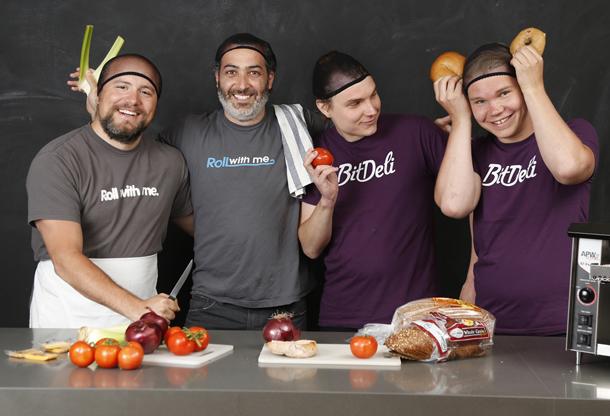
The engineering connection was older than the deal. Volonghi had followed Ville’s open-source work on Disco, an Erlang-based MapReduce framework. Bitdeli brought complementary skills in data processing and interfaces. Bell’s explanation of the acquisition emphasized richer analysis, useful visualizations and clearer access to customer data.
The company was expanding beyond that kitchen-counter mood. In April 2014, AdRoll announced $70 million in funding led by Foundation Capital, alongside plans to invest in mobile and international operations. Its investor described 15,000 active advertisers in more than 100 countries. The original problem of access had found customers well beyond the original food business.
The questions the boss has to answer
Expansion also changes the machinery of an office. You can know everybody in a small company. Add floors, countries and hundreds of colleagues, and familiarity stops doing so much of the work. Bell has spoken candidly about being outside his comfort zone when he became CEO after an engineering-heavy career.
His response included an unusually concrete habit: employees could submit questions for leadership to answer at all-hands meetings. Anonymity made room for questions that might otherwise remain conversations after the meeting. Listening acquired a repeatable mechanism.
One former colleague described the weekly Q&A as Rollywood Squares. When Google Moderator, the tool used to gather questions, was discontinued, Bell asked an engineer sitting nearby about a replacement. That request helped produce an internal tool called RollHands. Even the company’s conversation needed someone to maintain the software.
The colleague’s account includes the wonderfully ordinary concerns that attracted votes: lunches, sweaters, socks and hats. It is easy to publish a statement about transparency. It is more revealing to build a system that lets a roomful of people ask for socks and keep using it when the conversation gets more difficult.
Bell’s leadership advice was similarly practical: give people a clear direction, keep the company funded, set the cultural tone and establish a rhythm for goals. He favored outcomes over a roadmap treated as scripture. Shipping something on time tells you that it shipped. Customers supply the more interesting verdict.
“I love to build things.”
Aaron Bell, on his engineering background
Handing over the title, keeping the work
In November 2017, Bell moved from CEO to chief product officer, with Toby Gabriner taking the chief executive role. Bell’s new remit covered engineering, product, user experience, data science and supply. The change brought his formal responsibilities closer to the work that had occupied him before he ran a company.
AdRoll then reported roughly 500 employees and 35,000 clients. Those figures describe a particular moment in its history, when handing over a title involved a substantial organization. Bell publicly welcomed the partnership and the chance to focus on product development.
The business subsequently organized its consumer and business marketing activities under AdRoll Group and later the NextRoll name. Bell’s connection to it continued through the board. His own working life took another turn in 2019, when he joined Google Research, where his public professional profile lists him as an engineering director working on climate and weather.
The forecast has to leave the laboratory
Bell’s name appears among the authors of WeatherBench 2, introduced in 2023. Its purpose is straightforward to state and demanding to deliver: give researchers a shared way to evaluate data-driven global weather models against established forecasting approaches. The work includes public datasets, evaluation code and a website showing model scores.
A forecast can look persuasive in isolation. A benchmark asks how it performs under a common set of tests. That shared infrastructure helps other researchers investigate improvements, rather than each group having to construct its own entire comparison. The less glamorous work of evaluation gives an ambitious model somewhere to prove itself.
An October 2025 paper co-authored by Bell describes Global MetNet, an operational system for precipitation nowcasting. It combines satellite observations and other weather data to predict rainfall over the next 12 hours, including regions with sparse radar coverage. The paper reports forecasts at approximately five-kilometer spatial resolution and 15-minute intervals, generated in under a minute and already deployed through Google Search.
Rainfall forecast horizon
Spatial resolution
Time intervals
Forecast generation
Reported system specifications, not a claim that every forecast is correct.
These are team efforts, with long author lists spanning research and product work. Bell’s part belongs within that collaboration. The consequence for a user is pleasantly direct: a forecast reaches a familiar screen, without requiring the user to know which observations or models made it possible.
Earth AI, another 2025 collaboration with Bell among its authors, widens the view to geospatial information. It brings together models for imagery, population and environment with Gemini-powered reasoning. The technical ingredients differ from EarthTutor, but the earlier question is recognizable. How do you help someone ask a useful question of a planet’s worth of data?
An entirely reasonable interest in theme parks
Bell has another answer to the question of what he would build. On his Wellfound profile, asked what he would do if money were no issue, he chose a theme park. His favorite non-business book there is Douglas Hofstadter’s Gödel, Escher, Bach.
The combination has some charm: intricate systems on the bookshelf, intricate systems with queues in the daydream. A theme park, after all, requires a tremendous amount of engineering to produce an experience people can simply enter and enjoy.
It is tempting to turn every personal detail into a business lesson. This one can remain a good answer to a good question. Bell has spent years working with complex things: mission schedules, advertising exchanges, organizations and weather models. He also thinks a theme park would be fun. Even a career devoted to making tools useful ought to leave room for a ride.
Keep following the question
Bell’s public profiles, conversations and published work.