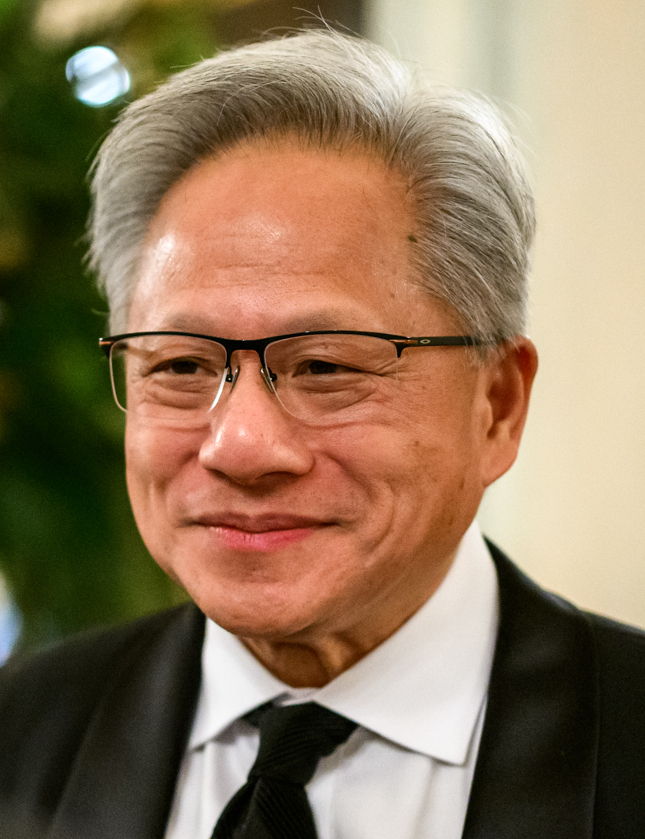
There is a moment in every immigrant story where the ordinary becomes miraculous. For Jensen Huang, it arrived on a carpet.
He was nine years old, freshly delivered from Thailand to a relative’s home in Tacoma, Washington, when he first stood on wall-to-wall carpeting. “It was the strangest feeling,” he tells former Secretary of State Condoleezza Rice. “I felt like I was walking on my bed with my shoes on.” The cereal, the morning television, Speed Racer in the afternoon, the Snickers bars, the cars — all of it struck him as almost impossibly beautiful. Half a century later, sitting inside a supercomputer-designed building on Nvidia’s California campus, the founder of the most consequential technology company in the world has not lost the sense of wonder. If anything, he has industrialized it.
▶ Watch on YouTubeThe conversation, part of Rice’s “Only in America” series, is nominally about technology. In practice it is a meditation on risk, gratitude, and the peculiar national chemistry that lets a busboy become a titan inside a single lifetime. Rice, who introduces the piece by noting that American innovation “is possible here because of our American freedoms,” is an ideal interlocutor: a Stanford professor and diplomat who understands both the machinery of power and the fragility of the conditions that produce it. Huang, for his part, is disarmingly candid, funny, and relentlessly reflective — a man who reasons about his own biography the way he reasons about processor architecture: from first principles.
A ten-year-old leading a nine-year-old
Huang was born in Taiwan. When he was five, his father took a job in Thailand helping to start an oil refinery. In 1973, a coup convinced his parents that the country was no longer safe for their sons, and they moved fast. An uncle in Tacoma agreed to take the boys “for a little while.” The logistics were staggering: Huang and his older brother — ten and nine years old — flew from Thailand to the United States alone, laying over in Chicago’s cavernous airport to find their connecting flight, then continuing to Kentucky.
“Could you imagine a ten-year-old bringing along a nine-year-old?” Huang marvels. “My older brother is incredible. I just followed him around.” Their destination was the most affordable, accessible boarding school his parents could find: a school in Oneida, Kentucky, a town Huang lovingly describes as “one little dot” on Google Maps with a population of roughly 600 — then and now. The school welcomed students of all backgrounds, sponsored the brothers, and gave Huang what he calls a “wonderful, incredible” childhood, even as it was “very difficult, very scary.”
Kentucky in 1973 had never seen a Chinese kid. There were, Huang acknowledges plainly, “all the things that come along with being a stranger in a town where nobody’s ever seen someone like you before.” But he frames the whole experience through the lens of expectation. “When you came from an even more difficult circumstance,” he says, “that’s the thing about immigrants — you came because of choice. You wanted to be here.” He joined the swim team and the soccer team. He discovered sausage and gravy. And after one swim meet, a coach took the team to a restaurant that “seemed like a spaceship,” where the menu was “all lit up” and the food came in boxes. It was a McDonald’s.
His parents eventually reunited the family in Tacoma, arriving with almost nothing — their belongings packed into a single suitcase, the classic immigrant tableau. His mother worked as a maid at a Catholic school; his father, an engineer, saved everything they had. For the family’s one great vacation, his father bought a seatless green van, laid a carpet in the back, set down milk crates for seats, and drove the boys from Oregon to Los Angeles to see Disneyland.
The homework pickup line
School, for a boy who loved math and science, meant a small and predictable social circle. “When you’re in high school and you love math and science,” Huang jokes, “you’re only going to have three other friends who also love math and science.” They were in the math club, the science club, and the computer club together, and afterward they played arcade games. When his best friend announced he was going to Oregon State, Huang said, “That sounds great,” and followed — a happenstance that landed him in a good engineering program at sixteen.
It also landed him next to Lori, one of only three women in a class of 250. Huang, ever the strategist, “statistically weeded out everybody” by maneuvering himself into her lab class, reducing his competition, he says, “from 250 to four.” Then came the immortal opener: “I asked her if she wanted to see my homework.” It worked. They have been together ever since.
The longest-running student at Stanford
Silicon Valley recruiters came to Oregon State, and Huang took a job at AMD — partly because the company would pay for him to attend Stanford at the same time. “You’re going to pay me to go to Stanford?” he recalls asking. “They said, ‘Yep.’” What followed was an unusually long, unusually rich education: classes, then time off, then more classes, stretched across some eight years. “I’m probably the longest-running student at Stanford,” he says. “Nobody paid Stanford more.”
But working and studying simultaneously collapsed the usual distance between theory and practice. “When you’re going to school, you think that the schoolwork is awfully academic,” he says, “because you’re not sure whether there’s any purpose.” Doing both at once, he could see the principles at work in everything he did. His family, his kids, his company, Stanford, his job — “all of it kind of in one giant soup.” It was there, in that stew, that his whole philosophy of computer science took shape.
A business plan ‘impossible to fund’
Nvidia was born at the dawn of the PC revolution, when everything in Silicon Valley was about the CPU, Moore’s law, and general-purpose computing. Huang and his co-founders bet against the consensus. A general-purpose processor, they reasoned, could not possibly be the right tool for every interesting problem — real-time computer graphics, then one of the hardest problems in computer science, chief among them. “There’s a right tool for the right job,” Huang says. They imagined a second processor that could offload the work a CPU handled poorly and, in effect, turn an ordinary computer into a supercomputer.
The trouble was the chicken-and-egg problem — a puzzle Huang calls “incredibly hard” and, apart from Nvidia, essentially never solved. For 64 years, applications had been built atop the CPU, each reinforcing the architecture’s dominance. How do you convince developers to write for something new? Nvidia’s answer was to find a first application that both needed the new architecture and shipped in high enough volume to make it proliferate. That application was 3D graphics for video games — an unglamorous market then dominated by Silicon Graphics, but one driven, as the film notes, less by the grown-ups in the house than by the kids demanding a more powerful gaming machine.
Sequoia Capital and Sutter Hill backed the impossible plan. “We were just determined that on a first-principle basis, the general-purpose computer cannot possibly be the only computing platform,” Huang says. The GeForce 3, one milestone along the way, packed a 57-million-transistor processor — more transistors, as an Nvidia engineer boasted at the time, than a Pentium 4 and a Pentium 3 combined. Crucially, it was programmable: for the first time, a graphics processor had an instruction set as flexible as a CPU’s.
‘We suffered our way here’
The genius of the bet was that graphics turned out to be a special case of something far larger. “Computer graphics is basically a simulation of the world,” Huang explains. “In a lot of ways, artificial intelligence is a simulation of the mind.” Both are massively parallel problems, unsuited to the step-one, step-two recipe execution of a CPU. So Nvidia kept finding new worlds to simulate: seismic processing, CT reconstruction, ultrasound, molecular dynamics, Newtonian physics — “on and on and on.”
Then, one day, researchers came calling — Andrew Ng at Stanford, Geoff Hinton at the University of Toronto, Yann LeCun at New York University — all chasing deep learning. Huang, “being alert,” recognized a problem Nvidia could help solve. The collaboration produced a level of computer vision “that no one had ever imagined,” and its success triggered a cascade of introspection: Why does it work? What else can it do? How far can it go?
What that success obscures is the loneliness of the decade that preceded it. “We suffered our way here,” Huang says, without a trace of self-pity. “We suffered every single step of the way, because nobody believed in it.” The hard part, he explains, is endeavoring toward something with “no positive feedback, no external motivation.” Asked by Rice how he kept engineers believing through the years when Nvidia was on no one’s lips, Huang returns, characteristically, to conviction: “You have to demonstrate that you were determined to pursue it, that you see that future in your mind’s eye even though nobody else can. You have to tell the story so that everybody else could see it in their mind’s eye. And you have to believe it yourself.”
Cautious optimism and a five-layer cake
On AI, Huang describes himself deliberately as a “cautious optimist.” Intelligence, he argues, is foundational to every industry and endeavor, but it must be advanced responsibly. “We have to be cautious so that we advance the technology as quickly as we can, so that it works as we promised,” he says. His fear is not science-fiction menace but ordinary malfunction: AI that “sounds like it’s intelligence, but it’s not — it’s flawed.” “I want my car to function as promised,” he says. “AI needs to function as promised.”
He offers Rice a framework: AI as a five-layer cake, and a nation must win every layer. Energy at the base, then chips, then the cloud infrastructure layer, then the AI model layer that dominates public conversation — and, above it all, the application layer. That top layer, he insists, is what matters most to the country: AI for health care, defense, cybersecurity, transportation, manufacturing. His warning is pointed. Even as the United States leads, “during an inflection in technology is exactly when leadership can change.” Policymakers, he cautions, must not hinder the application layer, “because whoever advances that layer most will exploit this industrial revolution the most.”
To the students Rice worries are gripped by fear — of AI, of a shrinking future — Huang offers a bracing counterpoint. “During technology change, during world change, is the only opportunity for greatness,” he says. “Status quo — it’s really hard to make a difference.” He urges them to dive into AI in every possible way, and to remember that a job’s purpose is never the same as its tasks. A doctor’s purpose is to care for people, not to read a scan; an engineer’s is to solve worthy problems, not merely to execute. “Every job’s purpose,” he says, “surprisingly consists of tasks but is not defined by the tasks.”
‘A chain of extremely low-probability events’
Could any of it have happened elsewhere? Huang doesn’t hesitate. His life, he says, was “a chain of extremely low-probability events” that led somewhere improbable — and America supplied the tailwind. “America provides tailwind, not headwind,” he says. Laws and rules you can understand and count on; a business environment where people play by knowable rules; the assurance that what you build “won’t be foreclosed on you randomly, arbitrarily, unpredictably.” Those are the quiet guarantees entrepreneurs rely on, and here, he says, they are “alive and well.”
He draws a straight line between the immigrant and the entrepreneur. Both come by choice, both are desperate to succeed, both have nothing to fall back on. “If you don’t work hard every single day, you will perish,” he says. “I’m certain my feelings about Nvidia and my constant desperation to do better is exactly the same feeling my parents had” — the same drive that moved a family to sell everything, pack a suitcase, and build a life for children who would have more than they did. There is a word for the thing that makes it all possible, Huang tells Rice, and it is not a technical one. “We call it freedom.”
He ends where he began — on the miracle. “This is genuinely an only-in-America story,” he says of Nvidia, and of himself. Not fifth generation, not third. “This all in one body, in one generation.” With parents who gave up everything and had no way to fall back, and a country that supplied the resources, the systems, the institutions to make a company like Nvidia possible, Huang arrives at the sentence that lingers long after the cameras stop. “I am,” he says, “the embodiment of the American dream.”