Rene Caissie had already sold a company when he went back to school. There are less demanding ways to celebrate an exit. A boat, perhaps. Caissie happens to race those across oceans, which suggests that even his alternatives to work come with a considerable amount of work attached.
In Canada, he had co-founded Medesync in 2011. TELUS acquired it in 2015. Years later, he earned a Master of Science in Management at Stanford, conferred on January 12, 2023. Between those two entries lies a choice that gives his career its shape: after building something other people wanted to buy, he put himself in a position to learn again.
Today he is the co-founder and CEO of Medeloop, a company established in 2021 with roots at Stanford. He also teaches, works with an investment firm, and makes room for pursuits involving mountains, aircraft, and long distances. The résumé can look restless. Follow the decisions rather than the titles, however, and a more practical story emerges. He keeps moving between the person who encounters a problem, the person who builds a response, and the person who must persuade somebody else to use it.
One engineer, paid from his own pocket
Medesync began with an unusually close relationship between maker and customer. Caissie wanted software that was easier to use in his own work. He used his own money to hire a full-time software engineer. The early ambition was local and concrete: make a troublesome part of the day less troublesome.
That beginning matters because it makes the familiar word “founder” rather less abstract. Before there was an acquisition, there was a salary to pay. Before there was a market, there was an intended user who could see whether a change helped. Caissie occupied both sides of that conversation. A feature could be judged against an actual task rather than applause at a presentation.
The product eventually became a business. Limited cash made the process stressful. Self-funding gave him room to develop it before accepting outside investment, but that room had a price. Independence arrives with its own invoices.
The 2015 sale to TELUS supplied a consequential answer to the commercial question. Someone else saw value in what he had built. It also left him with experience that a first-time entrepreneur has to acquire while making decisions: the distance between identifying an irritation, paying to address it, and creating an organization another organization wants to own.
Medesync
the business
Medeloop
in Management
A Canadian venture, a Stanford classroom
Caissie is Acadian in origin, and his business life has retained a Canadian connection through his move to California. In 2023, he spoke about wanting to direct Medeloop's spending toward Quebec and divide his time between California and Montreal. His ambition extended across the border even as he built his working life in California.
The interesting part is the geography of his ambition. California offered one setting in which to build; Quebec remained another place to recruit and invest. His story resists the tidy relocation plot in which a person leaves one country and the old address disappears from the narrative. The connection continued to have a business purpose.
Stanford provided a second kind of crossing. His management degree is a small, exact piece of the record, easy to overlook beside a financing announcement. It deserves attention. An experienced entrepreneur had chosen formal study, with all the ordinary obligations that sit behind a degree. Prior success had not closed the question of what he still needed to learn.
He has since taken on teaching and mentoring responsibilities at Stanford and instruction at UCSF. The student became an instructor without surrendering his job as an operator. That arrangement brings a useful tension to the classroom: business ideas can be discussed in the morning and encounter the inconvenience of reality before the day is over.
The money changes the job
In September 2023, Caissie announced an $8 million seed round for Medeloop, led by General Catalyst. Maven Ventures and OVO Fund were among the participants, alongside individual investors including Ken Frazier and Linda Grais. In November 2024, Inovia led a $15.5 million Series A. Icon Ventures and General Catalyst also participated.
Those two rounds total $23.5 million. They are company financing, not a measure of Caissie's personal wealth. More usefully, they mark the change from an entrepreneur funding an engineer himself to a CEO responsible for deploying capital supplied by other people.
A funding announcement compresses months of conversations into one number. It can make the founder's job appear to end at the moment the money arrives. The money instead gives the next set of decisions more consequence. A team needs priorities. Investors need a credible account of progress. A company has to turn the promises that earned the round into work that survives contact with customers.
Caissie has publicly thanked investors for advice as well as financial support. Among the people he has named are Sara Thomas Deshpande at Maven, Elena Viboch at General Catalyst, Eric Chen at OVO, and Amir Dan Rubin at Healthier Capital. The names make his account of entrepreneurship less solitary. A founder may be the recognizable face of a business while remaining dependent on a large cast of other people's judgment.
He also serves as a venture partner at OVO Fund. That puts him on another side of the early-company conversation. The operator seeking backing and the investor considering a founder face different questions. Having occupied both positions does not make those questions easy. It does give him more than one view of the table.
What a faster machine leaves unfinished
At a panel at OpenAI's San Francisco headquarters, co-hosted by Primary Venture Partners, Caissie faced a question familiar to many founders building with AI: should a smaller company worry about a model provider entering nearby territory? He began with a joke. Yes, he said, because OpenAI moves quickly.
His fuller answer concerned the work around the technology. He said about half of Medeloop's code was written with AI. He pointed to relationships, credibility accumulated over time, and validated performance as things that are harder to reproduce. His short conclusion was: “Trust is earned.”
It is a striking argument from somebody selling software. The increasing speed of making code gives him reason to talk about patience. A relationship has a history; credibility has witnesses. Neither appears merely because a product has acquired another feature. For Caissie, the application builder's responsibility includes supplying the context that makes the technology usable.
There is a plain business question underneath that position: why should someone choose this team? An impressive demonstration may secure a conversation. Continued use asks more of the people behind it. The attraction of Caissie's answer is that it places responsibility back on the company. Better tools increase what a team can attempt. The team still has to earn the decision to work with it.
“Trust is earned.”
Rene Caissie
A weekend with rather more weather
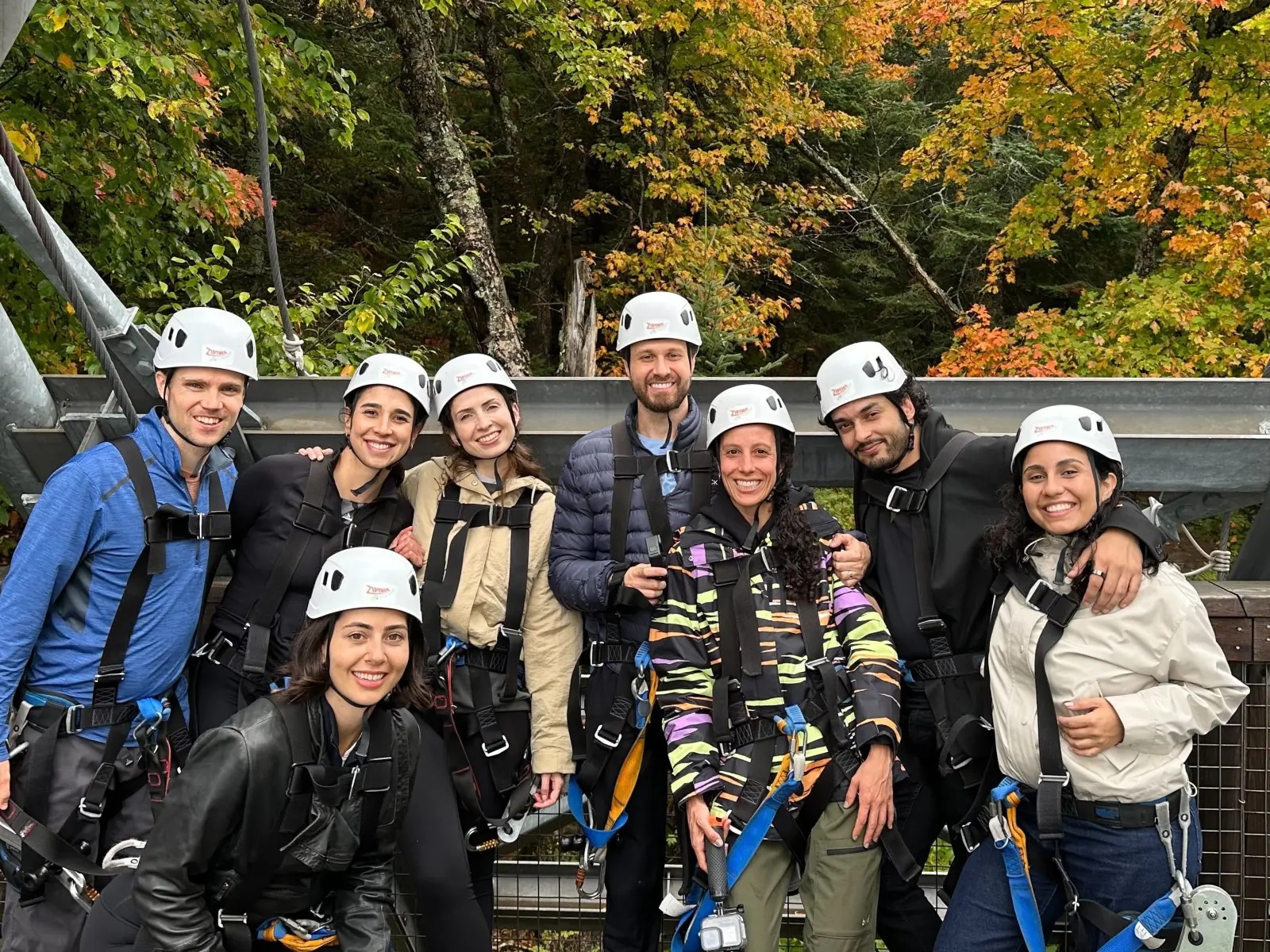
Away from the company, his interests have a conspicuous preference for distance and exposure to the elements. Caissie climbs mountains, races sailboats across oceans, and pilots an SR22 Turbo aircraft. He has qualified for the Ironman World Championship. For someone whose working life already includes uncertainty, this is a demanding selection of leisure activities.
It would be convenient to assign each pursuit a leadership lesson. A mountain could stand for persistence, an aircraft for preparation, a boat for teamwork. That would make a very orderly motivational poster. It would also reduce actual interests to office accessories. The more human detail is simply that his life has room for activities with stakes and pleasures of their own.
His April 2026 conversation with Adam Kaufman on Up2 ranged beyond company building to family life, board pressure, relationships, and extreme hobbies. That range gives the public account more texture. The CEO who appears beside a funding number also has a family in Silicon Valley and interests that require him to leave the desk.
His board service with Sprouts, a California nonprofit supporting young people through coaching and internships, adds another setting in which experience can be put to use. Teaching, investing, and nonprofit work all involve other people's progress. They make the career wider than the company whose name currently follows his own.
Ocean racing02
Mountain climbing03
SR22 Turbo pilot04
Ironman qualifier
Back in Montreal, with lessons to pass on
Startupfest's July 2026 program listed Caissie for office hours on pitching a founding story, AI and automation, and venture fundraising. It also listed him on a founder panel devoted to business disasters and lessons, moderated by Neil Grunberg. The subjects make a revealing combination: explain the idea, build the company, find the money, and discuss what went wrong.
A place on that program is not evidence of a particular disaster in his own company. It is evidence of the conversation he was invited to join. After the acquisition, the degree, and the funding rounds, there is still value in talking about the awkward parts of building. A career can become more useful to other founders when it supplies questions as well as milestones.
That is where the return to learning comes back into view. Caissie's path runs through a personally funded engineer, a Canadian exit, a Stanford classroom, and a venture-backed company. Each stage changes the people he must work with and the obligations he carries. He has kept adding settings in which his experience can be tested or passed along.
The sailboat is an apt detail to leave with, provided it remains a sailboat. Caissie actually races across oceans. He actually went back to school. He actually started another company after selling one. There is enough movement in the record without inventing a grand theory of his character. At the center is a founder willing to become a learner again, and then to make a place for the next learner at the table.