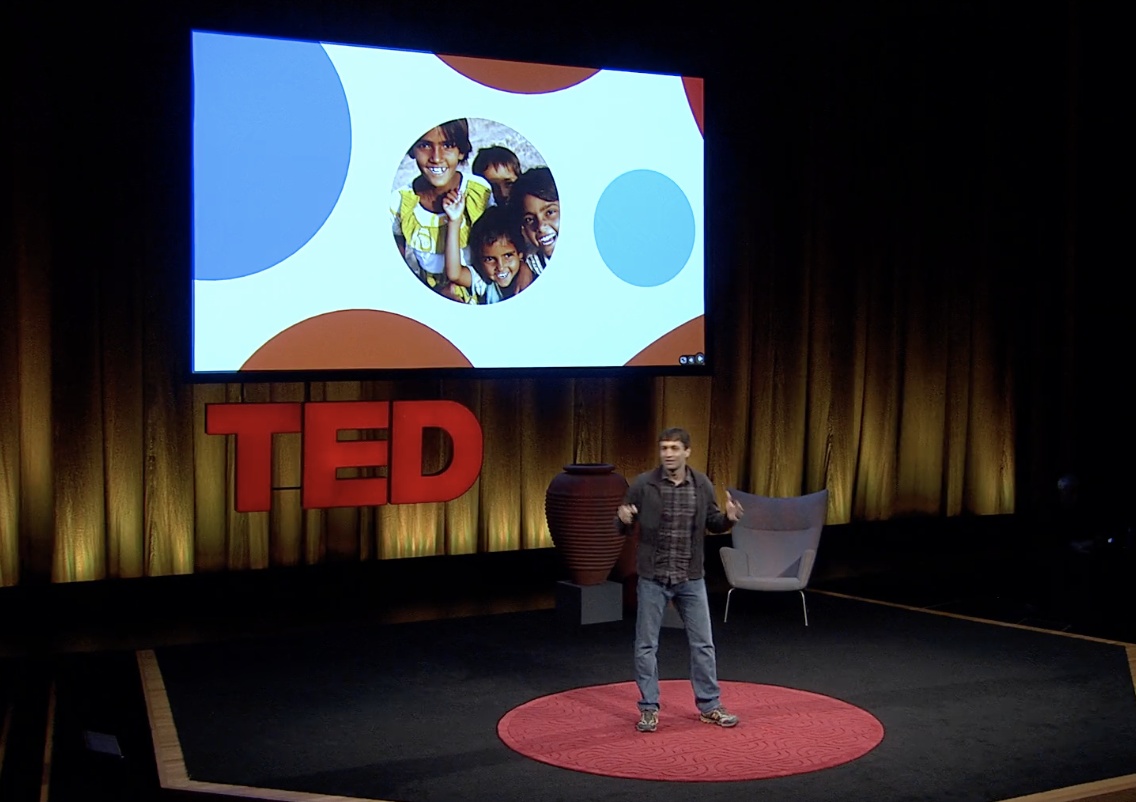
Ron Gutman took seven minutes and nine seconds to make a case for something people do before they have learned to make a case for anything. On the TED stage in 2011, he talked about smiling. In a world of ambitious presentations about the future, here was a founder directing attention to a facial expression. The equipment was already installed. There was no subscription to cancel.
The smile has followed him across businesses, books, teaching and conversations about artificial intelligence. It is an unusually modest object around which to arrange an expansive career. Gutman founded Wellsphere, then HealthTap, and later co-founded Intrivo. But the question that keeps returning in his public work is smaller and more intimate: how does another person experience an encounter with you, or with something you have made?
That question gives his story its shape. His language often reaches for very large ambitions. His practical examples bring those ambitions back to the scale of a conversation, a complaint, a gesture. A company can spend months discussing its mission. A customer may form an opinion in the time it takes to ask one question.
A mother's assignment, a child's computer
Gutman traces two of his interests to childhood. He loved computers and played both commercial and home-brewed games. His mother talked to him about Tikkun Olam, the Jewish idea of repairing the world. In his account, the instruction carried a responsibility: improve the society around you. Technology offered him a way to work on that assignment.
His mother also remembered him as a habitual smiler. On his personal site, he describes smiling and positivity as a signature running through his life. These are his own descriptions, and they have the warmth of a family story. A mother's recollection is allowed a little affection. It also explains why his later talk felt personal: he was describing a subject he had already adopted.
There is a useful tension in those childhood interests. Computer games offer rules, progress and visible results. Repairing the world is a less accommodating project. Nobody supplies a completion screen. Gutman's career has involved translating a large intention into products that people can actually use, a process that requires more attention to detail than an uplifting sentence can convey.
The smile travels better than the speech
By December 2011, his TED Book, Smile: The Astonishing Powers of a Simple Act, was being introduced to readers. The title sounds straightforward. The subject quickly becomes less so. Gutman had travelled widely, and his reflections on smiling included a practical complication: a familiar gesture does not mean exactly the same thing in every setting.
He pointed out that smiling at strangers is commonplace in the United States, while elsewhere it can invite suspicion. That distinction adds texture to his enthusiasm. Communication depends on the person receiving it. Taking a smile abroad does not remove the need to learn the local manners. Even the friendliest expression benefits from reading the room.
His talk and book gave him an audience beyond the people following his companies. The stage appearance also supplied an enduring visual shorthand: a founder standing on a red circle, discussing an everyday gesture. The subject was accessible enough to travel. You could remember it without remembering a product name or deciphering a diagram.
“Smiling is one of those great unifiers.”Ron Gutman, 2011
That accessibility helps explain the place smiling occupies in his public identity. A reader can disagree with an argument, or question how it applies to a particular situation, and still understand the proposition immediately. Gutman has kept returning to that proposition. His website now describes work on an expanded book about smiling, though the announcement gives no publication date.
What the customer is trying to tell you
His entrepreneurial chronology starts with Wellsphere in 2006. It was acquired in 2009. HealthTap followed in 2010, with Gutman as founder and original CEO. Those dates show a builder moving from one venture to another. They also place his TED appearance near the beginning of his HealthTap years, when the public speaker and the company founder were developing in parallel.
In an April 2015 Stanford entrepreneurship talk, he urged founders to pay close attention to the experience behind a product. The ambition could be broad; the understanding had to be specific. That is a demanding instruction. People rarely arrive with a neat specification for what they want. They arrive with frustration, expectations and habits that a product team must learn to recognize.
One part of that talk dealt with feedback. Gutman described rapid prototypes, early launches and testing with users. He also treated complaints from harsh critics as material for improvement. A complaint makes an awkward visitor in a room full of people proud of their work. It may also be the visitor carrying useful information.
The practical consequence is clear: a founder has to make room for answers that interrupt the original plan. Enthusiasm gets a project started. Listening helps determine what deserves to survive the next version. Gutman's teaching places both activities inside the same job, with the customer experience providing a reason to revise.
Repeat the cycle. The next version should reflect what people actually experienced.
Values have to survive the meeting
Gutman's Stanford advice extended to a company's stated values. He recommended revisiting them after they had been defined. A mission can become familiar enough that people stop examining it. The words remain in circulation while decisions drift elsewhere. Returning to those words forces a team to consider whether they still describe the work.
His HealthTap tenure ended in a dispute that belongs in this account. In May 2018, the board removed him as CEO after employee complaints and an outside investigation. The board alleged intimidation and mistreatment. Gutman denied the allegations and challenged the board's actions. Bill Gossman succeeded him. The removal is an established event; the competing accounts require attribution.
That episode makes the leadership ideas harder to read casually. A public commitment to positivity cannot settle a dispute about conduct. Readers have to hold the stated philosophy and the reported allegations in view together. Neither a stage performance nor an accusation should be made to do the work of a complete account of someone's character.
Gutman subsequently co-founded Intrivo, where public biographies identify him as co-CEO. The career continued, and so did his interest in leadership. The sequence matters without supplying a tidy moral. A founder's biography contains decisions made by other people too: colleagues, customers, investors and boards. Their experiences are part of the enterprise, even when the founder is the person on stage.
When change refuses to take a break
Working with Aneel Chima, Gutman developed a leadership framework he calls Sapient Leadership. Their 2020 writing described change along three dimensions: perpetual, pervasive and exponential. The vocabulary is formal, but the situation is recognizable. Change keeps happening, reaches across different parts of an organization, and can gather speed while leaders are still considering their response.
On his teaching page, Gutman describes humility, openness, learning and shared purpose as part of the response. The framework puts weight on teams being able to contribute what they know. That requires leaders to let their understanding be revised. A person who must always supply the answer can become an obstacle to finding it.
It keeps arriving.
It reaches across the organization.
Its pace accelerates.
Gutman's teaching work at Stanford gives these ideas another setting beyond his businesses. He has also curated TEDx Silicon Valley, bringing speakers and audiences into conversation. There is continuity in those activities: building a product, arranging an event and teaching a class all require attention to how other people participate. The stage may have a single microphone. The thinking need not.

The machine needs manners
In September 2024, Gutman wrote about compassionate behaviour in artificial intelligence. His argument concerned what systems do when they interact with people, rather than resolving whether they experience emotion. A system could be designed to recognize context and respond considerately. The exchange would still need to be judged by its effect on the person using it.
He also suggested that the effort to describe compassion for a machine could make its designers examine their own behaviour. That is an interesting assignment for a product team. Terms that sound pleasant in a presentation become harder when someone must specify an actual response. What should the system do when a person is frustrated? What would a considerate answer contain?
These are questions, not proof that any particular system has answered them. They connect his newer writing to the older interest in smiling: the experience of being met by something that appears to understand you. His attention has moved from a human expression to software behaviour. The receiving person remains central to the argument.
A garden does not read the pitch deck
Away from those arguments, Gutman says he enjoys designing landscapes and growing local plants, flowers and fruit. He likes travel, making friends and bringing people together. Gardening is a pleasing detail in a founder's account of himself. It offers work with a visible result and a timetable that is remarkably indifferent to a calendar invitation.
He has also offered a more reflective piece of advice to his younger self: slow down. In his telling, the attraction of quick rewards eventually gave way to a search for lasting meaning. That is a statement of aspiration, and a useful one to set beside the pace of his career. Wanting to build quickly leaves a further question about what will endure.
The smile remains a recognizable part of Ron Gutman's public story. It is easy to remember, easy to imitate and more complicated to live up to than a photograph suggests. Across his teaching, companies and writing, his recurring challenge is to give a generous intention a practical form. The expression takes a moment. The work continues after the conversation ends.