At AlgaeCal, an inconvenient thing happened to the advertising numbers: they refused to agree with the sales numbers. The supplement company worked with as many as ten vendors. Each had its own version of success. Jasper Mordeno, who managed its paid campaigns, had to export reports and compare them with analytics and customer records. Duplicate credit made the business look more prosperous inside its advertising tools than it was outside them.
- NextRoll builds the technology behind AdRoll and AdRoll ABM.
- Its advertising roots are in bringing retargeting to smaller businesses.
- RollWorks became AdRoll ABM in August 2025, bringing two products under one brand.
- The useful promise: connect campaigns, customer data and revenue decisions.
AdRoll’s measurement tools helped Mordeno reconsider the allocation. According to the company’s customer account, AlgaeCal reduced spending on some loyalty and branded-search campaigns while conversions continued. Money could move elsewhere. The first thing to break was the reporting. The change of mind came when spending less did not produce the feared decline.
This is a revealing introduction to NextRoll, the company behind AdRoll. An advertising business normally has an obvious interest in selling more advertising. Here, the interesting result was a customer finding reasons to buy less of some of it. Better measurement can make a vendor useful precisely when the customer becomes less credulous.
“we were able to uncover budget inefficiencies”
Jasper Mordeno, AlgaeCal
AdRoll customer case study
01 / The second chance became a business
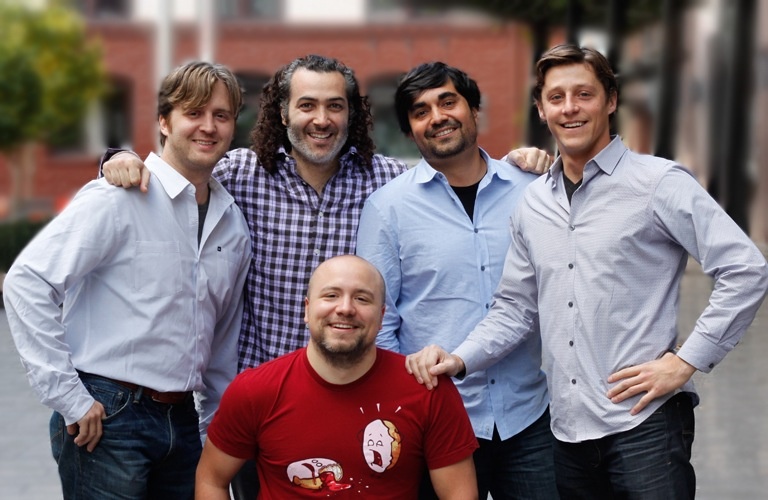
AdRoll began as an advertising network in the late 2000s. Its founding team included Aaron Bell, Jared Kopf, Adam Berke, Peter Krivkovich and Valentino Volonghi. The problem was familiar to a small business: online display advertising involved too much buying machinery for too little certainty about the return.
Advertising exchanges changed the opportunity. Software could bid for an impression as it became available. AdRoll turned toward retargeting, giving businesses a way to reach people who had already visited their websites. A shopper could leave a product page without buying and encounter a relevant ad later. The second chance became something a modest marketing team could purchase.
The important expertise lay beneath the banner. A bidding system had to decide which opportunity was worth buying and at what price. Data pipelines had to make the activity legible. AdRoll’s early attraction was packaging those decisions into a usable platform. The company’s subsequent expansion kept returning to that question: how much specialist work could the software absorb?
02 / Two names were one name too many
Eventually, the company faced two very different buyers. An ecommerce marketer might need to bring a shopper back to checkout. A B2B marketer might need to reach several people at a target company while a sales team worked toward a contract. Both buy advertising. Their definitions of progress differ considerably.
RollWorks emerged to serve the second group. In 2019, the parent became NextRoll and introduced Platform Services, opening parts of its marketing technology through APIs. The arrangement gave each business a separate identity. It also required customers to understand a small corporate genealogy before they could understand the software.
By August 2025, the company had decided that separation was creating unnecessary complexity. RollWorks became AdRoll ABM. The products remained purpose-built for their different marketing jobs, but the customer-facing brand became AdRoll. NextRoll remained the parent company. A naming exercise rarely deserves much suspense; this one matters because it acknowledges a cost of specialization.
Across ad channels
Formerly RollWorks
The announcement also introduced AdRoll AI Assistant for campaign creation, recommendations, creative and reporting. That puts conversational help on top of a business already built around predictive decisions. The assistant may be the more visible feature. Bidding and audience selection remain part of the underlying work.
03 / A cart is not a buying committee
Today, AdRoll supports multichannel campaigns spanning display, social, video, mobile and connected TV. Its users include ecommerce brands, agencies and mid-sized companies across industries. NextRoll says more than 110,000 brands have trusted its technology. That is a cumulative claim about reach, rather than a count of customers currently paying a bill.
AdRoll ABM combines account targeting, buyer signals and advertising with sales workflows. A team can use account fit and engagement information to choose whom to pursue, build audiences, run campaigns and track progress toward opportunities. Its advertised customers include PitchBook, Highspot and Fivetran. Here, an account moving toward a sales conversation can matter more than a completed online checkout.
The integration details make the distinction concrete. The ABM product’s HubSpot connection moves company data and account-level advertising metrics between systems. Its help documentation explicitly limits what flows back: account-level performance is available in HubSpot, while contact-level data does not sync back through that integration. Buying a connected platform still requires checking which connection you actually receive.
- IdentifyAccount fit + buying signals
- EngageAudience + campaign
- CoordinateCRM + sales response
- MeasureOpportunity + revenue
Illustrative ABM workflow, not a promise of conversion.
04 / What the invoice buys
NextRoll’s business combines advertising media with software and services. AdRoll’s published pricing describes dynamic CPM pricing: payment tied to a thousand impressions, with rates changing according to demand. It also lists paid packages, social and attribution add-ons, and managed support. Some account-management services require qualifying spending.
An account-based retargeting option is advertised with no starting fee and payment for media. Broader ABM packages invite a sales discussion. For a buyer, the practical exercise is to price the whole job: media, software, the required integrations and the people who will operate it. A low entry cost says little about the bill for the workflow you intend to run.
The company’s own transformation required capital, too. A $70 million financing round in 2014, led by Foundation Capital, supported mobile and international expansion. In May 2023, Capital IP committed $50 million to help advance the software business. The latter announcement describes financing capacity, which should not be confused with proof that every dollar was drawn or spent.
The market offers several routes to similar goals. Criteo competes in commerce advertising and retargeting. StackAdapt serves multichannel programmatic buyers. Demandbase and 6sense offer B2B account intelligence and ABM. NextRoll’s distinguishing proposition is the combination of advertising execution, measurement and a dedicated account-based product. Those overlaps make the intended workflow a better buying guide than a broad feature count.
05 / AI gets a less glamorous assignment
In April 2026, AdRoll and PubMatic announced an integration for diagnosing delivery problems. Using Model Context Protocol, AdRoll can query PubMatic’s deal diagnostics and compare the buying platform’s configuration with information from the selling side. The problems are unromantic: pacing constraints, blocked creative and publisher-side factors.
That is a helpful test of an AI claim. An ad is not delivering; information explaining why sits in different systems; the integration brings those clues into one investigation. The companies demonstrated a workflow for finding causes and recommending actions. Its usefulness depends on the diagnostic access and the quality of the underlying information, rather than the assistant’s conversational charm.
In August, AdRoll announced a separate experiment: a ChatGPT advertising pilot for selected AdRoll and AdRoll ABM customers. It offered campaign expertise to advertisers testing an unfamiliar channel alongside their existing investments. Access was limited at announcement. The interesting continuity is the service model: help smaller teams enter a new advertising environment without constructing every piece themselves.
06 / Cheaper attention still needs a purpose
The September 2026 advertising report offers a timely reminder that media economics move. AdRoll reported display prospecting CPMs down 45% year over year for July 1 through September 8. Display retargeting fell 29.1%; ABM CPMs rose 4.4%. These are findings from AdRoll’s report, not a forecast of any particular advertiser’s bill.
Change in CPM, year over year
Cheap impressions can make a test easier to fund. They do not settle whether an ad changes a buying decision. A reader can borrow a useful discipline from the AlgaeCal example: reconcile channel reporting with business revenue, examine where credit is duplicated, and test the consequence of changing an allocation. Attribution supplies a model of credit. It should not be mistaken for an experiment proving causation.
The approach asks something of the customer. Account campaigns need a defensible target list and a sales team willing to use the signals. Cross-channel reporting needs usable conversion records and consistent definitions. A company with little audience data, weak creative or no follow-up process may gain a tidier dashboard while its commercial problem persists. Software can coordinate work that exists; it cannot supply all the work that is missing.
07 / The people behind the prediction
Vibhor Kapoor became NextRoll CEO in February 2026. Roli Saxena moved to executive chair and chief strategy officer. The leadership announcement placed the change against competition and margin pressure in display advertising, alongside investment in channels such as connected TV and digital out-of-home. The company’s next chapter therefore has both an expansion problem and an execution problem.
Inside NextRoll, employees are called Rollers. Six Culture Creatures stand for values including growth, resourcefulness and transparency; eight employee resource groups support its stated inclusion work. The company describes a hybrid working model. Its engineering pages expose a less cuddly side of the business: bidding systems, data pipelines, event histories and machine-learning models. Animal mascots soften the vocabulary; the operational demands remain technical.
NextRoll’s appeal is easiest to understand at the moment a marketer has to make a decision. Which audience deserves the next dollar? Which account deserves a call? Which successful-looking campaign can afford a smaller budget? The platform’s worth will show in the answers, and in what changes when the team acts on them.