There is a small complication in the promise of instant money. Someone has to receive it. A notification is useful, but it cannot buy dinner at a shop that takes cash. Western Union lives in the space between the message and the meal: the point where a transfer becomes something a person can spend. Its yellow signs mark a physical answer to a digital question. Where, exactly, does the money arrive?
- The product: move money between people, countries and payout methods.
- The advantage: connect an app to a local counter, bank account or supported wallet.
- The tension: digital growth must carry an expensive, mature retail business.
A wire was only half the invention
The company began in 1851, when Hiram Sibley and Samuel Selden helped organize a telegraph business in Rochester. The early industry was a jumble of competing lines and incompatible ambitions. Service could be unreliable. Sibley’s answer was consolidation: buy connections, unify operations, make the network useful as a whole. In 1856, the company adopted a name that described the project: Western Union.
The change was practical, and it cost money. One important acquisition was the Midwest Morse patent rights, bought for $50,000 in 1854. The early printing-telegraph venture had struggled against existing competition. Rather than keep building another isolated line, its organizers changed the unit of ambition. They wanted the connected system.
In 1871, Western Union introduced money transfer. The insight was economical: a communication network could carry instructions about value. You did not need to put the customer’s banknotes on a train. You needed a dependable arrangement at the destination. That distinction still explains the company better than its age does.
The expensive part is getting there
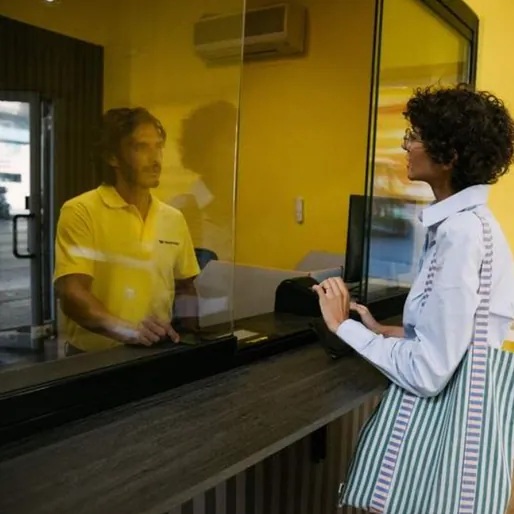
Today, customers can send through an agent, a website or an app. Recipients can collect cash, receive a bank deposit or use a supported mobile wallet. Migrants supporting family are central to the use case. So are the ordinary emergencies and obligations that make distance inconvenient: a bill due, a relative short of money, a household waiting for support.
The useful feature is choice at both ends. In supported markets, a customer can begin on a phone and pay cash in-store. Neither person necessarily needs a bank account for a cash-to-cash transfer. The network covered more than 200 countries and territories at the end of 2025, with approximately 360,000 agent locations having handled money transfers during the preceding year.
Illustrative service flow. Options depend on the country and transfer.
The customer pays for this arrangement through transfer fees and, when currencies change, the exchange rate. A fee promotion does not erase that second cost. The sensible comparison is the recipient’s final amount against the sender’s total payment. Speed also needs a footnote: agent hours, identification checks, local rules and currency availability can interrupt the promise of minutes.
The expertise is in coordinating the pieces: local agents, payout partners, currency conversion and transaction checks. Bill payments, money orders and travel money extend the relationship beyond sending cash home. A separate business-payments operation took another path: Western Union sold Business Solutions for $910 million, with the final closing in 2023. That operation now belongs to independent Convera.
A network needs a referee
The same distributed system that makes Western Union convenient creates a supervision problem. A familiar sign does not make every agent trustworthy. In 2017, the company agreed to forfeit $586 million in a settlement with U.S. authorities and admitted violations involving anti-money-laundering controls and aiding and abetting wire fraud.
The failure had warning signs. The FTC said the company knew about agents facilitating fraud and failed to act. Internal security staff had proposed tougher agent-suspension guidelines years earlier. The settlement required stronger oversight and corrective action. Western Union also said it had increased compliance funding by 200 percent over five years. Reach without enforcement had become an expensive liability.
Every extra place to collect money is also another place the system has to supervise.Editorial analysis
Two speeds, one company
Western Union now faces a different mismatch. Its digital business is growing while parts of retail struggle. In the second quarter of 2026, branded digital revenue rose 7 percent and transactions rose 25 percent. Total company revenue fell 1 percent. GAAP operating margin dropped to 13 percent from 19 percent a year earlier.
Digital means branded digital. Bar lengths show absolute percentage change; orange marks decline.
CEO Devin McGranahan said, “we did not see the improvement in Americas Retail that we had expected”. Management accelerated cost reductions while continuing digital investment. More transactions were not enough to protect margins. For a network business, volume and financial health can move in different directions.
The proposed Intermex acquisition makes the retail commitment explicit: approximately $500 million, with expected annual cost savings of $30 million within 24 months. Those savings were a forecast. An August 2026 update still described a pending transaction, with California approval complications. Meanwhile, an October renewal with Publix kept transfers, money orders and bill payments available alongside grocery shopping.
The digital dollar still needs a destination
The next experiment puts newer technology behind the same problem. Western Union launched USDPT in May 2026, issued by Anchorage Digital Bank on Solana. In August, it launched Stablecard with Rain: a USDPT wallet and Visa secured credit card, initially in 37 markets. On October 20, Noah announced its selection to support the planned Receiver Redirect service, intended to let recipients take transfers as USDPT.
MoneyGram, Ria, Remitly, Wise and banks offer alternatives with different strengths. Western Union’s particular proposition is the connection between physical access and digital instruction. That matters less when both people already have convenient accounts and a cheaper route. It matters more when cash access determines whether the transfer is useful at all.
The lesson a reader can copy is to design backward from receipt. Check the final payout, opening hours and identification requirements before choosing the sending interface. A founder can ask the same question of any delivery business: what happens after the screen says done? Western Union’s answer has changed its machinery repeatedly. The person at the other end remains the point.
Follow the money
Try the transfer estimator, read the company news or browse the Western Union blog.
Watch: how to send money in the app Official walkthrough / Bahrain / 2023