CEO of Sama. Running the human backbone of AI. Keeping 3,000 people in East Africa employed while your chatbot learns to be less wrong.
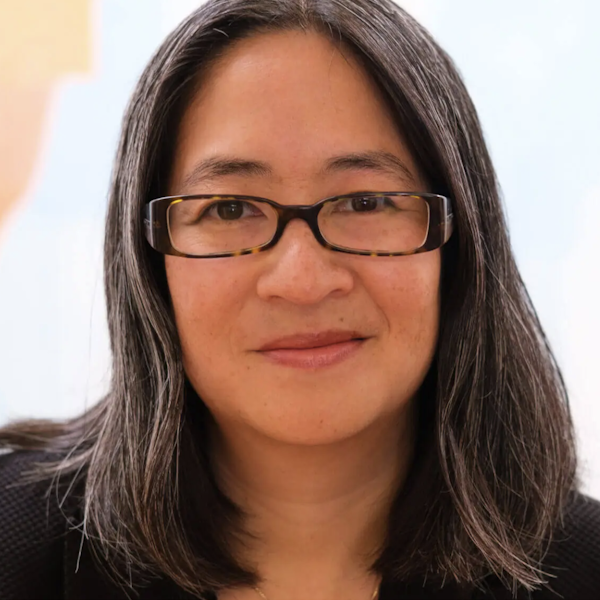
Wendy Gonzalez · CEO · Sama
Wendy Gonzalez became CEO of Sama in January 2020 - thirty days before the pandemic shut the world down. Most executives would have started with a listening tour. She started with logistics: laptops shipped to Nairobi, battery packs to Kampala, hotel rooms booked so annotators without stable internet could keep working. The AI didn't pause. Neither did she.
Sama, the San Francisco-based data annotation and model evaluation company, has a workforce of over 3,000 people, 98% of them in East Africa. These are the people who look at millions of images and video clips, decide whether the pedestrian on the left is walking or running, label the rare tumor in the CT scan, and score which AI output is actually correct. They are, in a very real sense, the people who taught your AI to see. Gonzalez runs the company that employs them - and she runs it as a B Corp, a public benefit corporation, and a living argument that mission and margin can share a spreadsheet.
"Talent is equally distributed, but opportunity is not."- Wendy Gonzalez, CEO, Sama
Before Sama, Gonzalez spent two decades doing what ambitious people do when they're good at systems: consulting at EY, strategy work at Capgemini, product and engineering leadership at an IoT startup she helped co-found that hit $10M in ARR before being acquired. She was solving interesting technical problems for companies that could afford her. Then her father died suddenly. She started asking a different question.
"I've spent my career trying to answer one question: How do you use technologies to move businesses forward?" she has said. "As my career progressed and I started a family, I began to ask myself a second question: How could I serve communities in my full-time work?"
At her first meeting with Sama founder Leila Janah, Janah's dog was named Angela Merkel. Gonzalez took that as a good sign. She joined in 2015 as SVP and Managing Director, became President and COO in 2018, and found herself running the whole organization when Janah passed away in January 2020 - the same month the world started paying attention to a novel coronavirus in Wuhan.
Two crises at once. One month into the job. With three children at home.
The founding insight of Sama - articulated by Leila Janah and carried forward by Gonzalez - is deceptively simple: "The best way to solve poverty, which is basically the root cause for every major social ill in the world, is by giving work, not giving aid." It is not a slogan. It is a structural decision baked into how the company recruits, trains, and pays its workforce in Kenya, Uganda, and Tanzania.
When Sama hires someone in Nairobi, it trains them and then employs them - bringing them into the formal economy with a salary, benefits, and career advancement potential. About 10% of entry-level annotators advance into product or management roles. It is not enough for every critic, but it is a lot more than a donation receipt.
Since 2008, Sama has lifted over 65,000 people out of poverty. Gonzalez inherited that number and has kept adding to it while also converting the company from a nonprofit to a for-profit public benefit corporation - a structure that legally requires it to pursue its social mission alongside profit. The Leila Janah Foundation remains the primary shareholder.
"If you say I'm really a business but want this nice thing on the side, it never works. The mission has to be the strategy."
Source: Sama company data, Axios reporting, pulse2.com interview
Imagine a world where only men from California sourced, collected, and structured your AI data.
AI needs a human in the loop, giving it feedback and working in concert with it.
Be the best version of your authentic self. What makes you the person you are has value.
Business for social good needs to be a part of how everyone thinks about business.
When women succeed, whole communities succeed.
Not only are we giving you training, but we're actually going to hire you into the formal economy.
When other data companies were piling into content moderation for the big platforms, Gonzalez pulled Sama out. The company had taken contracts with Meta and OpenAI for content moderation work - the kind that involves reviewing disturbing material at scale - and she decided the cost to her workforce was not worth it. In 2023, Sama exited that business entirely.
The bet she made instead: generative AI model evaluation, red teaming, supervised fine-tuning, and computer vision annotation. These are the services that make AI models less likely to hallucinate, more accurate on domain-specific tasks, and safer for deployment. They are also, as it turns out, where the enterprise AI budget is moving.
Sama now serves 40% of FAANG companies. Its clients include Walmart, Google, NVIDIA, GM, and Getty. The company's Platform 2.0 delivers a 99% client acceptance rate for AI training data. It is not a charity case that happens to do AI work. It is an AI company that happens to have a mission.
"Ethical AI focuses on alignment with specific values. Responsible AI asks broader questions concerning the entire lifecycle."- Wendy Gonzalez
At the Sama Cup soccer tournament in Nairobi, Gonzalez played as an honorary team member alongside the annotators who power her company. Her own assessment: "I was the weakest link on the team." She went anyway. There is something worth knowing in that detail - about how she leads and where she shows up.
Her first meeting with founder Leila Janah: the founder's dog was named Angela Merkel. Gonzalez took that as a good sign about the kind of organization she was joining. She was right. The dog's name captured something - a sense of humor about power and an appetite for ambition without taking itself too seriously.
Her father died suddenly. She was deep in a demanding IoT startup, working 14-16 hour days with three young children at home, and the loss prompted a reckoning: what was the work actually for? The answer led her to Sama, and to the question she now asks out loud in interviews - how do you serve communities in your full-time work, not just on weekends?
She became CEO one month before the pandemic. While executives globally debated remote work policies, she was shipping laptops to Nairobi and booking hotel rooms for annotators in Uganda so they could access stable internet. The AI training data pipeline never stopped. The workforce never lost their jobs. That is a management story as much as a social impact one.
Gonzalez grew up in an immigrant household. Her husband immigrated from Mexico at age 3, and his family's story - the trajectory of people who crossed a border and built something - shaped how she thinks about opportunity. When she says "talent is equally distributed, but opportunity is not," it is not a conference talking point. It is autobiography.
She studied history at the University of Washington before switching to accounting, a concession to practicality she has clearly not let define her. She volunteers with YMCA Project Cornerstone in Silicon Valley, mentoring youth. She is a mother of three. She describes herself, without irony, as working every day to be "a proof point that social business is possible in tech."
When she became CEO, she initially considered adjusting her communication style to match some imagined template of what a tech CEO sounds like. She decided against it. "Be the best version of your authentic self," she has said. "What makes you the person you are has value." She mentions it in interviews because she believes it, but also because it took her a moment to believe it herself.
She has received Globee Awards, TITAN Awards, and Stevie Awards for Women in Business. She has spoken at Web Summit, the Women in Tech Global Conference, and Forbes Books Radio. She sits on the board of the Leila Janah Foundation, which remains the primary shareholder of the company she runs.
The family motto, passed down: "Leave people and places better than you found them." She runs a company of 3,000+ people. The motto scales.