The great inconvenience of infrastructure is that success looks like nothing happened. The dashboard loads. The code ships. The agent answers. Nobody applauds the pipe for declining to burst. Wayne Jin has built a career in this quiet territory, translating technical systems into reasons for businesses to pay attention before silence turns expensive.
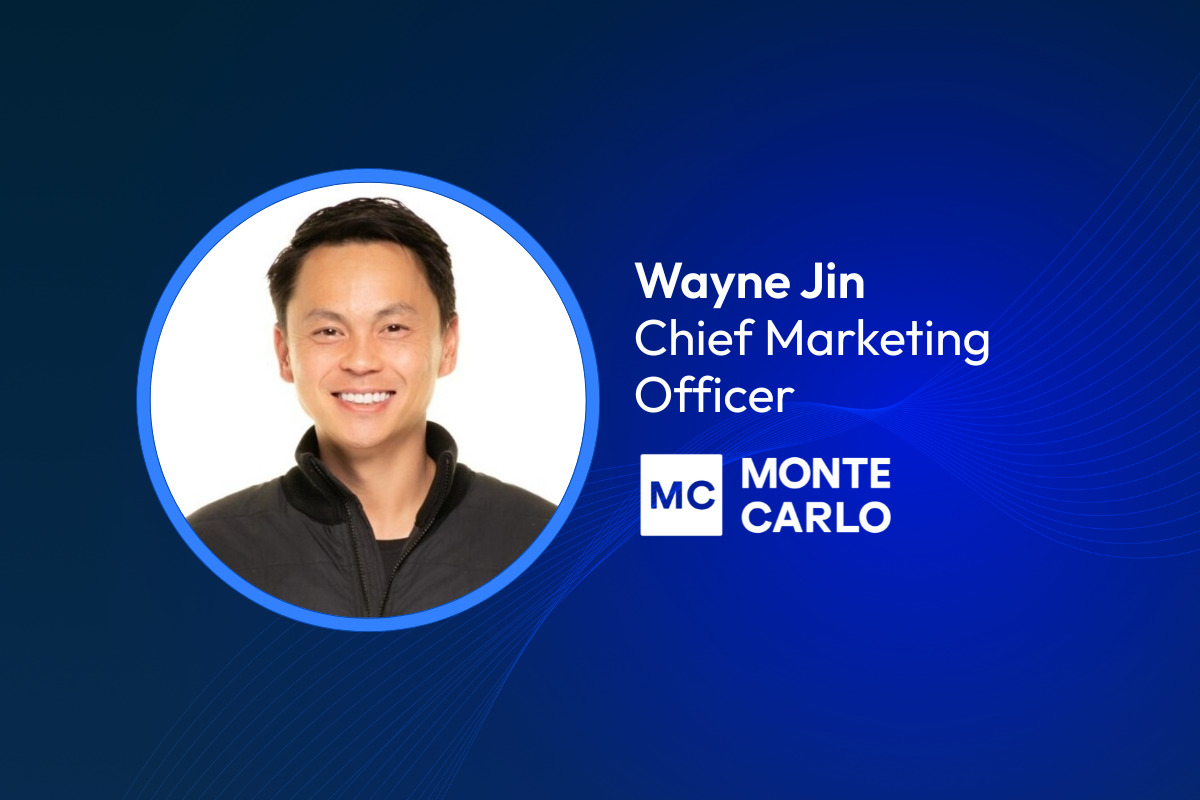
His current brief concentrates the puzzle. In September 2025, Monte Carlo appointed Jin as its first chief marketing officer. The San Francisco software company began by helping data teams detect broken pipelines and unreliable tables. It was moving deeper into AI observability just as enterprises were putting agents into production. Jin took responsibility for brand, product marketing, demand generation, and communications. In ordinary English: he must make trust tangible.
There is an appealing symmetry to the appointment. Jin began with the machinery itself. He earned a bachelor's degree in computer science at Emory University, then crossed disciplinary borders at Harvard, where his master's work focused on technology, innovation, and education. His coursework drew from the Graduate School of Education, Harvard Business School, and MIT. Code on one side, learning and behavior change on the other. Between them lies the profession he eventually made his own.
A translator learns the machinery
Jin's route to the C-suite did not begin with lifestyle brands or glossy consumer campaigns. It ran through enterprise software whose users tend to arrive with strong opinions and command-line windows. At Google Cloud, he led product marketing and global enablement work that supported enterprise adoption. At GitHub, he built product and partner marketing functions around a platform that developers already loved and large organizations needed to govern.
A 2018 presentation in Japan captured the balance. Speaking about GitHub Enterprise, Jin argued that security and compliance were part of the process of helping developers concentrate on development. The controls mattered, but they were not the purpose. It is a useful distinction for any enterprise marketer. Buyers need risk addressed; users need the product to remain recognizably theirs. Let the paperwork swallow the product and the story becomes a filing cabinet.
By 2019, Jin was at AppDynamics, the application-performance company Cisco had acquired two years earlier. As vice president of marketing, he led product, customer, and partner marketing. A former colleague later described him as someone able to deconstruct complex business challenges, guide executives and teams, and bring product, marketing, and sales closer to customer-centered releases. Another called him strategic, data-oriented, collaborative, and attentive to how technology affects customers. These are recommendations, not laboratory measurements, but they agree on the essential shape: analysis in service of alignment.
Growing with Grafana
Jin joined Grafana Labs in 2021 as vice president of product marketing. Grafana occupied another peculiar corner of technical culture: an open-source project with devoted practitioners becoming a broad commercial observability platform. Marketing could not simply announce features from a balcony. It had to work with a community that knew the product intimately, while helping enterprise customers understand an expanding portfolio.
Two years later, Jin published an anniversary note. During that span, he wrote, Grafana Labs had grown from 300 employees to more than 1,000 while meeting adoption and revenue goals. The figure gets attention; the thank-you list explains more. He named leaders, peers, members of his team, the open-source community, customers, and partners. He credited work across core product marketing, pricing, competitive intelligence, and enablement. The post read less like a victory lap than the credits after a very busy film.
That habit of distributing credit is not mere graciousness. Product marketing sits in the middle of quarrels it does not own. Engineers know exactly why the product is difficult. Salespeople know exactly why the deal is difficult. Customers know exactly why their day is difficult. The product marketer's job is to produce a sentence all three groups can recognize without allowing any one group to annex the dictionary.
At Grafana, Jin also appeared at ObservabilityCON to discuss enterprise observability design and implementation. By then his subject had shifted from marketing a single tool to helping organizations understand a whole operating practice. That prepared him neatly for Monte Carlo, where the category was widening even as he arrived.
Trust enters the org chart
Monte Carlo announced Jin one day after unveiling Agent Observability, a product intended to follow reliability across data inputs, agent behavior, and outputs. The timing gave his role unusual clarity. AI had made a familiar data problem louder. A plausible answer can still be founded on stale, incomplete, or misrouted information. A fast agent can manufacture a bad decision with excellent manners.
Jin's language since joining has stayed close to production. After meeting an engineering executive from a global media company at AWS re:Invent, he described the immediate question: “How do we ensure these agents are reliable from the data inputs to the agent outputs?” His emphasis was not on a theatrical contest between people and machines. It was on inputs, outputs, cost, latency, and the ordinary operational burden of knowing when a system has misbehaved.
“I'm excited to help scale the company's marketing impact at such a pivotal moment for the industry.”Wayne Jin on joining Monte Carlo
He has also shared a four-layer description of the production AI stack: data, semantic, agent-build, and trust. The diagram is marketing in its most useful form. It gives technical and business teams a common map. More importantly, it places trust as architecture rather than an optimistic adjective pasted onto a launch announcement.
Begin with the user. At GitHub, enterprise requirements were meant to help developers do their work, not become the work.
Name the system. At Grafana, product, pricing, intelligence, and enablement became parts of one commercial practice.
Make risk concrete. At Monte Carlo, trustworthy AI becomes a chain of observable inputs, behavior, outputs, cost, and latency.
The education beneath the marketing
Jin's graduate study deserves another look because it supplies the least obvious thread in his biography. Technology marketing is often mistaken for compression: fewer words, brighter slides, the same bewilderment in a smaller box. Education asks a harder question. What must someone understand before behavior can change?
That question appears across Jin's career. Google Cloud needed established companies to adopt a different computing model. GitHub needed enterprises to see developer collaboration as governable without domesticating it. AppDynamics and Grafana needed organizations to treat visibility into software as an operating discipline. Monte Carlo needs leaders to understand that AI reliability begins well before an answer appears on screen.
The progression is also a small history of enterprise technology. Cloud moved from novelty to default. Developers acquired more influence over buying decisions. Open source became an enterprise foundation. Observability escaped the operations room. AI turned the quality of hidden data into a public consequence. Jin did not invent those movements, but his jobs kept placing him near the moment each one needed a shared commercial language.
There are quieter continuities too. His public profile lists English and Mandarin. It records volunteer work with CS First, a program designed to expand young people's access to computer science. Earlier in his career at the consultancy BTS, he received two sales awards and a quality award tied to a high-profile C-suite project. Selling, teaching, quality, technology: the ingredients were present before the title caught up.
A marketer for the unnoticed
The temptation in AI is to market magic. Monte Carlo's opportunity is almost the opposite. Its subject is vigilance: lineage, freshness, quality, traces, evaluations, failures, and the tedious glory of catching trouble early. Jin's cheerful public manner must carry a message of disciplined doubt. Trust your system, certainly, but first earn the evidence.
This may be why the job fits his route so well. A computer-science education gives him respect for the mechanism. An education degree gives him respect for the learner. Years with developers give him respect for an audience allergic to decorative language. Executive roles give him respect for the fact that a technically correct story can still fail to move an organization.
When infrastructure works, it vanishes. Jin's task is to make its value visible without waiting for disaster to perform the demonstration. It is an odd form of show business: the better the product does its job, the less drama there is to show. For a marketer who has moved steadily closer to the hidden systems beneath modern companies, that is not a contradiction. It is the plot.