Soda Wants Your Data to Rat On Itself Before It Wrecks the Dashboard
The idea behind Soda is almost rude in its simplicity: software gets tested before it ships, so why does data get to skip the exam? Two Belgians decided it shouldn't.
Every data team has the same 2 a.m. story. The pipeline ran overnight. Every job lit up green. And then, sometime the next morning, a number in a dashboard turned out to be quietly, confidently wrong - a currency in the wrong denomination, a table that stopped refreshing on Tuesday, a join that silently dropped half the rows. Nobody was alerted. The software worked perfectly. The data lied. Somebody, usually, found out when an executive did.
Soda exists because two people got tired of that story. Founded in Brussels in 2018 by chief executive Maarten Masschelein and chief technology officer Tom Baeyens, the company sells a deceptively plain proposition: your code gets tested before it ships, so your data should too. Not watched. Not vibe-checked. Tested - with explicit rules, run automatically, that fail loudly when the numbers stop making sense.
01 / The problemThe most expensive bug isn't in the code
Modern companies run on data the way factories run on electricity. Dashboards drive decisions, machine-learning models price loans and recommend products, finance teams close the books on warehouse tables nobody has eyeballed in months. When that data is wrong, the cost is rarely a crash. It is worse: a decision made on a bad number that looks exactly like a good one.
The uncomfortable truth is that most data pipelines have no equivalent of the test suite that guards software. A broken feature gets caught in continuous integration. A broken table gets caught in a meeting. Soda's founders framed the gap bluntly.
Testing and monitoring of software is ubiquitous, so why not apply the same principles to data?
02 / What it doesChecks that read like sentences
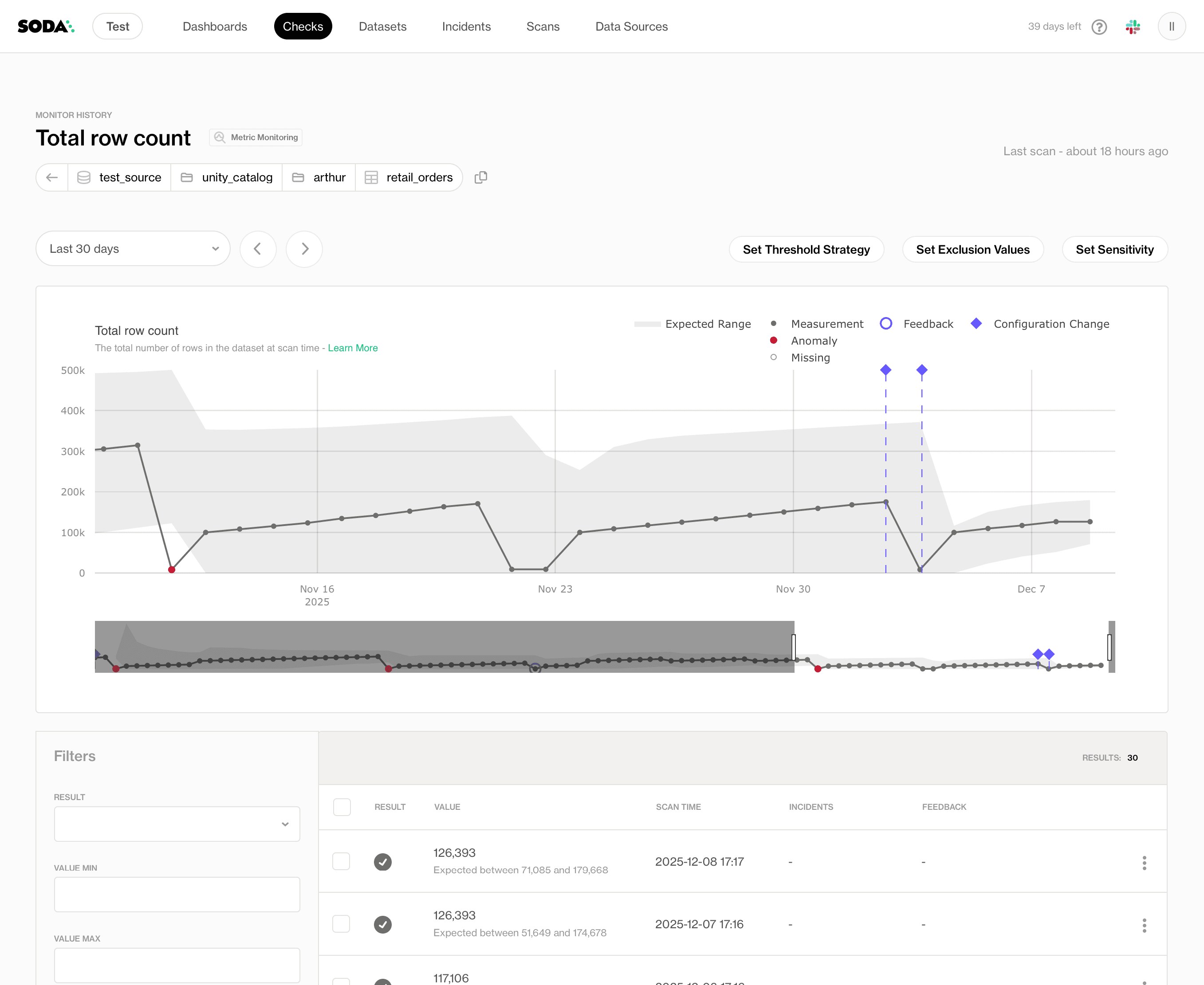
Soda's core idea is to turn "the numbers look weird" into something a machine can enforce. Its checks language, SodaCL, is written in plain YAML that reads almost like English. You point it at a table and say what "good" means: this column should never be empty, this order count should stay within a normal range, this table should refresh every day, this schema should not change without warning. Then Soda runs the checks on a schedule - or inside a pipeline - and tells you the moment reality drifts from the promise.
checks for retail_orders:
- row_count > 0
- missing_count(order_id) = 0
- duplicate_count(order_id) = 0
- freshness(order_datetime) < 1d
- schema:
warn: when required column missing
That is the whole trick, and it is why engineers like it: the rules live in version control next to the rest of the code, they run in the same continuous-integration pipelines, and a failing data check can block a release the same way a failing unit test does. The free, open-source engine, Soda Core, does the heavy lifting against warehouses like Snowflake, BigQuery, Databricks and Postgres. The paid Soda Cloud layer sits on top, collecting results, watching for anomalies it wasn't explicitly told to look for, firing alerts into Slack, and keeping a running history of every table's health.
03 / The contractMaking "trust me" enforceable
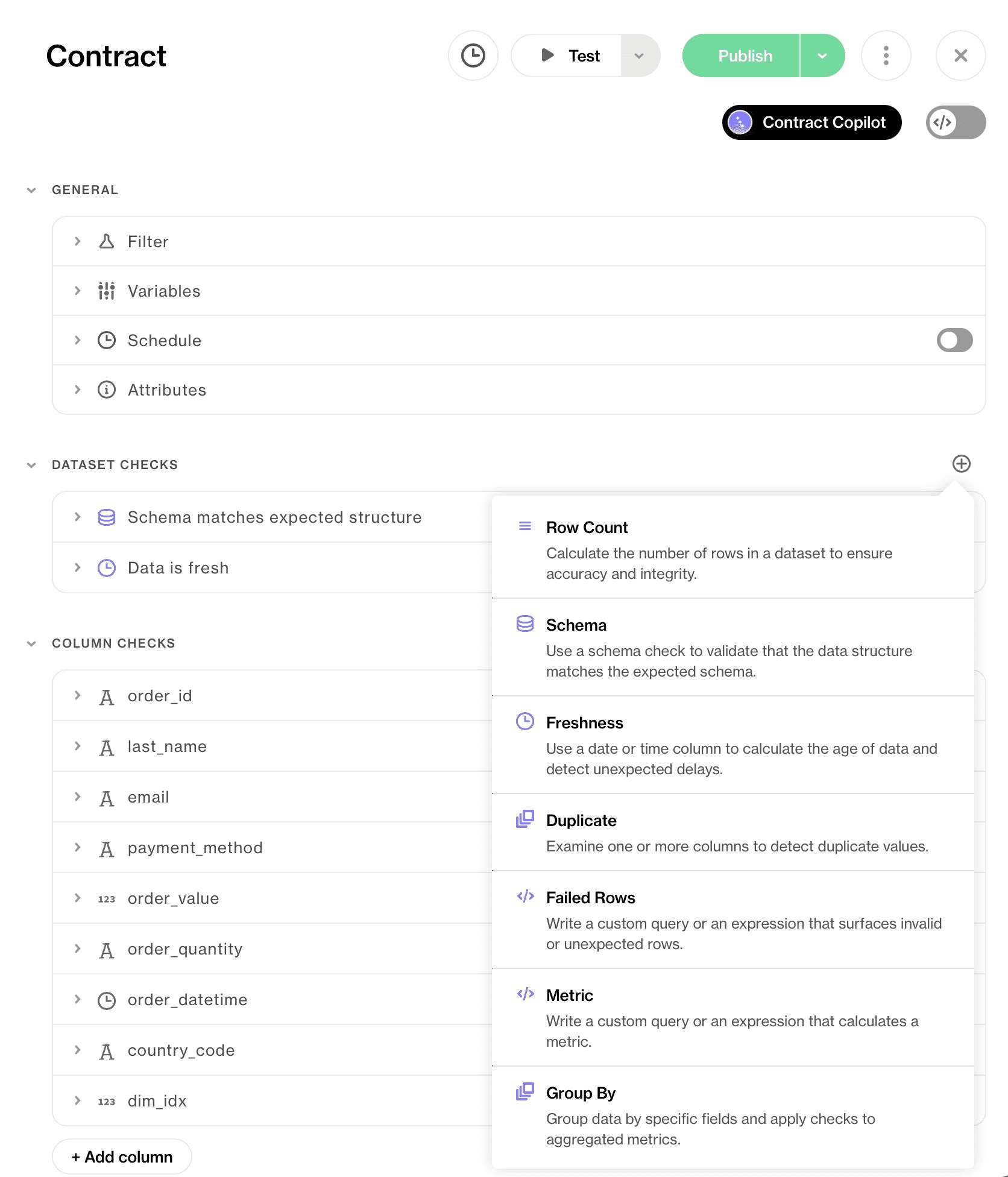
The concept Soda has bet its latest chapter on is the data contract: a single file that spells out what a dataset is supposed to be - its columns, its types, its freshness, its quality rules - and then enforces that agreement wherever the data moves. It is the handshake between the team that produces data and the teams that depend on it, except the handshake is executable and fails the build if either side breaks it.
With Soda 4.0, launched in January 2026, that contract became the center of the product. Soda Core 4.0 is described as a data contracts engine; Soda Cloud 4.0 wraps it in AI that can draft contracts from a table's own profile and detect anomalies without being told exactly what to watch. The pitch is a shift from catching problems to preventing them - from noticing bad data to refusing to let it through.
Data quality shouldn't depend on someone noticing a problem.
04 / Who buys itDisney, Bloomberg, and a data mesh at HelloFresh
Soda sells to the people who get paged when the data breaks: data engineering, analytics and platform teams inside large enterprises. Its named customer list runs to the kind of logos that make a data outage genuinely expensive - Disney, Bloomberg, Nubank, Abercrombie & Fitch, Ralph Lauren, Marks & Spencer, CBRE and 2K Games among them. The company says it has hundreds of customers worldwide.
The clearest example of how it lands is HelloFresh, which adopted Soda Cloud while moving to a "data mesh" - an arrangement where individual domain teams own their own data instead of routing everything through one central group. Soda gave those teams a shared way to certify their datasets, complete with bronze, silver and gold quality badges. As the company's data platform director put it, investing in data quality lets cross-functional teams "make accurate, complete decisions with fewer risks and greater returns." It is a decidedly un-glamorous sentence, which is rather the point.
05 / The foundersThe man who accidentally seeded an industry
Soda's origin has a nice bit of lineage. Masschelein spent about seven years at Collibra, the other Brussels data company to become a global name, before returning home in 2018 to build something of his own. Baeyens brought a deeper open-source pedigree. Years earlier he had created jBPM and co-initiated Activiti, projects for automating business workflows. Activiti was later forked into Camunda, today a major workflow-automation company in its own right. In other words, the CTO of Soda has already watched code he wrote grow into an entire software category once. He is now trying to do it again, this time for the far less exciting, far more universal problem of whether a number can be trusted.
Originally, we were a European company. But for us it's clear that the market to win is the U.S. market.
That conviction shows up in the money. Soda's first funding was not venture capital at all but a €500,000 innovation prize from Innoviris, the Brussels regional research agency. A €2.6M seed from Point Nine and Hummingbird followed in 2020, and a €11.5M Series A led by London's Singular in early 2021. In July 2024 the company added $14M - led again by Singular and Point Nine - explicitly to open a New York office and chase American enterprises, which by then already made up roughly 40% of its revenue. Total raised sits at around $30M.
06 / The competitionCode-first, in a crowded aisle
"Data quality" and "data observability" have become a busy market. On one side sit AI-first monitoring platforms like Monte Carlo, Anomalo and Bigeye, which watch pipelines and surface unusual behavior. On the other sit open-source, engineering-first tools like Great Expectations and dbt's built-in tests. Soda's position is a deliberate straddle: code-first and explicit like the open-source camp, but with the anomaly detection, collaboration and AI assistance of the commercial platforms bolted on top.
There is also a philosophical line Soda likes to hold: its AI features work on metadata only, never on the raw data rows, and keep a human in the loop. In a market where "let the model see everything" is the default reflex, that restraint is itself a selling point - especially to the banks, retailers and media companies whose data it is being pointed at. In 2025 the company extended its reach by acquiring NannyML, a Leuven-based machine-learning-monitoring startup, so it can watch not just whether the data is healthy but whether the models built on that data are quietly failing.
We help big tech companies improve their data quality. We propose or develop solutions that do not exist yet.
07 / The betBoring, on purpose
What is genuinely interesting about Soda is how uninterested it is in being interesting. It does not promise to eliminate work or replace your data team. It promises that your data will get checked, automatically, in the pipeline, before it can embarrass anyone - and that when something breaks, you will hear about it from an alert rather than from your CEO. In a field addicted to grand claims, treating a broken pipeline like a failing test rather than a 2 a.m. surprise is a modest idea. It is also the kind of modest idea that companies quietly pay for, year after year, once they have lived without it.
For anyone building on top of data - which is now nearly everyone - the lesson Soda offers is portable even if you never buy the product: write down what "good data" means, put those rules where your code lives, and run them before the numbers reach a human. The refreshing part is how obvious it sounds once someone says it.