The first person to notice bad company data is too often the person presenting it. A revenue line jumps during a board meeting. A product manager spots a missing week. A customer finds the broken number before the data team does. Elementary was built for that awkward interval between a pipeline going wrong and a human realizing it. Its promise is simple enough to explain without a glossary: detect the problem before the user does.
The company did not begin by selling a grand platform. In August 2021, longtime friends Maayan Salom and Or Avidov chose a problem both knew firsthand. Salom brought years in data analysis and cyber incident response; Avidov brought software, machine learning and data engineering. Their public handbook says the two spoiled enough double dates with startup talk that founding one became the logical next step. Before writing the product, they spoke with roughly 70 data teams in a few weeks, including plenty of cold outreach.
The complaint was consistent. Reliability tooling was complex, rigid or awkward inside the work data engineers already did. Software teams had logs and application monitoring. Security teams had visibility and anomaly detection. Data teams still learned about trouble from Slack messages that began, politely, “Is this dashboard right?”
 Maayan Salom / CEO & co-founder
 Or Avidov / CPTO & co-founder
The free smoke detector
Elementary’s first useful trick was restraint. It released open-source lineage in September 2021, joined Y Combinator’s Winter 2022 batch, and launched a dbt package for monitoring pipelines and detecting anomalies in March 2022. The package and CLI read artifacts, metadata and test results from dbt and the warehouse. They can surface failed tests, track freshness and volume, draw lineage, generate a report and send alerts to Slack or Microsoft Teams.
That placement matters. dbt is where many analytics engineers already define transformations and tests. Elementary made configuration part of code instead of another console to feed. Its metadata-only design also means the service does not need to copy a customer’s raw warehouse data into a new system. For a security review, “we read the map” is an easier opening sentence than “we move the cargo.”
The open-source repository has since reached about 2,400 GitHub stars. Elementary says thousands of organizations adopted the OSS software and more than 1,500 data teams now use its technology. That figure includes free users, not just paying accounts, but it still explains the commercial opportunity. Once an engineer can see a fire, a larger organization asks for automatic patrols, a shared incident room, permissions, support and someone to maintain the alarms.
“We weren’t just maintaining a tool. We were building an entire observability framework from scratch.”An Elementary customer on moving from OSS to Cloud
What changed their mind
Open source did the detecting, but users wanted less tending. Automated monitors needed to cover many assets without hand-written thresholds. Lineage needed to run from ingestion through transformations into BI. Alerts needed owners, context and incident history. Analysts and leaders needed a view that was not a generated engineering report. Elementary’s answer, launched in April 2024, was Elementary Cloud.
Cloud is the paid control room: automated anomaly detection, tests, column-level lineage, a catalog, health scores, performance monitoring, incident management, BI and task integrations, and enterprise deployment controls. The pricing page does not publish dollar amounts. Plans are quoted around seats and environments, with table allowances and charges for extra capacity. Scale starts with up to 10 editor seats and 1,000 tables; Enterprise adds more seats, SSO, role controls and deployment choices; Unlimited removes seat caps. The OSS package remains free under Apache 2.0.
| Choice | What you buy | Where the cost hides |
|---|---|---|
| Elementary OSS | dbt-native tests, reports, lineage and alerts | Your team operates it and tunes the workflow |
| Elementary Cloud | Automation, UI, incidents, integrations and controls | Quote-priced seats, environments and table capacity |
| Build it yourself | Exact internal fit and full ownership | Engineering time, false positives and permanent maintenance |
The better cost argument appears in customer accounts. Kaiyo, a used-furniture marketplace, spent eight to 12 months building detailed event tracking on Segment and dbt. The tracking itself worked; quality assurance became the Icarus part. Competing tools felt too expensive or demanded too much configuration. Custom threshold tests were buggy and needed babysitting. After adding Elementary, Kaiyo said it detected anomalies within 24 hours of a release instead of one week to one month, and scrapped most of those custom checks.
Dooly offers another clean before-and-after. Its small data team was fielding code changes and quality questions, while stakeholders discovered strange metrics first. The company says it took about three days to onboard Elementary, select tests and set up Slack and email. Test coverage rose to 90 percent of dbt models, and support messages prompted by the business finding incorrect data fell 75 percent. These are customer-reported results, not controlled benchmarks, but they identify the product’s actual job: shorten noticing, diagnosis and routing.
From dbt monitor to AI control plane
Elementary now sits in a crowded aisle. Monte Carlo, Bigeye, Soda, Acceldata, Anomalo, Metaplane and warehouse-native tools all attack parts of data observability. Great Expectations, dbt tests and internal SQL checks remain viable alternatives. Elementary’s distinction is less a single algorithm than a bundle of product decisions: an open-core entry point, a deep dbt fit, code-native configuration, metadata rather than raw-data movement, and commercial pricing that is not based only on the count of monitored assets.
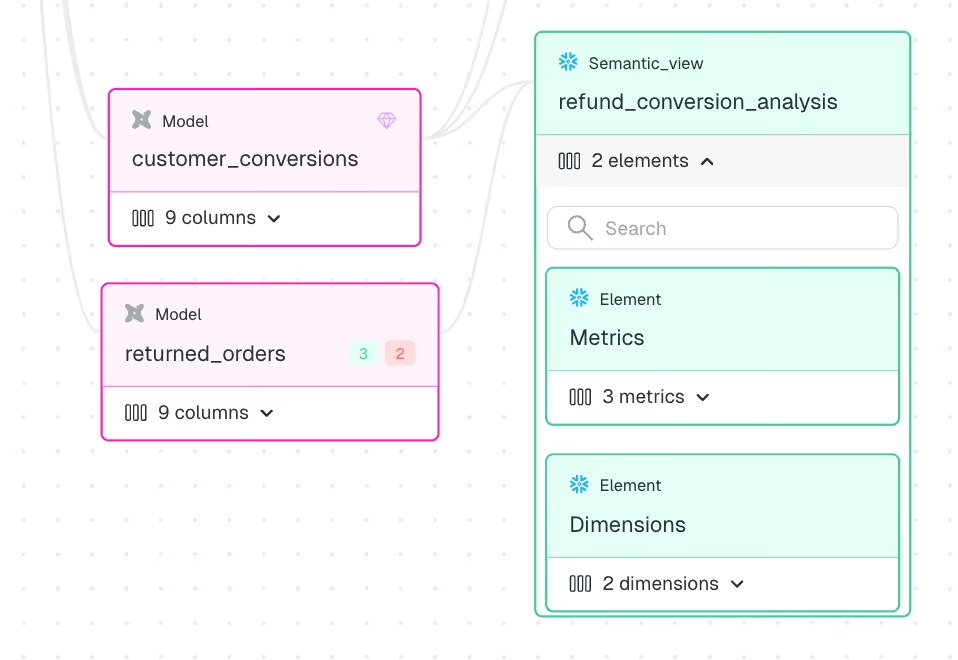
The company is also trying to outgrow the narrowness that made it legible. In 2025 it introduced Ella, specialized agents that recommend tests, help triage incidents, fill governance gaps, answer catalog questions and inspect performance. An MCP server lets assistants such as Claude or Cursor request lineage, coverage and incident context. Elementary 2.0, announced in December 2025, widened the label to a “data and AI control plane.” Python workloads, non-dbt tables, multiple dbt projects, semantic layers, ingestion jobs and business-user workflows have followed.
The expansion makes strategic sense. Bad data once produced a wrong chart. When an automated agent consumes it, the error can trigger hundreds of actions before lunch. Reliability therefore has to move upstream into code review and outward to the moment a business user or model consumes the number. Elementary’s agents are most credible where the underlying context is explicit: test history, ownership, lineage, incidents and repository changes. An agent without that context is merely a faster guesser.
There is tension in the expansion. A product loved for fitting neatly inside dbt can become a broad suite with many buyers and many menus. Competitors already sell polished enterprise observability. Cloud warehouses are adding native quality features. And every promise of autonomous remediation raises the burden of proof: what did the agent change, why, and who approved it? Elementary’s stated preference for pull requests, transparent logic and plan review is the right answer on paper. Customers still have to test it against their own failure modes.
The trust company had a trust incident
On April 24, 2026, malicious code entered version 0.23.3 of Elementary’s open-source Python CLI after an attacker exploited script injection in a GitHub Actions workflow. The affected release reached PyPI and a Docker registry. Elementary said its cloud service, dbt package and other CLI versions were unaffected.
The team removed the artifacts, shipped a clean 0.23.4, rotated credentials, moved authentication toward OIDC, audited workflows and published a detailed timeline. The first failure was not Elementary’s anomaly engine. It was the release machinery around it - a blunt reminder that an open-source trust layer is also a software supply chain.
The part worth stealing
Elementary’s most copyable move is not adding an AI tab. It is sequencing. The founders interviewed practitioners until they could describe one irritating workflow. They entered through an existing developer habit. They made the first useful layer open and inspectable. Then they waited for adoption to reveal the work organizations would pay to stop doing: tuning thresholds, assembling context, maintaining dashboards, routing incidents, proving governance and shepherding procurement.
A four-step pilot you can copy
- Pick 10 to 20 models whose failure has a visible business cost.
- Map each model to an owner, downstream consumer and response channel.
- Baseline detection time, alert volume and time to diagnosis before adding automation.
- Expand only when false positives fall and someone reliably acts on the alert.
This will not work everywhere. A tiny stack with a handful of stable tables may not justify another control plane. Teams without dbt can use Elementary’s newer non-dbt and Python features, but its deepest advantage remains in dbt-heavy environments. A company that has no asset ownership or incident habit will simply automate the creation of ignored alerts. A buyer that needs raw, row-level validation should also confirm what a metadata-first architecture can and cannot observe.
The practical dividing line is not company size. It is the cost of being surprised. If a stale model can misprice inventory, corrupt customer reporting or feed an autonomous agent, the economics change quickly. Elementary has spent five years moving closer to that moment of consequence - from a free smoke detector in an engineer’s repo to a control room shared across the company. Whether it can own the whole building is still open. It has at least learned where the exits are.